Generative AI is changing more than software-development throughput. It may also be changing how companies create the next generation of senior engineers.
The risk is straightforward: much of the work AI can automate—routine coding, troubleshooting, testing and documentation—is also where junior engineers develop technical judgment. Remove too much of that formative work, and organizations can improve short-term efficiency while eroding their long-term ability to diagnose failures, challenge an AI system’s output and operate when automation breaks down.
That is a familiar problem in safety-critical industries. Aviation and industrial control systems have long dealt with the automation paradox: automation handles normal operations well, but it leaves humans with less practice for the unusual, high-stakes cases when they must take over.
The apprenticeship pipeline is under pressure
Evidence on AI’s employment effects is still emerging, and causal claims deserve caution. But recent research points to a potential imbalance. A Harvard working paper examining roughly 65 million workers across more than 280,000 U.S. firms found junior employment fell by about 9% within six quarters of generative-AI adoption relative to nonadopting firms, while senior employment continued to grow. Stanford researchers, using ADP payroll data, similarly found younger workers lost ground in occupations with greater AI exposure after late 2022—especially where AI substitutes for work rather than augments it.
Other explanations matter. New York Fed researchers have argued that remote work, which can make mentoring inexperienced hires harder, accounts for much of the rise in young-graduate unemployment. But for engineering leaders, the shared operational issue is more important than settling a single cause: the pathways for learning from hands-on work and close mentorship are fragile.
An engineer does not gain judgment solely by reviewing an AI-generated answer. Judgment comes from reproducing a defect, following misleading clues, forming a hypothesis, testing it and learning why an apparently sensible fix failed.
Treat skill retention as a design requirement
Aviation’s response to automation provides a useful model. After repeated lessons in how quickly manual proficiency can decay, the FAA stated in a 2017 safety alert that manual flight is the foundation for other technical flying skills. Airlines can preserve those skills by deliberately including hand-flying in appropriate, low-risk conditions, despite the small loss of operating efficiency.
Technology organizations can apply the same principle through manual gates: explicit points in an AI-assisted workflow where people perform selected tasks without automation in order to retain critical capability.
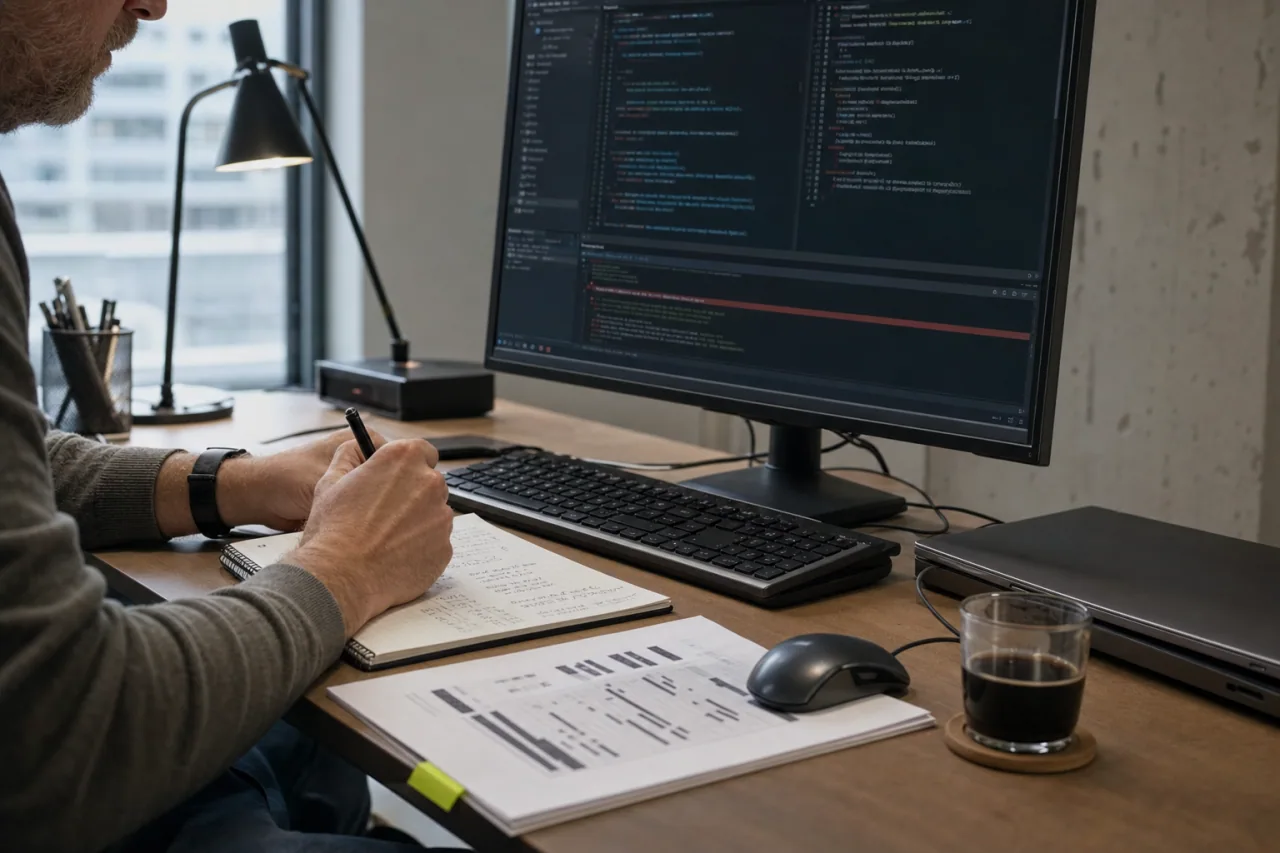
For a software team, a manual gate might require the assigned engineer to reproduce a production defect, trace a likely root cause and write a failing regression test before using an AI assistant to generate fixes or search for related issues. The AI is not banned; it is sequenced. The engineer first builds an independent model of the problem, then compares it with the model’s output.
That comparison is valuable. Agreement can build confidence; disagreement exposes ambiguity or a possible model error while the stakes are still manageable.
What leaders should protect
Not every task needs a manual gate. The point is to identify capabilities that would be costly to lose on a bad day. For engineering teams, that list may include:
- root-cause debugging in critical systems;
- reading and modifying unfamiliar legacy code;
- writing tests that capture failure modes rather than happy paths;
- incident response and rollback decisions;
- architecture trade-offs, security review and performance diagnosis.
These activities should be paired with deliberate mentoring, especially for junior staff. AI can help a new engineer move faster, but speed is not a substitute for ownership of the reasoning process.
The trade-off is real
Manual gates cost time. That is their purpose: they reserve some near-term efficiency for future resilience. The difficult management question is whether a company views junior work purely as labor to optimize or as the training infrastructure for its future technical leaders.
The firms best positioned to benefit from AI will likely be those that do both: automate routine production work aggressively, while protecting enough hands-on practice to keep human expertise current. The metric to watch is not only code shipped per engineer. It is whether the organization still has people who can explain, test and repair the system when the AI’s confident answer is wrong.