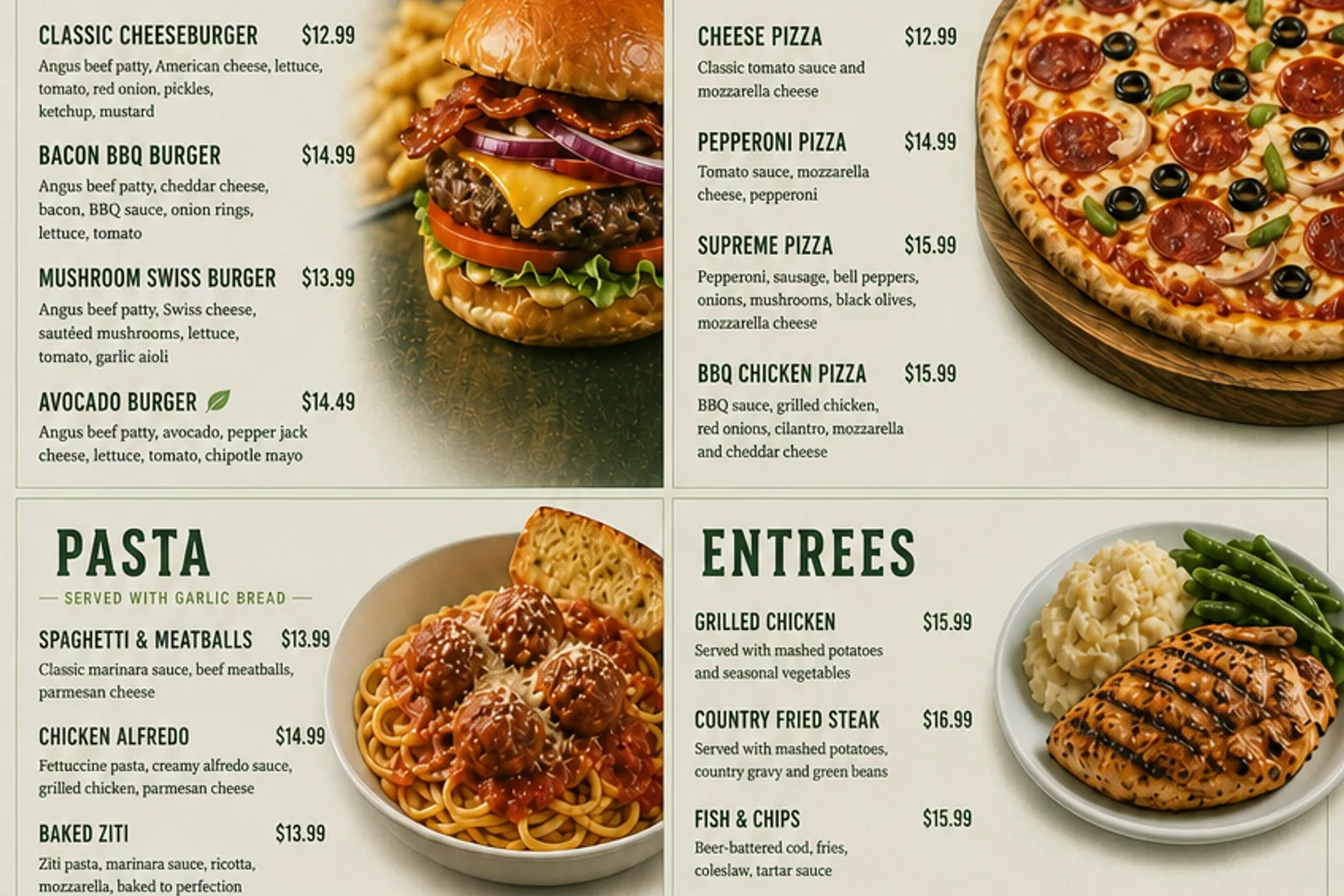
A growing number of restaurant menus are acquiring the same telltale look: immaculate buns, perfectly spherical scoops of ice cream, hyper-smooth sauces and food that appears appetizing at first glance but becomes unsettling on inspection.
That is not simply a design fad. It is a practical warning for businesses using generative AI as a low-cost replacement for photography or illustration. The tools can rapidly produce a menu visual, but their outputs tend to converge on a narrow, familiar commercial aesthetic—often resembling the highly optimized fast-food advertising of the past decade. For a restaurant, the result can undercut the very job a menu is meant to do: make diners want the food and communicate why this establishment is distinct.
Why the images converge
Image-generation models learn statistical patterns from enormous bodies of visual material. A prompt for a burger menu is likely to draw on the most prevalent examples associated with that category: major-chain menus, food advertising and polished product photography. Those source materials already share conventions, so the generated output reinforces them.
Alex Lisle, CTO of content-verification company Reality Defender, told TechCrunch that this helps explain why so much generated food imagery resembles a “Chili’s menu from 2015.” Lee Rainie, director of the Imagining the Digital Future Center at Elon University, described the broader dynamic as optimization for pleasing, non-offensive output—a process that “shave[s] off the edges.”
The issue can compound during production. Restaurants frequently need to revise pricing, descriptions, item names or layouts. According to TechCrunch’s reporting, repeated in-tool edits can make food images progressively rounder, smoother and less plausible. A social-media experiment that repeatedly edited an AI-generated menu in ChatGPT produced a visibly degraded end result; TechCrunch said it replicated the effect.
This is distinct from full “model collapse,” the risk that models substantially degrade when trained on too much AI-generated material. The nearer-term issue for menu makers is convergence: outputs become less varied and less faithful to real-world detail without becoming unusable.
The commercial risk is bigger than bad shrimp
Food marketing is unusually exposed because it depends on sensory credibility. A menu image is a promise about the meal a customer will receive. When an illustration looks synthetic—whether through anatomically improbable shrimp or an unnaturally flawless burger—it can create doubt about the restaurant’s care, authenticity or even the product itself.
Research cited by TechCrunch from the University of Duisburg-Essen found an uncanny-valley response to AI-generated food images: near-real images generated more disgust and unease than obviously artificial ones. That matters because the most common business use case is not surreal experimentation; it is an attempt at convincing, familiar commercial imagery.
For independent restaurants especially, sameness creates a second cost. Generative tools may reduce design expense, yet a generic fast-food visual language can flatten local identity, chef-led differentiation and the cues that justify a premium price. Customers may not be able to explain what is wrong, but they can still form a negative impression.
A better operating approach
The simplest rule is to avoid using generative images as literal depictions of menu items. Use real photography when the image is meant to set expectations for food, ingredients or portioning. If a restaurant uses AI in the creative workflow, it can be more useful for early concept exploration, typography directions, background patterns or campaign mockups than as final product imagery.
Teams should also put approval controls around revisions. Keep an original asset, limit serial image-to-image edits, and have someone familiar with the actual dish check every final visual for ingredient accuracy and visual plausibility. A quick customer test can be more valuable than an internal review: ask whether the image looks appetizing, believable and recognizably specific to the brand.
What to watch next
As AI-generated content becomes more common in training data and commercial design workflows, visual homogenization may become a broader brand problem—not just a restaurant problem. Businesses will need to decide where efficiency is worth the trade-off and where original assets, human art direction and product truth are strategic inputs.
For restaurants, the answer is straightforward: a cheaper menu is not a bargain if it makes diners less hungry.