
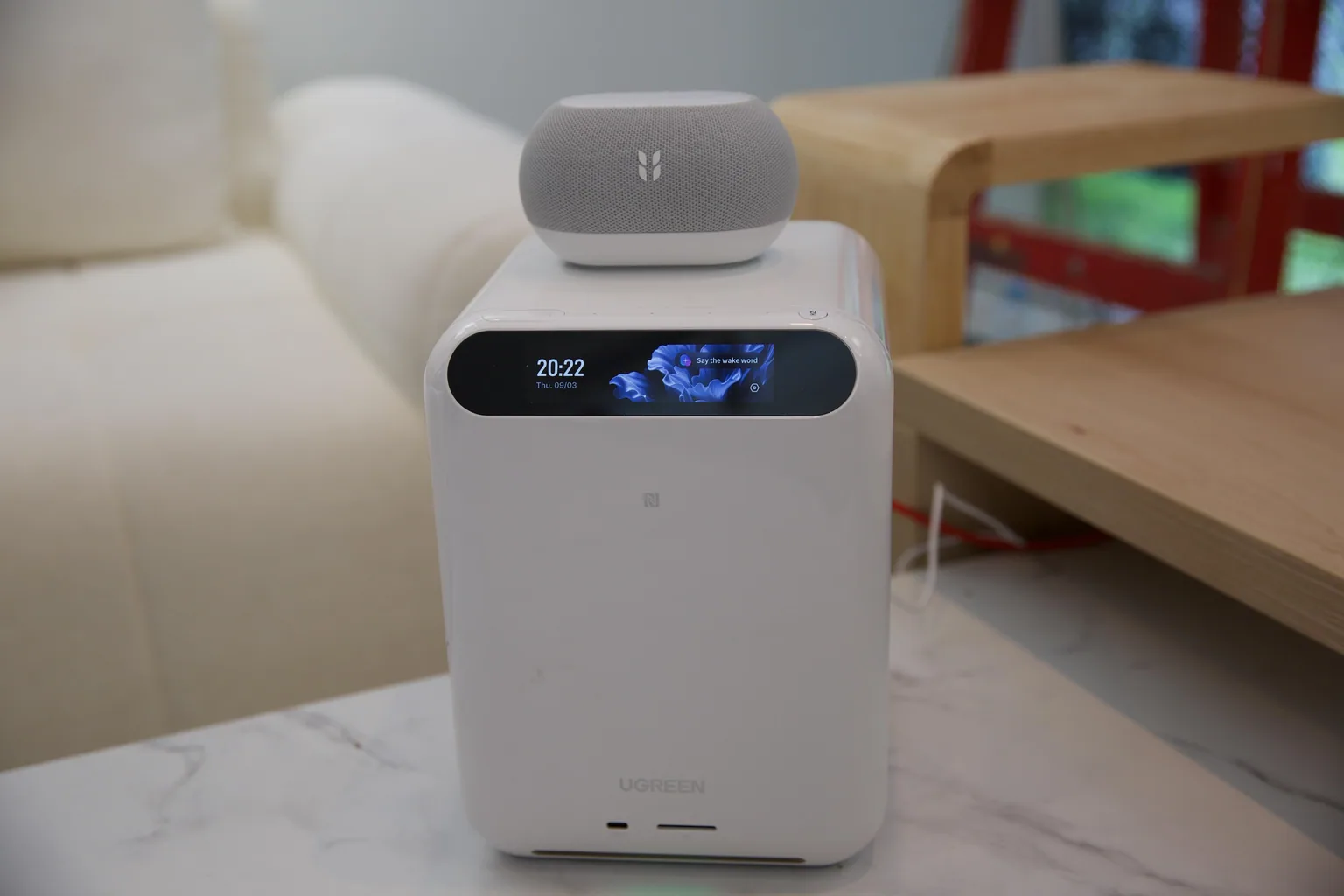
Ugreen is expanding from network-attached storage and charging gear into smart-home infrastructure with HomeAgent, a platform that puts camera storage, device control and AI processing on a hub inside the home.
The proposition is straightforward: retain video and personal files locally, run much of the intelligence on-device, and avoid the recurring cloud-storage fees that have become standard in consumer security products. The company plans to launch HomeAgent on Kickstarter in October; full retail pricing has not been announced.
A NAS becomes the control plane
HomeAgent combines several roles commonly spread across separate products: a NAS, a camera recorder, a smart-home controller and an AI appliance. Its hubs process footage locally and can power functions including cross-camera tracking, alerts for people, vehicles, pets and packages, video search, and generated event descriptions.
Users can also ask live-status questions—such as where a pet is—and control devices or automations with natural-language commands through Ugreen’s Uliya voice assistant. Alongside video, the system can store personal media and files, extending the familiar NAS model into the household’s broader digital archive.
Ugreen will offer three tiers. The base HomeAgent HA100 handles basic rules and specific voice commands; the HA100 Pro adds semantic and context-aware capabilities; and the MasterAgent MA100 uses Nvidia’s Jetson Thor T5000 platform for the company’s most compute-intensive local AI features.
That segmentation reflects a larger industry reality: local AI can reduce dependence on remote services, but useful computer vision and conversational interfaces require meaningful hardware investment. Ugreen is trading potentially higher up-front cost for fewer ongoing fees.
Interoperability is the crucial test
HomeAgent is a Matter controller, and Ugreen says it will support devices through Wi-Fi, Zigbee, Thread, Bluetooth, NFC, ONVIF/RTSP and PoE. That breadth matters because a local hub only becomes valuable when it can work with an existing collection of cameras, lights, sensors, blinds and switches.
Matter offers a standards-based route to that compatibility, but Ugreen’s initial implementation is narrower than the headline suggests. Its first phase supports lights, switches, sensors and curtains, and the company recommends sticking to an approved list that currently includes products from Aqara, ThirdReality, SwitchBot and Eve. In principle, Matter devices should work; in practice, operators should wait for the detailed compatibility list and validate the integrations they rely on.
Ugreen is also building out its own endpoints: indoor, PoE and battery security cameras, plus a Uliya smart speaker. A new E Ink photo frame can display images kept on the hub, reinforcing the local-data pitch.
Local-first is not fully offline
“Local” does not mean every service works without the internet. Push notifications and remote camera viewing require connectivity, and Ugreen offers a cloud option for Uliya. Buyers should distinguish between where data is stored and processed by default, and which conveniences still introduce a network or cloud dependency.
The launch arrives as more smart-home vendors pursue similar architectures. SwitchBot, Reolink and Aqara have all moved toward local processing and control, while Anker introduced its Eufy MindBase system at IFA as another AI-focused security hub.
What to watch
For Ugreen, execution will matter more than raw AI specifications. The key questions are the final price, how much storage ships with each configuration, the reliability of camera analytics, setup complexity, and the speed and scope of third-party device support. Buyers will also need clarity on remote-access security, software-update commitments and what functionality changes when cloud services are unavailable.
HomeAgent is an early sign that the NAS category may be evolving from file storage into a local control plane for AI-enabled homes. But the winning system will be the one that makes that architecture feel simpler—not merely more private—than today’s cloud-first alternatives.