
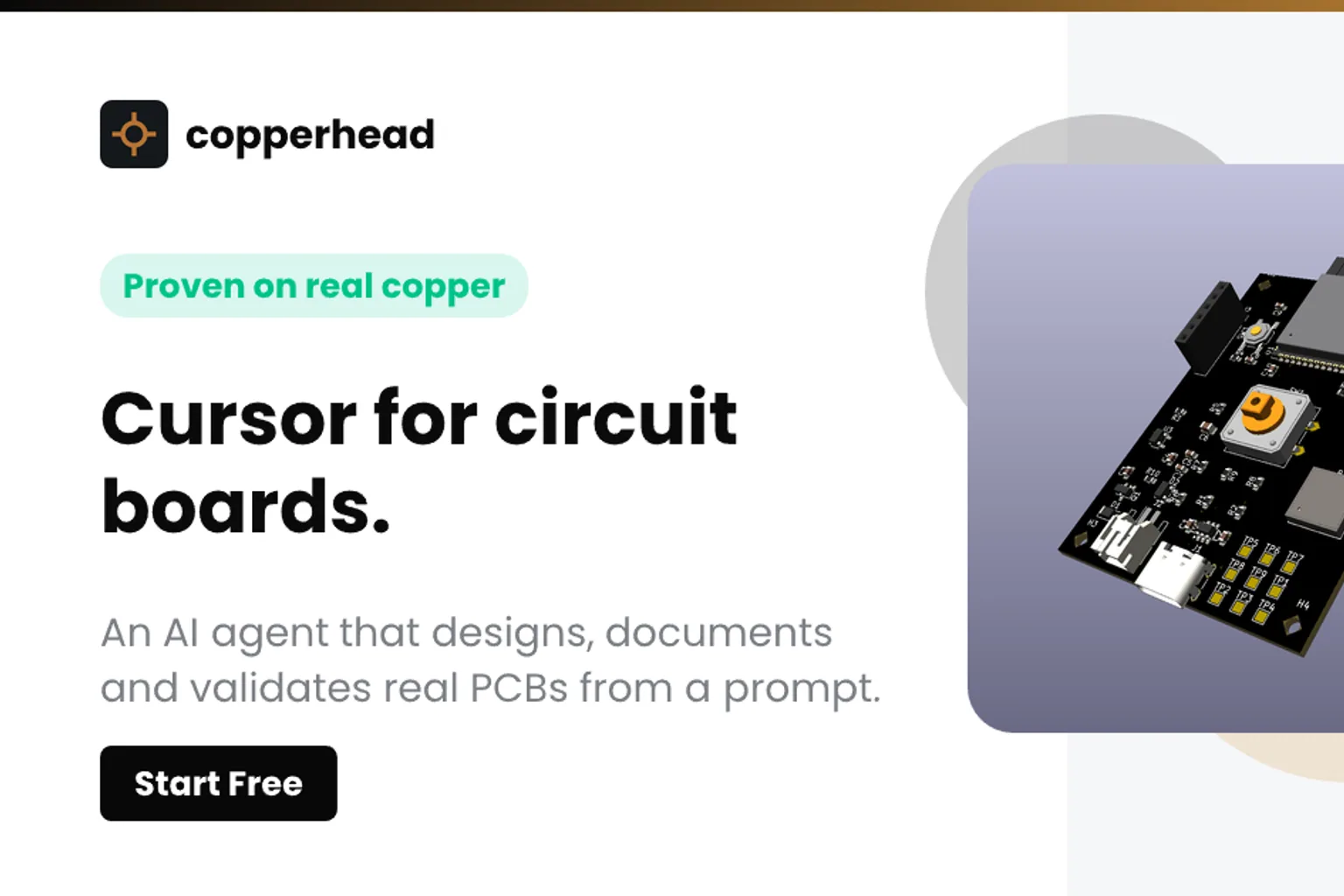
Copperhead, a new open-source AI agent for printed-circuit-board work, is pitching a familiar software-development idea to hardware teams: make every change explicit, reviewable and automatically checked.
The tool works on KiCad repositories and is designed to take a product brief or requested modification, prepare a validated change proposal, edit the underlying design files, and run KiCad’s electrical-rule check (ERC) and design-rule check (DRC). Its core claim is not that AI can eliminate engineering judgment, but that it can reduce the documentation and consistency failures that make board revisions expensive.
The problem is design drift
A board change rarely lives in one place. A component substitution or power-budget adjustment can affect the schematic, PCB layout, bill of materials, constraints, power calculations, manufacturing outputs and bring-up plans. Those artifacts can diverge without generating an obvious failure until prototype testing.
Copperhead’s workflow attempts to treat that drift as a build failure. It stores specifications and decisions in plain Markdown and JSON alongside KiCad files in a Git repository. Before editing a design, the agent requires a validated proposal; after editing, it runs the native KiCad checks. It also says it will reject work on a dirty Git tree and refuse changes that violate documented constraints or budgets.
That approach is consequential for operators because the output is intended to be more than a conversational answer: the project can include the schematic and board files, Gerbers and drill files, DXF and STEP exports, renders, an orderable BOM, firmware scaffolding and a bring-up plan. In other words, Copperhead is targeting the handoffs that turn a circuit concept into something a team can review, manufacture and test.
Why reviewability is central
Copperhead says its changes are surgical edits to KiCad’s s-expression source, rather than a wholesale regeneration of design files. That matters in hardware repositories, where a massive file rewrite can obscure a small net or footprint change and make code-review-style processes ineffective.
The product also positions its restrictions as a feature. It says the agent cannot invent a part number without datasheet justification, and it cites the constraint it would violate when declining a requested change. These controls do not prove that a resulting design is correct or manufacturable; ERC and DRC catch defined classes of electrical and layout issues, not every real-world integration risk. But they make the process more inspectable than an unconstrained prompt-to-design workflow.
Copperhead’s public proof point is Open Telegraph, a pocket-size ESP32-S3 Morse key with USB-C and a custom copper switch. The project’s design materials are public, offering prospective users an opportunity to examine the workflow’s output rather than relying solely on generated renders or claims.
Open core, with a hosted path
The command-line product is Apache-2.0 licensed and free, according to Copperhead. Users install Node 20 or newer, KiCad with `kicad-cli`, and provide their own model API key. The company says the CLI can create a project from a brief or, more importantly, make changes to an existing KiCad design.
Paid Cloud and Team offerings are listed at $49 per user per month, with the Team tier also carrying a $199 monthly platform fee. The hosted products add private repositories, a web viewer, run history, exports and shareable check reports; Team adds a CI bot intended to make checks required pull-request statuses, plus shared constraint libraries and identity controls. An enterprise option adds self-hosting or VPC deployment and promises Altium support.
What to watch next
The key question is whether Copperhead can earn trust on existing, messy board designs—not merely generate a clean demo from a short brief. Its practical value will depend on component-data quality, constraint coverage, the reliability of its edits, and whether engineering teams find its proposals and diffs genuinely useful in review.
For founders and hardware leaders, the broader signal is clear: AI tooling for electronics is moving beyond schematic generation toward governed change management. The winners will likely be tools that preserve engineering accountability while reducing the tedious cross-file work surrounding every revision.