
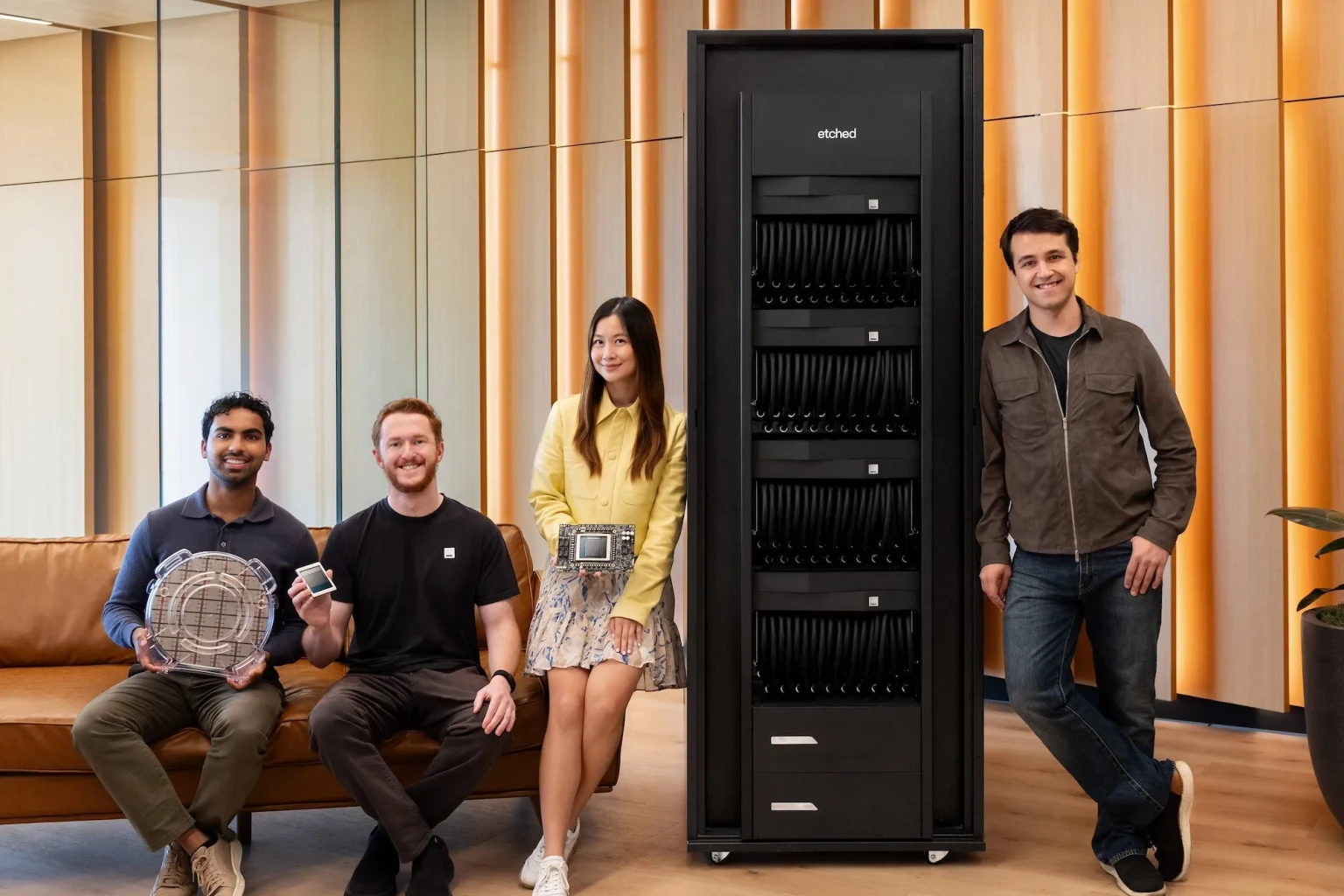
Etched, the AI-chip startup pursuing custom hardware for inference, is reportedly reviewing new investment approaches that could value it between $40 billion and $50 billion. The discussions are early and may not result in a deal, TechCrunch reported, citing people familiar with the company.
The reported interest comes only months after Etched announced a $700 million round at a $21 billion valuation. Before that, it disclosed a $300 million financing at a $10.3 billion valuation in July. If the latest offers translate into a financing, they would underscore how rapidly investors are repricing companies that claim to offer an alternative to Nvidia for AI serving workloads.
The bet is on inference, not training
Etched is building full hardware systems around proprietary chips designed for inference—the computation performed after an AI model receives a user request. That distinction matters commercially. As AI applications move from experimentation to production, the recurring cost, latency and capacity of serving models can become as consequential as the upfront cost of training them.
The company says its processors can deliver more tokens at higher speed and lower cost than Nvidia hardware. Those are company claims rather than independently verified benchmarks, but they point to the purchasing criteria enterprise AI operators increasingly care about: throughput, response time, power use, reliability and the total cost of running a production workload.
Etched said in July that it had secured $1 billion in customer orders after producing a test chip at TSMC. Quantitative trading firm Jane Street led its most recent $700 million round and has received an early system, according to the report. For a trading firm, small reductions in processing latency can have unusually high economic value; that makes it a meaningful early customer, though not necessarily a proxy for broader enterprise demand.
Why the funding matters
Designing and shipping semiconductor systems is extraordinarily capital-intensive. Etched has a 10-megawatt Silicon Valley data center and a Taiwan facility intended to coordinate production near TSMC, TechCrunch reported. It also needs to fund chip design, manufacturing, packaging, systems integration and customer deployment—while maintaining enough inventory and support capacity for buyers.
A large new round could therefore be less about extending a software startup’s cash runway than financing a hardware supply chain and building the capacity needed to turn orders into installed systems. One person familiar with the offers told TechCrunch that a round comparable in size to the last one could provide up to 3.5 years of runway.
The company has also recruited heavily from Nvidia: roughly 15% of Etched’s 400 employees previously worked at the incumbent, according to a Wall Street Journal report cited by TechCrunch. That talent concentration may help execution, but it does not remove the harder test: proving that performance claims hold in varied production environments and at scale.
A valuation signal—with caveats
The speed of Etched’s reported valuation climb illustrates a broader financing pattern among highly sought-after AI startups. Consecutive rounds at sharply different prices can function much like separately priced tranches of one continuing capital raise. That can supply a company quickly, but it also raises expectations for revenue conversion, delivery timelines and technical differentiation.
For founders and infrastructure buyers, the immediate takeaway is not that a new Nvidia challenger has arrived. It is that inference has become a strategic layer of the AI stack, attracting capital normally reserved for companies with far more mature operations.
What to watch next
The key milestones are operational: whether Etched closes a new financing; whether its reported order book converts into deployed, revenue-generating systems; and whether independent customers validate its cost and latency claims against Nvidia and other accelerators. Also worth watching is its manufacturing cadence at TSMC and whether the company can broaden beyond customers whose economics strongly reward ultralow latency.
For enterprise teams, this is a reminder to benchmark inference choices on real workloads. The relevant question is not simply which chip is fastest, but which platform can reliably meet latency, capacity, software compatibility and support requirements at a sustainable cost.