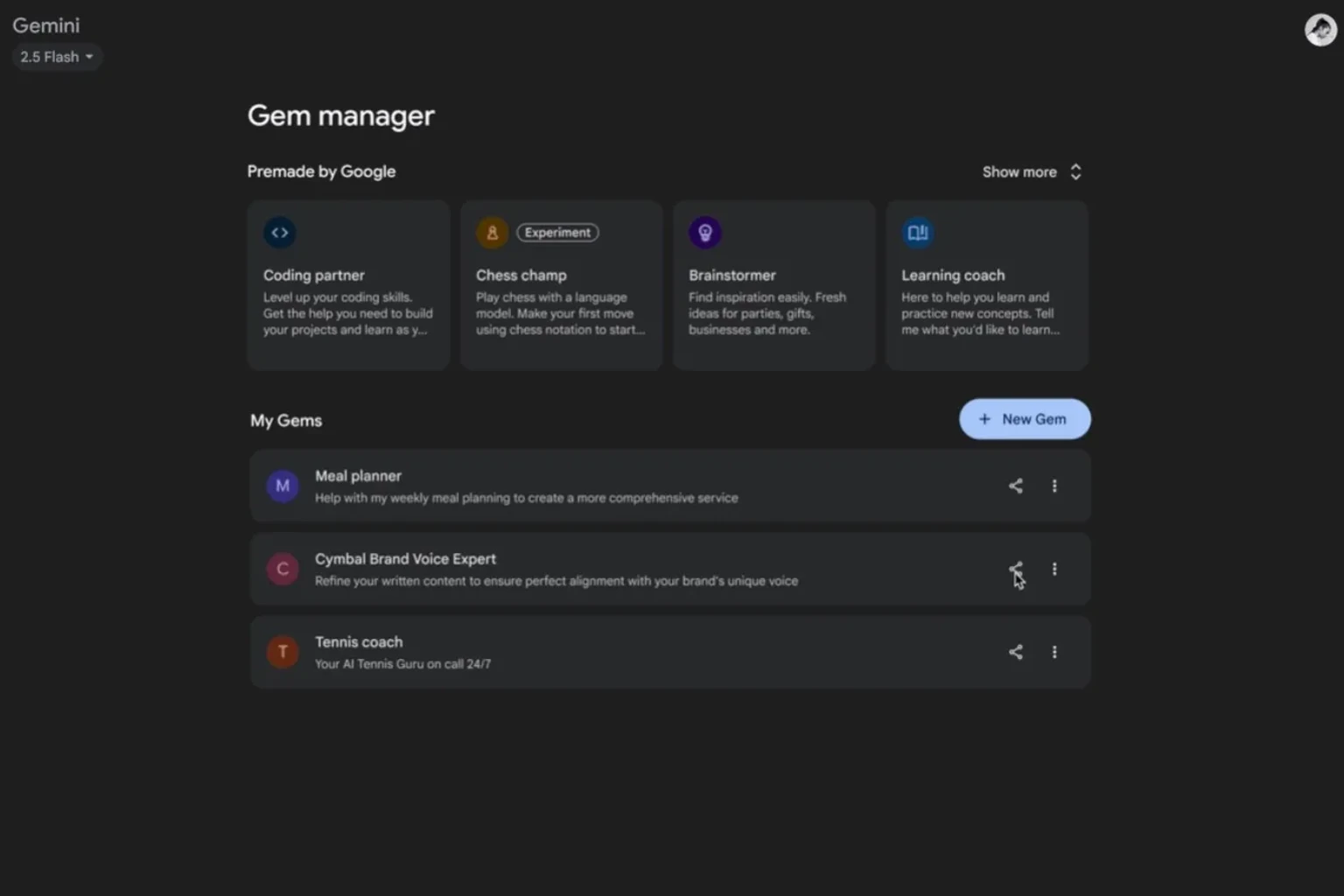
Google is retiring Gems, Gemini’s custom-assistant feature, and replacing it with “skills” beginning November 17, 2026. Existing Gems will be automatically migrated, according to a notice in the Gemini app, and will remain usable until the transition date.
For teams and individuals that built task-specific Gemini configurations, the immediate disruption should be limited: Google says users do not need to take action to carry their work over. The larger change is conceptual. Instead of treating a custom configuration as a standalone assistant, Gemini will position it as a reusable capability that can be invoked within different tasks.
What is changing
Google introduced Gems in 2024 as a way to save instructions for recurring work without rewriting a prompt each time. It offered prebuilt options such as a learning coach, brainstorming assistant, career guide, coding partner and editor. Users could also create and, later, share their own Gems.
The new skills model retains that custom work but changes how it is accessed. In a Gemini task thread, users will select a skill by entering a forward slash (`/`). That resembles command-oriented interfaces familiar to developers and power users more than a conventional consumer chatbot experience.
Google has not detailed in the source material whether skills will add new permissions, tool access, sharing controls, analytics or administrative capabilities beyond the migration from Gems.
Why operators should care
The move reflects a broader product-design question facing AI platforms: should repeatable workflows live as separate agents, or as modular instructions and capabilities inside a general-purpose assistant?
For operators, reusable skills could reduce the friction of maintaining multiple narrowly defined assistants. A team might preserve a standard set of instructions for drafting, coding or editing, then call the relevant skill inside a broader piece of work rather than moving between dedicated assistant profiles.
But migration does not eliminate governance work. Businesses that shared Gems internally should verify after November 17 that the migrated skills retain the intended instructions and are available to the right people. They should also review internal documentation and training materials that refer to “Gems,” since the product vocabulary and interaction pattern are changing.
The slash-based invocation also creates an adoption consideration. It may be efficient for frequent users, but it requires people to know that a reusable capability exists and remember how to trigger it. Teams deploying Gemini for less technical employees may need to make their approved skills easy to discover and explain when each one should be used.
A product simplification, with branding costs
Google’s decision removes another distinct label from its AI product experience. Gems had their own identity and place in Gemini navigation; skills instead suggest a component of the wider Gemini workflow.
That may make strategic sense if Google is building toward agents that combine multiple reusable capabilities. Yet frequent shifts in product names and interfaces impose a real cost on customers: documentation ages, enablement has to be repeated, and confidence in building around a feature can weaken.
For founders building on top of Gemini, the practical lesson is to avoid tying workflow design too tightly to a single product abstraction. Preserve core instructions, expected outputs and evaluation criteria outside the platform so they can be adapted if Google changes the interface again.
What to watch next
The most important unknown is whether skills become more than renamed Gems. Watch for details on cross-task reuse, sharing and organization-level management, as well as whether skills gain access to tools or actions that would make them closer to operational agents.
Also watch adoption. Google is making the migration automatic, but the success of the change will depend on whether users find slash-invoked skills faster and clearer than selecting a standalone custom assistant. That interface choice will determine whether the shift feels like a simplification or another layer of AI product complexity.