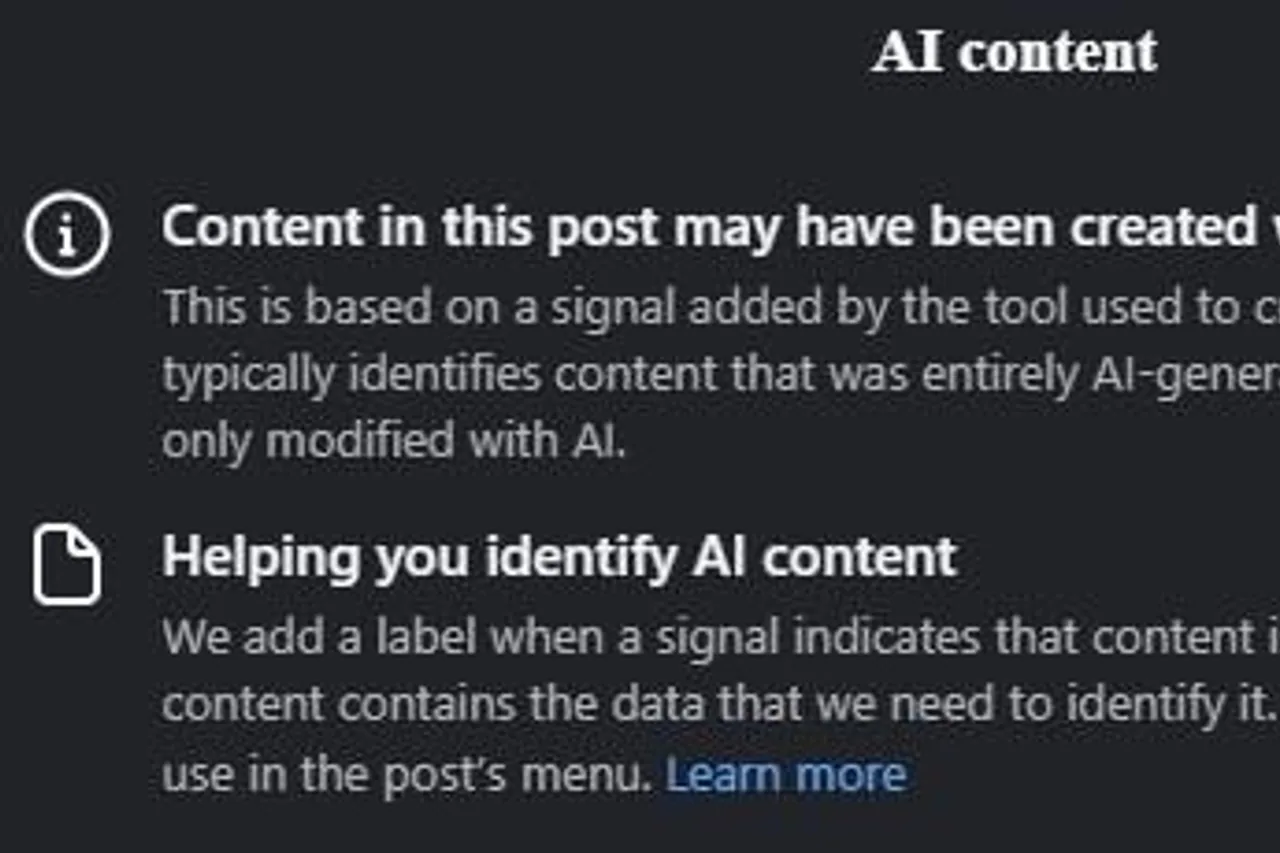
Instagram’s “AI Content” labels are intended to give users a quick signal about whether an image was made with artificial intelligence. But a new round of reported mislabeling is doing the opposite: leaving creators, brands and audiences unsure whether the content—or the disclosure—can be trusted.
According to [The Verge](https://www.theverge.com/ai-artificial-intelligence/989617/instagram-ai-content-label-confusion), users have recently reported labels appearing on conventional photos that received small edits, including background removal and blemish correction. At the same time, the publication’s testing found that a range of AI-edited and fully generated images from third-party tools were not labeled on Instagram. Images created or edited in Meta’s own AI app were labeled in those tests.
A disclosure problem, not just a detection problem
The distinction matters. Background removal, object selection and similar assistive features often rely on machine learning, but they are not necessarily the type of generative image creation audiences associate with fabricated scenes, people or events. When a light touch-up earns an “AI Content” label that viewers interpret as “entirely AI-generated,” the label can misrepresent the work and damage credibility.
The issue is especially consequential for businesses whose social accounts function as product catalogs, brand proof and paid-media creative. About Face, the cosmetics company founded by Halsey, was among accounts whose photos were labeled; its social manager said the images were taken on an iPhone and only slightly edited, with no AI used to create them. The exact editing tools involved were not confirmed.
For teams that depend on creator content, a false label can prompt customer questions, dilute claims of authenticity, and create friction with talent or clients. A missing label creates the inverse risk: campaigns that use materially generated content may reach audiences without the disclosure context the platform says it provides.
Metadata is proving insufficiently intelligible
Meta said in 2024 that it would scan for IPTC and C2PA metadata, as well as industry-standard indicators attached by other companies’ tools. Such provenance signals can help identify whether generative AI was used to create or alter an image. Yet they do not solve the harder product question: what degree and type of AI intervention should produce a public-facing label?
Canva reportedly told content strategist Jess Bruno that some assistive AI tools had been tagged as generative and that its tools were subsequently tagging correctly. Canva’s background-removal help page says use of that tool does not add Canva AI-generated-content metadata. Reports persisted, however, of labels appearing after use of the feature—and in some cases where it was reportedly not used.
That suggests a chain-of-custody issue that spans creation tools, metadata standards, platform ingestion and label policy. Without clear explanations, users cannot tell whether an outcome resulted from embedded provenance data, a platform classifier, an account-level signal, or an implementation error.
What operators should do now
Social teams should treat Instagram’s label as an imperfect platform signal, not a definitive audit of their creative workflow. Keep an internal record of source photography, editing steps, tool versions and approvals for high-stakes posts. This is particularly useful for regulated industries, celebrity-led brands and campaigns built around “real” creator imagery.
Teams should also test their actual export-and-upload path before a major launch. The relevant question is not simply whether an editing tool includes AI, but whether the final asset triggers a label after platform processing. If a label appears incorrectly, retain originals and edits, document the post, and use available reporting or support channels.
What to watch next
Meta has not publicly clarified what specific signals currently drive these labels or why similar assets receive different treatment. The next meaningful improvement would be more than a better classifier: it would be a graduated, comprehensible disclosure system that distinguishes AI-assisted edits from substantially or wholly generated imagery, plus a workable appeal path.
Until then, Instagram’s AI labels risk becoming a weak proxy for authenticity precisely as businesses need dependable provenance signals most.