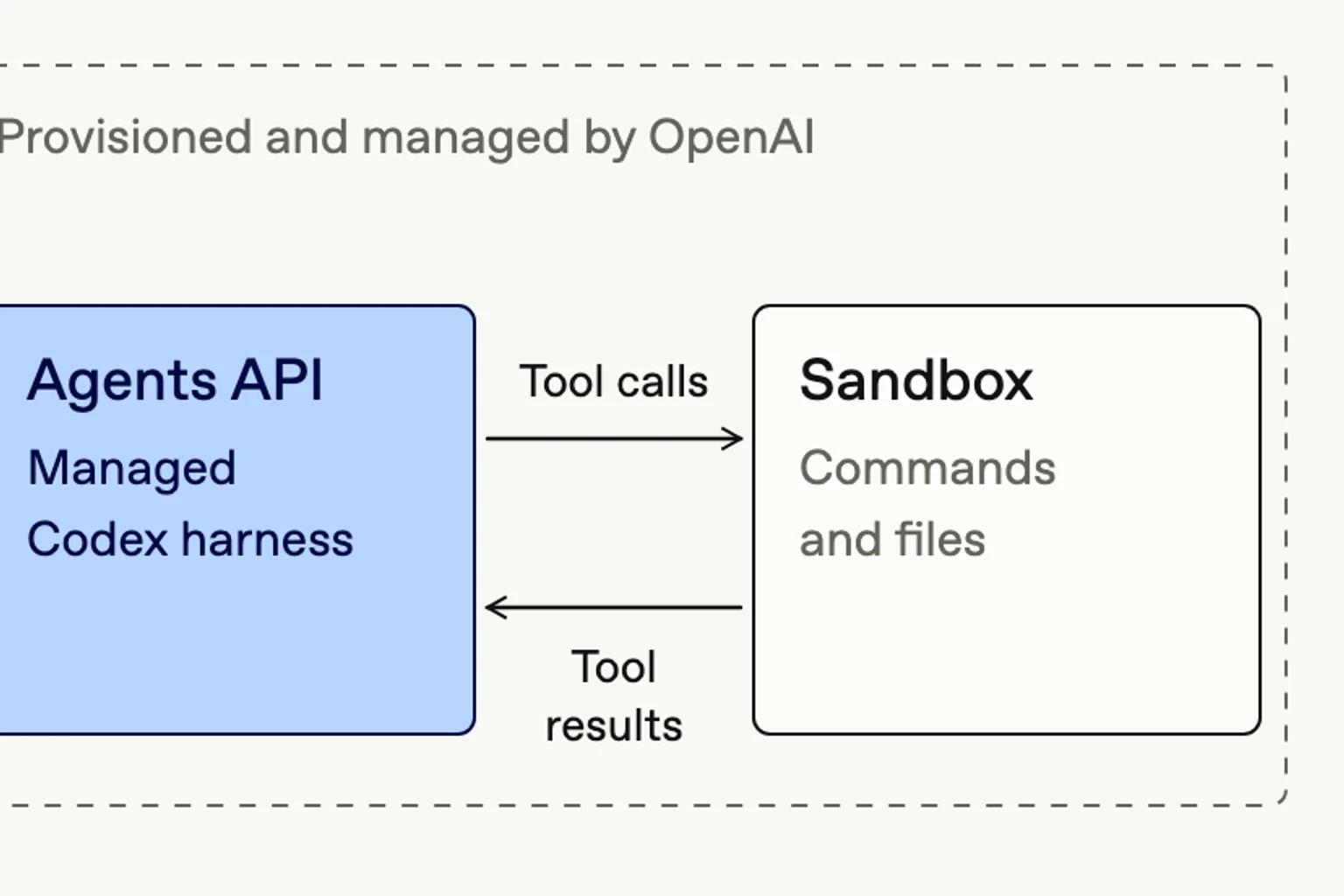
OpenAI has documented an Agents API that gives applications managed access to its Codex harness, shifting several pieces of agent runtime infrastructure—session management, orchestration, context compaction and recovery—into the platform.
The practical pitch is straightforward: developers configure an agent’s model, instructions, tools and MCP servers, then supply a task. OpenAI can provision and manage a sandboxed environment, run the agent, and return progress and results through streaming or webhooks. Developers can alternatively select a self-hosted environment.
What changed
The API is organized around agents, environments, durable sessions, and the events and items exchanged during a session. Its managed harness can run commands and code, edit files, use connected tools or Model Context Protocol (MCP) servers, create artifacts, summarize earlier work to manage context, delegate subtasks to subagents, and resume work later.
That combines capabilities that many teams have been assembling themselves: a model loop, tool invocation, workspace isolation, state persistence, monitoring hooks and recovery behavior. OpenAI’s examples point to operational use cases rather than just chat: incident investigation with approval requests for recovery actions, read-only warehouse analysis, GitHub issue reproduction, document review, and workplace-tool research in Slack.
Multi-agent work is also a first-class configuration option. A developer can enable subagents and set a concurrency ceiling, while the central agent combines results. That may reduce the application code needed for parallel research or decomposition, though it also introduces more calls, more tool activity and more operational variability to measure.
Why it matters for builders
The important decision is not simply whether to use an “agent.” It is where to draw the boundary between application control and provider-managed runtime.
A managed OpenAI sandbox can speed up prototypes and reduce the burden of maintaining isolated execution environments. Durable sessions may also make long-running or iterative workflows easier to build without repeatedly reconstructing a conversation state. Webhooks and streamed events provide the integration points needed to surface progress, request human input, or trigger downstream processes.
But the application remains responsible for consequential choices. Teams select which tools and MCP servers an agent can access, determine the execution environment, and must design approval steps for actions that could change production systems or data. An incident-response workflow, for example, should keep investigation and remediation distinct, with explicit approval before recovery actions.
Cost modeling will need to include more than model tokens. OpenAI says model use is billed at the chosen model’s API rates, while built-in tools and OpenAI-hosted sandboxes have their own standard rates. Workflows that run code, fan out into subagents, search the web, or remain active across multiple turns can therefore have a materially different cost profile from a single request-response application.
A key enterprise constraint
The current data-control posture is likely to shape adoption. OpenAI says the Agents API supports data residency only in the United States and does not support Zero Data Retention. Using a self-hosted sandbox does not make the API eligible for Zero Data Retention.
That means organizations with regional residency requirements, strict retention commitments, or highly sensitive workloads should validate fit before committing architecture to the API. Self-hosting the execution workspace may change where commands run, but it does not remove the platform-level data-control limitation described in the documentation.
What to watch next
The near-term test is whether managed orchestration produces a reliable enough operational layer for production workflows—not just compelling demos. Teams evaluating the API should start with bounded, read-oriented tasks; instrument duration, tool failures, retries, approval rates and per-task cost; and limit external permissions by default.
They should also assess portability. MCP connectivity and self-hosted environments offer useful integration flexibility, but applications built around durable OpenAI-managed sessions and the Codex harness will still depend on platform-specific runtime behavior. For many builders, that trade-off may be worthwhile. It should be made deliberately, with governance and exit considerations designed in from the start.