
AI coding agents are good at producing code. That is not always the same as producing the right amount of code.
Ponytail, a ruleset and plugin for AI coding tools, is built around that distinction. Its premise is deliberately blunt: make an agent behave like an experienced engineer responding to an overnight incident—solve the problem, avoid creating a new maintenance burden, and move on.
The project is available for Claude Code and lists support for Codex, Copilot CLI, Gemini CLI and a range of other agent environments. Rather than introducing a new coding model, it supplies instructions intended to steer existing agents toward smaller diffs and fewer new dependencies.
A hierarchy for doing less
Ponytail’s core mechanism is a decision ladder. Before writing custom code, the agent is asked to check whether the requested capability needs to exist at all; whether the repository already has a reusable helper or established pattern; and whether the standard library, a native platform feature or an installed dependency already covers the need.
Only after those checks should it write new code—and then it should aim for the smallest implementation that works.
That sequence codifies familiar engineering practices: YAGNI (“you aren’t gonna need it”), reuse, dependency restraint and preference for platform primitives. Its relevance to AI-assisted development is that coding agents can default to expansive implementations: new abstractions, custom utilities and packages that may be technically valid but add review and long-term ownership costs.
The project illustrates the point by replacing a custom cache manager with a standard library `lru_cache` use. The claim is not that every cache should be a one-liner; production requirements can demand observability, eviction controls or distributed coordination. The useful prompt is whether those requirements actually apply before an agent builds the larger system.
Reported gains, with important limits
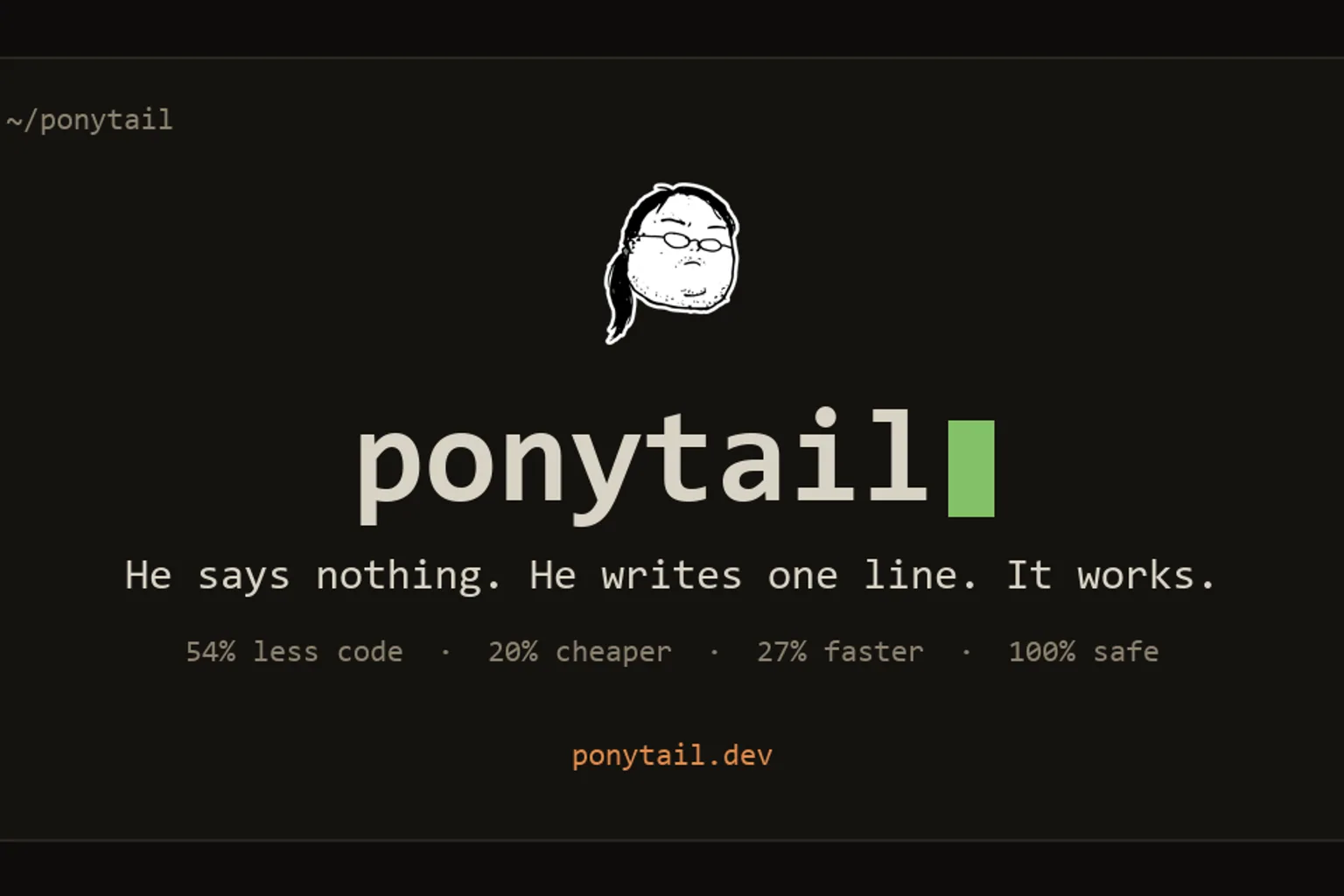
Ponytail reports median results across 12 feature tasks in a FastAPI and React repository: 54% less code, 22% fewer tokens, 20% lower cost and 27% faster completion, while claiming safety was retained. It says validation, error handling, security and accessibility are not meant to be simplified away.
Those are project-reported benchmarks, not an independently published evaluation, and the small task set and single stack limit what can be inferred. Still, the measurements point to an operationally important trade-off. Fewer generated tokens can reduce model spending and latency, while fewer lines may reduce the surface area reviewers must assess and teams must support.
For engineering leaders, the more meaningful metric is unlikely to be line count alone. A minimal patch that violates local conventions or silently omits edge cases is not a win. Teams evaluating rulesets like Ponytail should measure review cycles, escaped defects, dependency additions, rollback rates and follow-on maintenance alongside token use.
Controls for teams and a review use case
Ponytail offers three modes: a default “lite” mode that proposes a leaner alternative, a “full” mode that enforces the ladder, and an “ultra” mode that challenges parts of the requested requirement. It also includes commands to review the current diff for over-engineering, audit a repository for bloat, and record deferred shortcuts in a debt ledger.
That last group may be as useful as generation guidance. AI agents increasingly affect codebase consistency through many small changes. A focused diff-review pass can give teams a structured way to question needless complexity without requiring every developer to use an aggressively minimalist generation mode.
What to watch next
The test for Ponytail will be whether its rules transfer beyond a controlled feature-task benchmark. Teams with mature architectures may benefit from stronger reuse prompts; teams in regulated, high-availability or security-sensitive settings will need to verify that “minimum” does not become under-specified.
Its broader signal is clear: as coding agents become cheaper and more capable, governance may shift from asking whether an agent can implement a feature to asking whether it should implement quite so much of it.
[Read Ponytail’s README on GitHub](https://github.com/DietrichGebert/ponytail#readme).