Reco has raised $55 million to expand its AI agent security business, bringing its total funding to $140 million. The round follows a $30 million Series B announced in February and includes investment from customer AT&T’s venture arm, Forestay and Quadrille Capital.
The funding is notable less for the financing alone than for what it signals: securing AI agents is rapidly becoming a distinct enterprise software category—and a crowded one.
The operational problem: unknown agents and inherited access
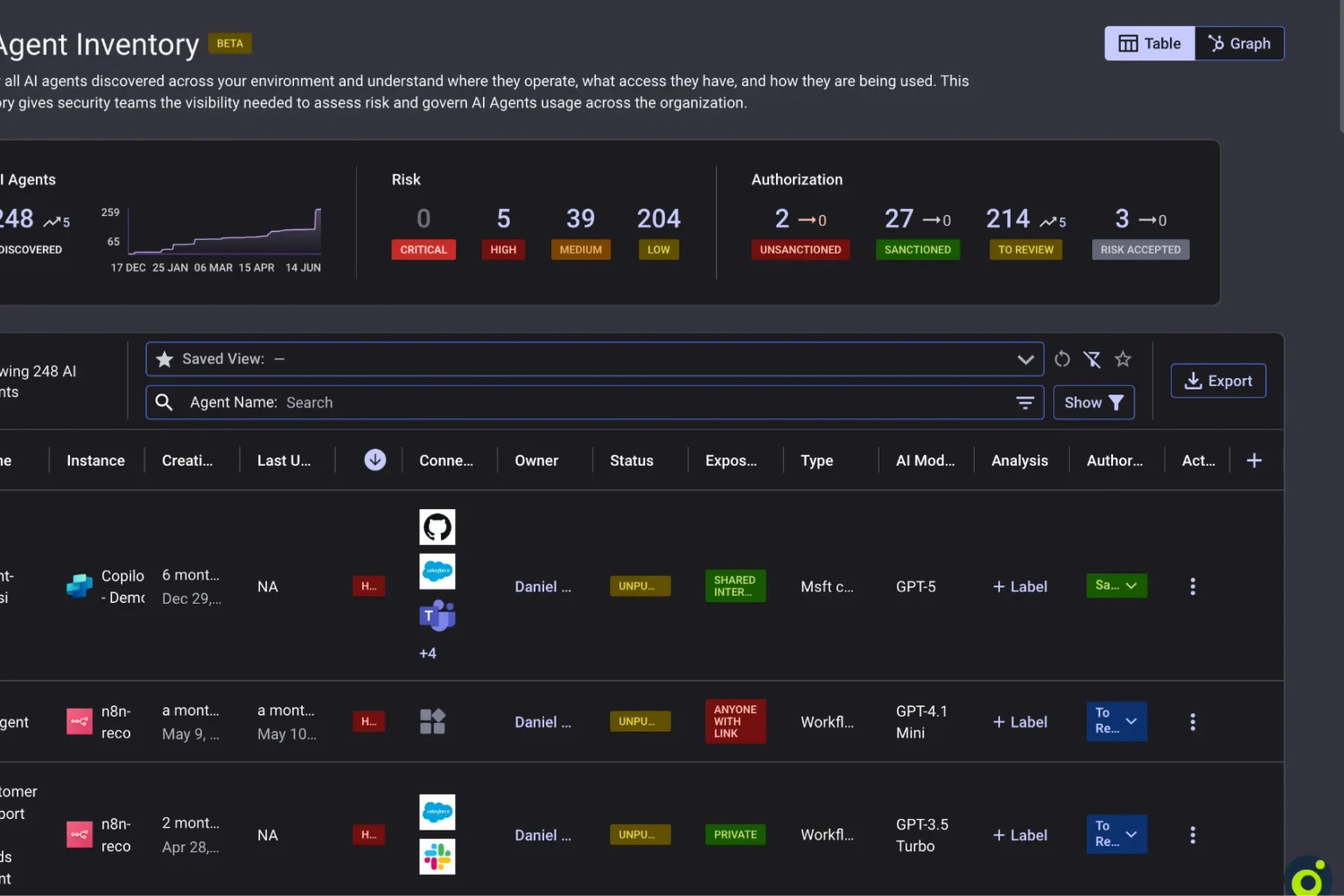
Enterprises are deploying agents across SaaS tools, internal workflows and customer-facing systems. That creates a familiar security challenge in a new form: organizations often do not have a reliable inventory of what agents exist, which identities they use, what tools they can call, or which data they can access.
Reco, previously focused primarily on mapping and securing SaaS and AI platforms, has repositioned around that broader visibility problem. Its platform uses a context graph to connect agents with applications, people, accounts and permissions. The aim is to show security teams an agent’s effective reach and remove access that is unnecessary.
The company says its system found 21,000 previously unknown agents at one Fortune 100 customer. It also says it identified an agent created by a former employee at a financial-services customer that could access Salesforce and send data to an external domain not visible to the company. Those are vendor-reported examples, but they illustrate the practical concern: agent risk is often an identity, access and data-governance issue before it is a model-safety issue.
A crowded category takes shape
At least two dozen companies are now pitching some version of AI agent security, according to the report. Their approaches vary: vetting agent tools and extensions, governing data access, detecting risky activity on endpoints, and discovering unapproved AI use.
The messaging is converging around a similar set of capabilities—agent discovery, continuous monitoring, runtime controls, tool-call inspection, access governance and validation of Model Context Protocol (MCP) connections.
That overlap should make procurement harder. Buyers should resist treating “AI agent security” as a single product category with a standard feature checklist. The useful question is where an organization’s exposure actually begins:
- **Identity and permissions:** Can teams see which human, service or delegated identities an agent uses?
- **Data reach:** Can they determine what records, files and SaaS objects an agent can retrieve or share?
- **Tool governance:** Can they approve, constrain and audit the tools, connectors and MCP services an agent invokes?
- **Runtime evidence:** Can they investigate prompts, tool calls and actions after an incident?
- **Off-platform discovery:** Can they find agents operating outside the applications directly connected to a security product?
Reco says it integrates with more than 280 applications and can use browser and network signals to identify agents beyond its direct integrations. It also says it can inspect prompts and tool calls.
Why incumbency may matter
Reco’s strategic argument is that existing SaaS-security coverage provides a distribution and data advantage. As SaaS vendors embed agents into products that already hold company data, the controls for SaaS access, application inventory and AI governance increasingly overlap.
For security leaders, that may favor platforms that can work from current identity and application telemetry rather than require a separate agent registry maintained by developers. But it also raises a consolidation question: some organizations may prefer a broader SaaS security vendor, while others may buy specialized controls for high-risk agent workflows.
Reco says it has more than 100 customers, with financial services representing about 40% of its business. CEO Ofer Klein said annual recurring revenue is in the double-digit millions of dollars and is expected to triple this year; those figures were not independently verified.
What to watch next
The next test for this market is whether products move from discovery dashboards to repeatable enforcement. Inventory is valuable, but operators will need policies that automatically reduce excessive access, govern tool use and produce incident-ready audit trails without stopping legitimate automation.
Reco plans to use the capital for hiring, sales, partnerships and customer support. For buyers, the immediate priority is simpler: establish an authoritative inventory of production agents and their permissions before the vendor landscape becomes even harder to untangle.