Roland is entering generative AI music with [Melody Flip](https://www.roland.com/global/products/rc_melody_flip/), a digital audio workstation plug-in designed to generate musical starting points rather than finished, vocal-led songs.
That distinction is central to its business and product strategy. While services such as Suno and Udio have popularized the idea of typing a prompt and receiving a completed track, Melody Flip focuses on components producers can develop: melodies, chord progressions, basslines, and drum patterns.
An AI sketchpad for producers
Melody Flip offers roughly 250 “Palettes,” or genre-organized sets of musical ideas. Users can generate combinations of musical parts from scratch or supply a reference track for the tool to build from its melodic ideas.
Controls are relatively constrained. Rather than describing a complete sonic brief in natural language, a user selects parameters such as genre, note density, tempo, and key. The genre list ranges from broad categories including ’80s disco and ’90s R&B to more specific options such as Kawaii Future Bass and Anime World.
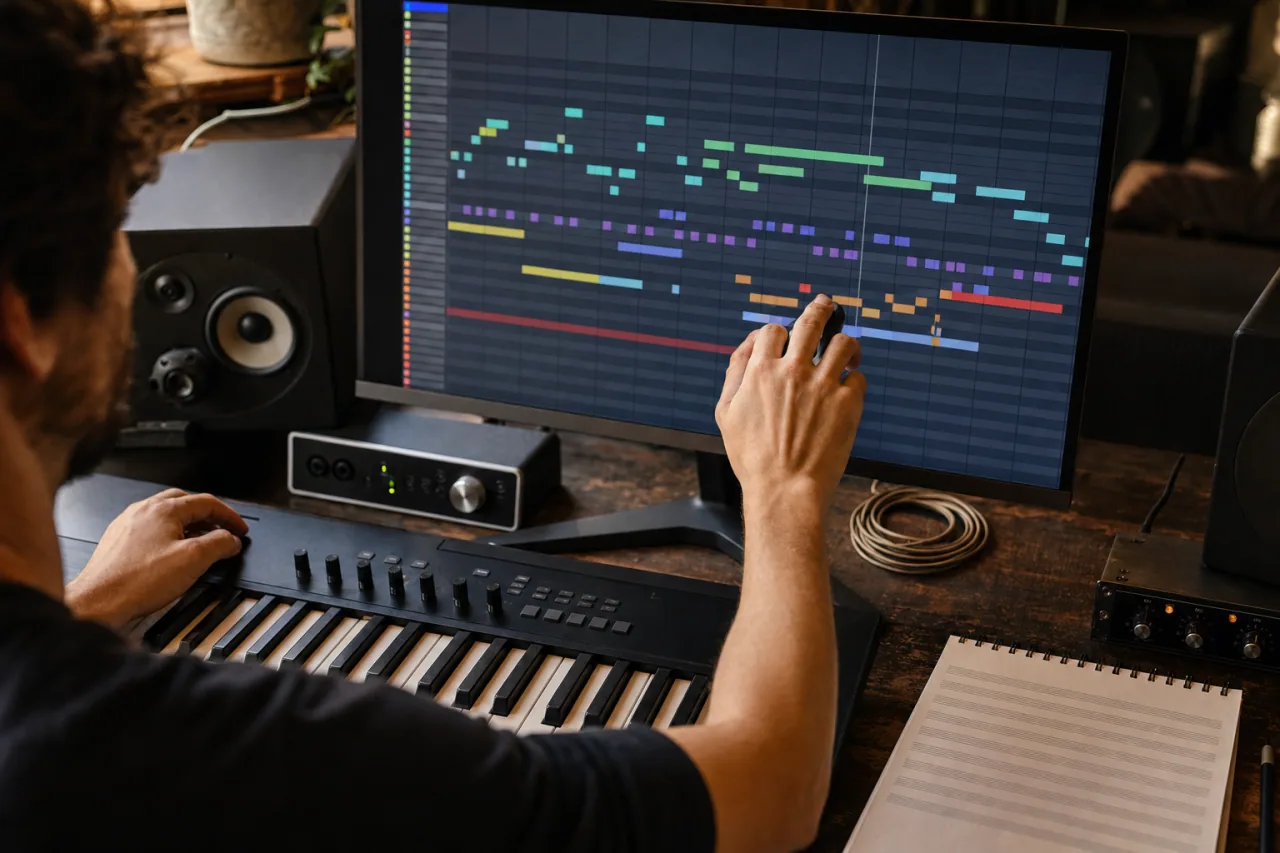
The output is intentionally closer to a loop or compositional prompt than a release-ready production. Its sounds are largely basic, general-MIDI-style tones, according to The Verge’s assessment. The practical workflow is therefore likely to be exporting generated MIDI into a DAW, editing the notes, and assigning them to a producer’s preferred instruments, synths, samples, and effects.
That makes Melody Flip less a replacement for production software and more a new idea-generation layer within it.
Why the narrower scope matters
For working musicians and production teams, the constraints may be a feature. MIDI is editable: users can change harmony, timing, voicing, instrumentation, and arrangement after generation. A producer can treat the tool’s output as a rough draft, rather than accepting an opaque audio file as the final creative unit.
For Roland, a company whose name carries weight in instruments and electronic-music hardware, that approach is also a more natural fit than competing directly in the market for one-click, fully generated songs. Melody Flip can complement an established DAW-and-instrument workflow and encourage continued use of the broader ecosystem of plug-ins and sound tools.
The product may be most useful where creative friction is expensive: a writer looking for alternate chord movement, a producer beginning a session with a brief to explore, or a small team that needs several quick musical directions before committing to a full arrangement. Its value will depend less on whether a generated loop is usable as-is and more on whether it helps users reach better decisions faster.
The adoption problem remains
Generative music remains contentious among musicians, particularly as the industry debates training data, attribution, creator compensation, and the prospect of stylistic imitation. Melody Flip’s modest, MIDI-first design does not resolve those issues, but it avoids presenting itself as an automated substitute for a songwriter, singer, arranger, and producer all at once.
Roland also has to earn confidence on software experience. The company has faced customer criticism over its Roland Cloud subscription service, though recent instruments including the P-6 Creative Sampler, SH-4d, Gaia 2, and TR-1000 have helped sharpen its product direction.
What to watch next
The early question is whether Melody Flip becomes a genuinely useful compositional tool or merely another source of generic loops. Operators should watch for three signals: the quality and diversity of generated MIDI, how smoothly it integrates with common DAW workflows, and whether Roland expands user control without turning the interface into a prompt-engineering exercise.
If it succeeds, Melody Flip could illustrate a more durable role for generative AI in music: not “push button, get song,” but a configurable collaborator that leaves the decisive creative work to the person in the session.