
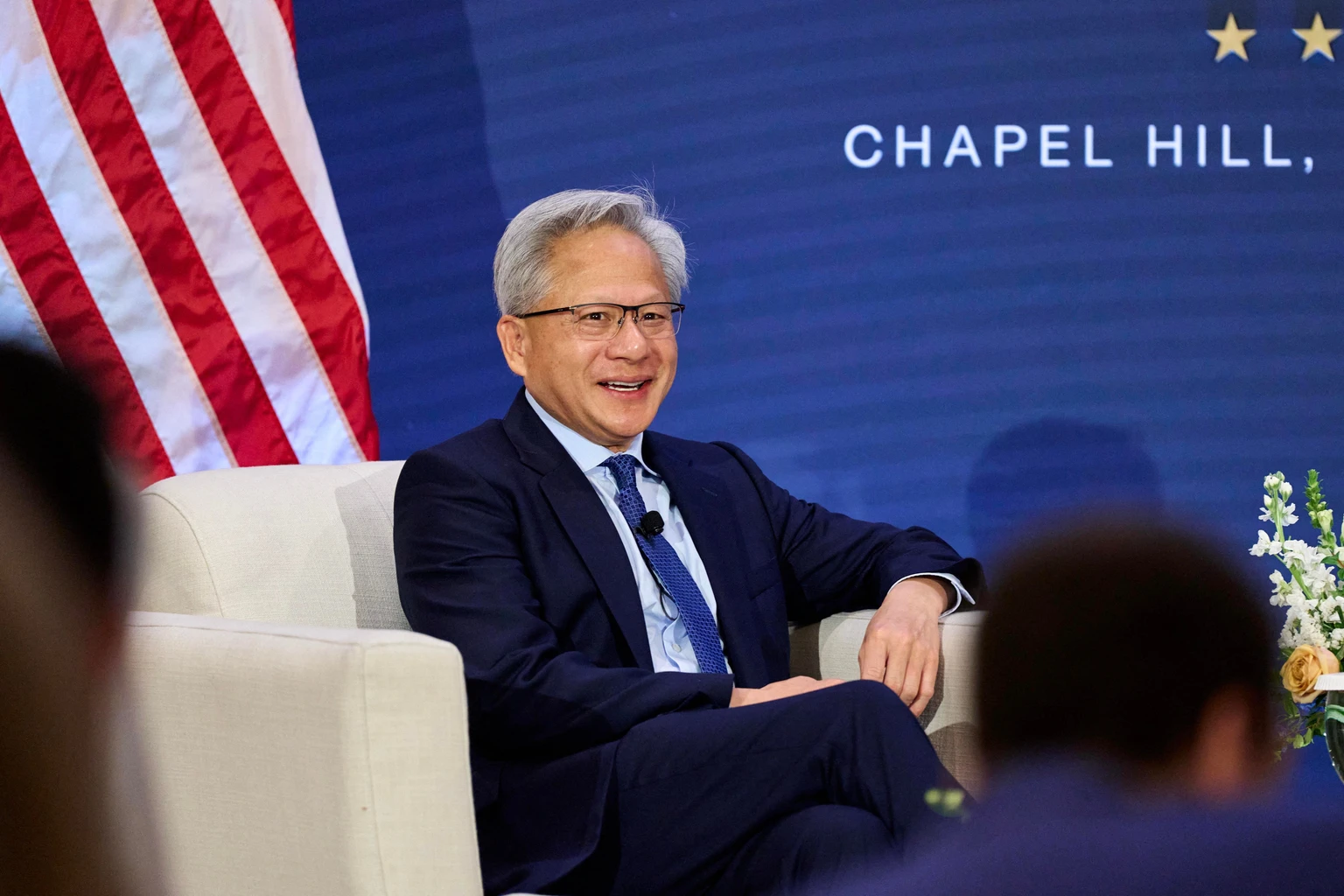
Nvidia CEO Jensen Huang put President Donald Trump on speakerphone during an onstage appearance at the All-In Summit on Monday, creating an unusual public display of alignment at a moment when the AI industry is debating whether development should slow down.
Trump used the call to dismiss fears around AI as a “hoax” and tell the audience that “the robots will not be taking over.” He also praised the economic potential of data centers, claiming they can enrich communities that host them, without naming specific projects or places.
Huang did not challenge those remarks. Instead, he framed the U.S. AI push as broadly inclusive: “We’re going to make sure that everybody wins in the AI race in America. Every industry, every company, every state, every people.”
The policy message is acceleration
The exchange matters less as a prediction about robots than as a signal about the emerging political framing of AI. Trump’s comments cast concern about advanced AI risks as an obstacle to economic growth and national competitiveness. Huang’s response emphasized diffusion of AI’s benefits across industries and regions rather than guardrails or constraints.
For executives planning AI infrastructure, that rhetoric reinforces a policy environment likely to favor domestic buildout: data centers, power capacity, chips and enterprise adoption. Nvidia sits at the center of that investment cycle as a leading supplier of AI computing hardware.
Still, supportive rhetoric does not eliminate the operational constraints that determine whether projects get built. Data-center operators and their customers must manage power availability, grid interconnection, permitting, water use where relevant, financing and local community acceptance. Claims about local prosperity will face scrutiny as large facilities seek approvals and long-term energy arrangements.
A contrast with the frontier-AI safety debate
The call came shortly after Anthropic CEO Dario Amodei published an essay arguing that frontier AI development should proceed at a measured pace and with coordination among governments. According to The Verge, the essay drew responses from AI executives who generally agreed with its concerns.
That leaves companies navigating two parallel conversations. One is about deploying current AI tools into businesses and building the infrastructure to support them. The other concerns how to govern increasingly capable systems and whether developers should accept limits on the pace of progress.
Those discussions can overlap, but they produce different decisions. A chief information officer rolling out coding assistants or customer-support automation needs controls for data access, evaluation, reliability and workforce design. A frontier-model developer faces questions about capability thresholds, testing and coordination with regulators. A data-center developer is primarily balancing demand forecasts with energy, land and permitting risk.
Treating all of those issues as either “AI optimism” or “AI fear” is not especially useful for operators.
What to watch next
The practical question is whether public political support translates into concrete policy: faster approvals, transmission and generation investment, federal incentives, export rules or a clearer national approach to AI oversight.
Businesses should also watch whether calls for AI safety produce voluntary industry commitments, government coordination or new requirements that affect model development and deployment. For now, Huang’s appearance shows that AI infrastructure and industrial competitiveness are becoming central to the public case for moving faster—even as the argument over how fast is far from settled.