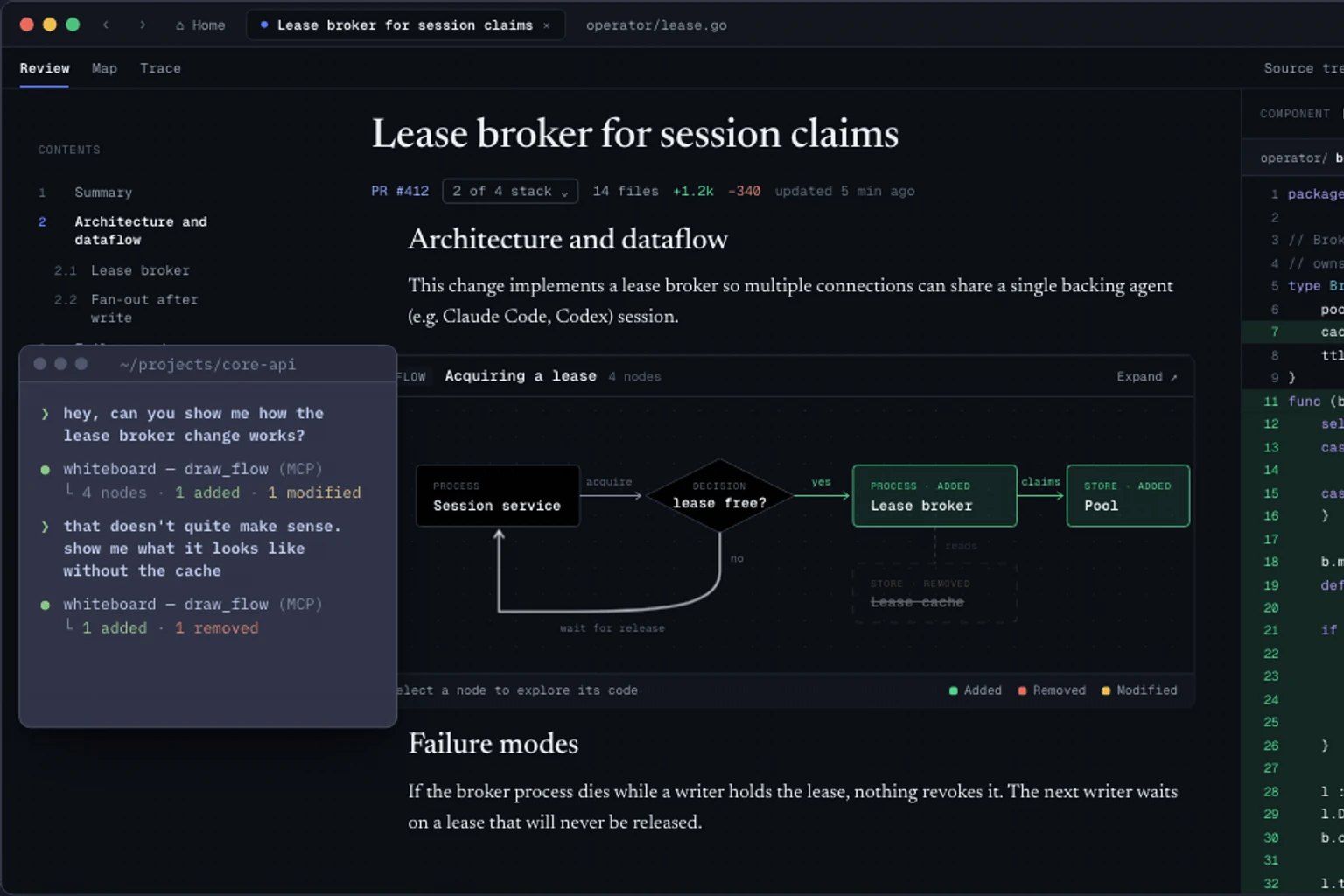
AI coding agents can produce changes faster than teams can comfortably understand them. Whiteboard, an open-source desktop application from YC W26, is built around that gap: it connects to coding agents such as Claude Code and Codex, then gives both the agent and developer a shared visual workspace for reviewing architecture and implementation.
The project is available under the MIT license and runs against local code checkouts. Its premise is not that a diagram replaces code review; it is that diagrams, agent traces and links back to source can make agent-produced changes more legible before they are accepted.
What changed
Whiteboard packages several review-oriented capabilities into a Code OSS-based desktop application:
- An agent SDK that lets coding agents draw architecture diagrams and explanations on an in-app canvas.
- Links from visual artifacts—such as sequence diagrams, entity-relationship diagrams and agent-trace excerpts—to underlying code.
- A semantic, AST-aware diff viewer written in Rust. By default, it can summarize large added functions as pseudocode and collapse or hide unit-test and documentation changes.
- A decision-log workflow intended to expose requirements, implementation choices and the decisions an agent made autonomously.
- A WASM-based plugin system for customizing diff presentation.
The suggested starting workflow is practical: connect a coding agent, ask it to compare a working branch with current main, and inspect the resulting review in Whiteboard. The project also provides prompt patterns for API changes and telemetry work.
Why this matters to engineering leaders
The constraint in agent-assisted engineering is increasingly review capacity rather than code generation. A pull request with a large raw diff may show *what* changed while making it difficult to establish the rationale, affected systems or implicit tradeoffs.
Whiteboard’s approach treats comprehension as a product surface. For staff engineers and reviewers, a generated flow diagram tied to source could shorten the path from “this looks plausible” to “I understand the system behavior and risks.” For teams using agents on unfamiliar codebases, retaining a visible account of requirements and agent decisions may also help reduce knowledge loss.
Its semantic-diff defaults point to a broader workflow shift: reviewers may want summaries and system-level views first, with conventional line-by-line inspection reserved for the portions that warrant it. That can be useful, but it also makes the quality of the filtering and summaries consequential. A tool that hides routine changes must make it easy to discover exceptions.
Local and open-source positioning
Whiteboard says it works against local checkouts and that anonymous telemetry excludes code, diffs, Whiteboard text, prompts and model output; telemetry can be disabled. That posture may matter to organizations evaluating agent workflows around proprietary repositories.
The project vendors Code OSS rather than maintaining a patch-based fork, saying it plans to merge upstream security and feature patches. It also says it removes components it does not need from the stock editor baseline. For prospective adopters, the operational question is whether that maintenance approach keeps pace with Code OSS updates over time.
Limits to evaluate now
Whiteboard is early and explicitly has gaps. Files cannot currently be edited inside the application. Cross-repository browsing and review are not well supported. Shared reviews can be sent between machines, but subsequent updates do not automatically appear for recipients; users must re-share them.
Those limitations make it best suited initially to individual or small-team review workflows, rather than as a complete collaboration and development environment.
What to watch next
The company plans a hosted team product while saying the software will remain self-hostable. The important test will be whether it can preserve the local-first review model while adding durable collaboration, permissions, review updates and multi-repository context.
For builders, Whiteboard is worth watching less as a replacement for an editor than as an experiment in a new interface for agent oversight: one where diagrams, rationale and code changes remain connected.