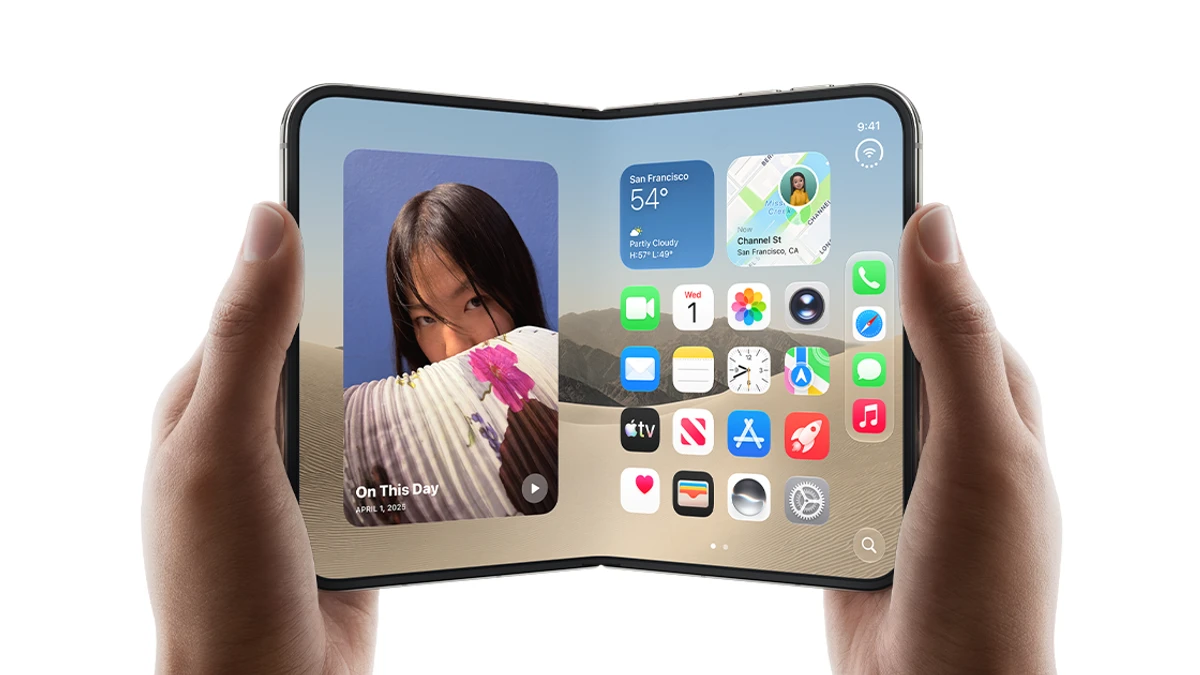

Apple has introduced the iPhone Duo, its first foldable phone, marking the company’s entry into a category that Samsung, Google, Huawei and other Android vendors have been developing for years.
The device starts at $1,999 for 256GB, with preorders beginning October 16 and availability on October 23. It is the first marquee product launch under Apple CEO John Ternus, according to TechCrunch.
What Apple is shipping
The iPhone Duo uses a wide, book-style design: a 5.4-inch outer display opens into a 7.6-inch inner Retina display. Apple says both displays support ProMotion, always-on functionality and up to 3,000 nits of peak brightness. The large panel is the biggest on an iPhone so far.
Hardware decisions reveal where Apple believes differentiation is needed. The company says a custom nano-texture material reduces glare and makes the fold crease less visible, while a hinge assembled from more than 100 components is intended to improve durability and smoothness. The device has a titanium frame, IP68 dust and water resistance, and an under-display camera on the inside screen.
Apple is making trade-offs, too. The Duo uses Touch ID in a side button rather than Face ID, has an eSIM-only design, and includes a dual rear-camera system—a 48-megapixel main camera and 48-megapixel ultrawide—without a telephoto camera. It is powered by the A20 Pro chip and C2 modem.
The product story is multitasking, not just a larger screen
For builders, the more consequential announcement is iOS 27’s adaptation to the foldable layout. Apple demonstrated side-by-side apps, app pairings, and vertical use cases in which a video can be pinned to the upper half while another app runs below. Controls and the dock can shift for the unfolded, vertically oriented interface.
That makes the Duo closer to a pocketable small tablet than a conventional large phone. The operational question for product teams is not simply whether their app looks acceptable on a 7.6-inch display. It is whether the product has workflows that improve with persistent two-app context: customer support beside account data, messaging beside documents, a dashboard beside a task queue, or video collaboration alongside notes.
Apple Pencil support is due later this year, The Verge reports. If delivered, it could further expand the device’s usefulness for annotation, field work and creative tasks—but teams should avoid planning around it until the feature is available.
A premium-category validation test
Foldables remain a small segment. Counterpoint data cited by The Verge puts them at 1.6% of global smartphone sales in 2025; TechCrunch cited a Counterpoint estimate that foldables would still account for less than 2% of overall smartphone shipments in 2026.
That scale limits the near-term case for Duo-specific product investment. Yet Apple’s arrival changes the calculus because it brings a large installed-base ecosystem, established developer distribution and the company’s influence over accessory, component and app-design decisions.
The $1,999 entry price also places the Duo squarely in the premium tier. It is priced above Samsung’s Galaxy Z Fold 8 base model, according to The Verge, and below the Z Fold 8 Ultra. That positioning suggests the first cycle will test demand among high-value iPhone users rather than pursue mass-market volume.
What to watch next
The first practical signals will be independent assessments of crease visibility, hinge durability, battery life and camera compromises. Apple claims up to 31 hours of video playback on the inner display and 44 hours on the outer display; real-world use across mixed apps and networks will matter more.
For software leaders, watch how quickly Apple documents and promotes the new display states, multitasking patterns and Pencil behavior. The key question is whether the Duo creates repeatable productivity use cases—or remains an expensive, better-shaped screen for existing iPhone apps.
Apple has not created the foldable market. But it has made the category newly relevant to teams whose customer base is concentrated on iPhone.