
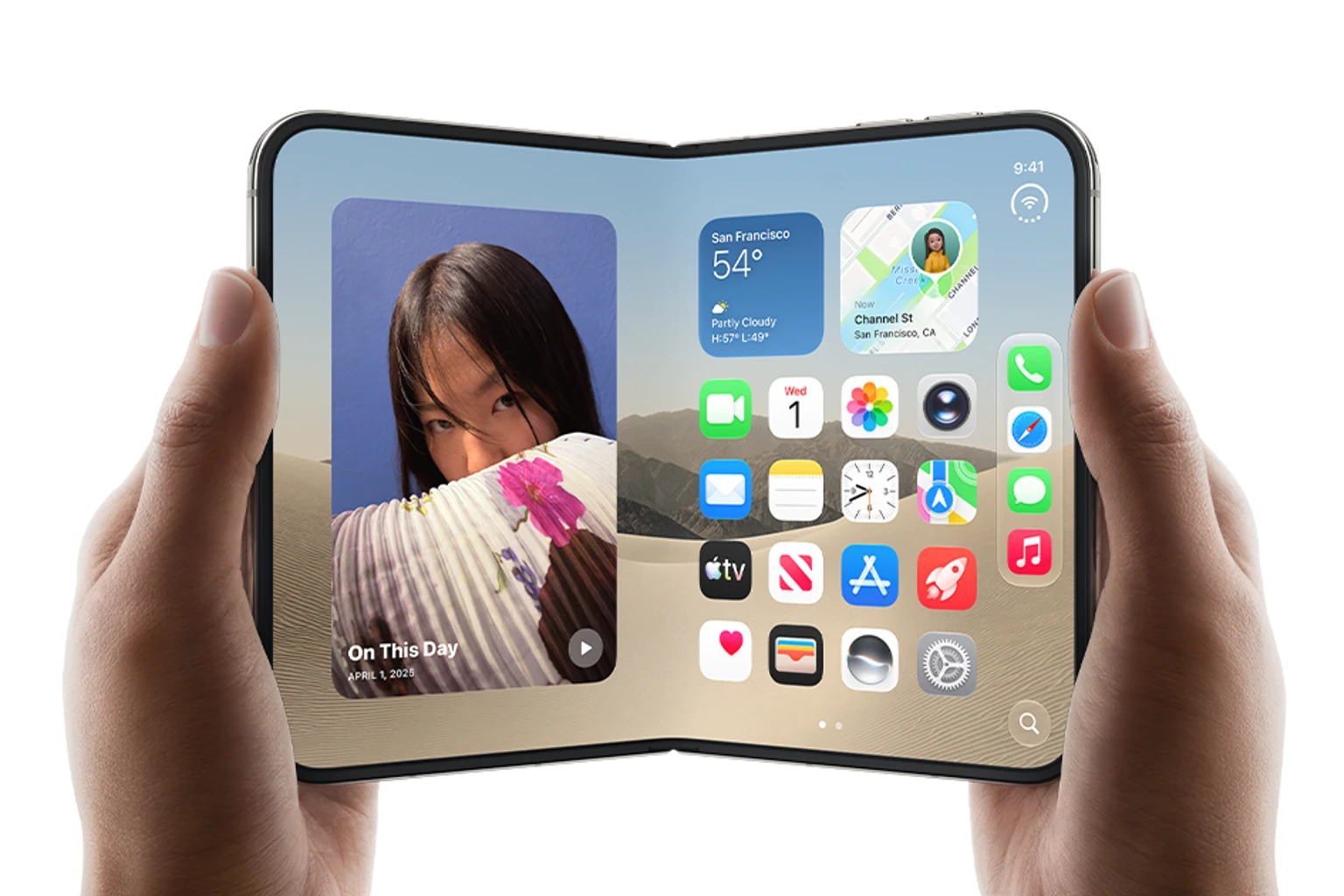
Apple has entered the foldable-phone market with the iPhone Duo, ending years of speculation and putting the category in front of Apple’s installed base.
The immediate hardware impression, according to a hands-on from *The Verge*, is that Apple has addressed several of the category’s persistent usability objections: the hinge moves smoothly, the device is rated IP68, glare is reduced by a matte inner finish, and the crease is difficult to detect by touch. But the more consequential move may be how iOS changes as the device opens, closes and sits in different positions.
What changed
The iPhone Duo has a 5.4-inch outer display and a 7.6-inch inner Super Retina XDR display. Apple says the open display is 50% larger than the iPhone 18 Pro Max’s and uses a 10-layer panel with a custom nano-texture finish. The Duo’s closed proportions are relatively squat—closer to a passport than two conventional phones side by side—giving its large screen a wider canvas for landscape video while retaining a useful portrait layout for reading and side-by-side apps.
Apple is also positioning the device as a new interaction format rather than simply a larger screen. In the hands-on, content transitions gradually between the external and internal displays rather than appearing to switch abruptly. In laptop mode, Netflix placed video on the upper panel and playback controls below before fading them away. Tent mode supports StandBy even without external power.
Apple’s own software pitch includes side-by-side apps, hands-free FaceTime and flexible viewing angles. These behaviors matter because a foldable’s value depends on making its intermediate states useful, not merely making a phone expandable.
The hardware is built around Apple’s A20 Pro chip, with a dual 16-core Neural Engine, vapor-chamber thermal management, a dual-battery system and the company’s C2 modem. Apple rates playback at up to 31 hours using the inner display and up to 44 hours using the outer display. Those are vendor estimates, and real-world endurance—particularly when the screen is active in tent or laptop modes—remains a key question.
Why it matters for the market
Foldables are not new. Samsung introduced its first model in 2019, and Google, Motorola, Huawei, Xiaomi, Oppo and others have since released their own versions. Apple’s arrival does not validate the hardware concept on its own; it changes the distribution and developer stakes around it.
For app teams, the Duo creates a reason to treat adaptable mobile layouts as a first-class product surface. The opportunity is broader than displaying two app panes: workflows can move from quick, outer-screen tasks to extended work on the internal display, while half-open postures can support video calls, reference material, controls or capture tools. The risk is that apps which merely stretch existing iPhone interfaces will make the device feel like an expensive novelty.
For enterprise mobility leaders, the most relevant promise is a pocketable device that can better support multitasking, document review and video collaboration without carrying a tablet. That case will depend on practical factors that have not yet been established in the supplied materials: price, fleet management considerations, repairability, application compatibility and durability over long-term use.
The Duo also sharpens a familiar Apple trade-off. It shares the A20 Pro with the iPhone 18 Pro, but its camera system is less extensive: it has 48-megapixel main and ultra-wide cameras, while the 18 Pro adds a telephoto camera and variable aperture. Buyers will be choosing form factor and display flexibility over the company’s fullest camera configuration.
What to watch next
Three tests will determine whether the Duo expands beyond early adopters. First is sustained battery performance across open-screen, laptop and tent use. Second is whether Apple’s transition and posture-aware iOS features are matched by third-party apps with genuinely useful layouts. Third is reliability: IP68 and an unobtrusive crease are encouraging early signals, but a foldable has to prove its durability over years, not a hands-on session.
Apple’s real contribution may be less about introducing a new device category than setting a higher baseline for its software behavior. If the Duo makes the larger screen useful in ordinary work and communication, it could move foldables from a hardware experiment toward a mainstream mobile-computing option.