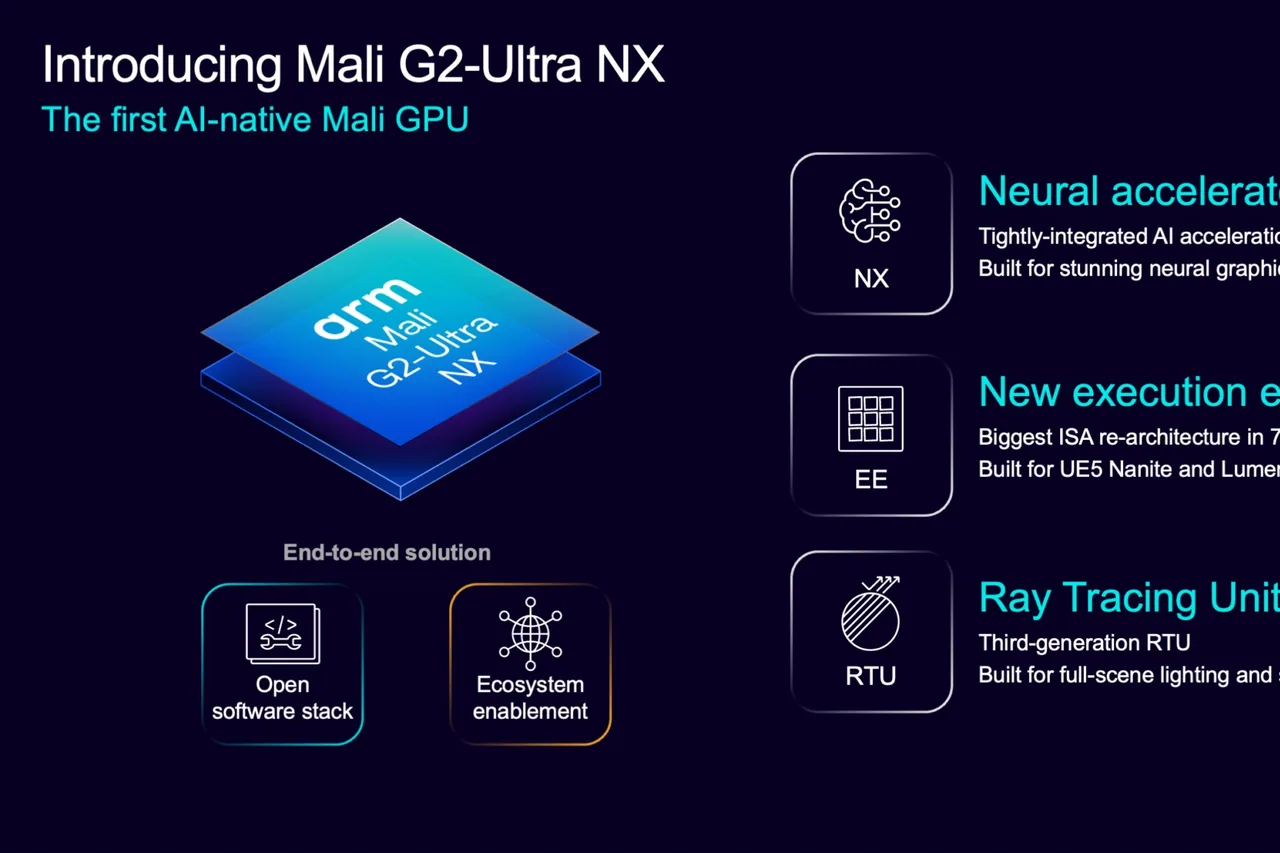
Arm has introduced the Mali G2-Ultra NX, a mobile GPU designed around a premise increasingly familiar in PC graphics: render less conventionally, then use neural processing to reconstruct, enhance or create parts of the final image.
The company calls it its first “AI-native” Mali GPU. The important architectural change is that neural accelerators sit directly in the shader cores and share the GPU’s memory system, coherent caches and control structures. Arm’s aim is to avoid the overhead of moving graphics data between separate processors—a material concern in mobile devices, where power, heat and external-memory bandwidth constrain sustained performance.
Three techniques, one trade-off
The GPU is built to support three neural-graphics workloads:
- **Neural Super Sampling (NSS):** reconstructs a higher-resolution image from a lower-resolution render, using data including motion, depth and frame history.
- **Neural Frame Rate Upscaling (NFRU):** generates intermediate frames to raise apparent frame rates.
- **Neural Super Sampling and Denoising (NSSD):** couples upscaling and denoising for computationally demanding ray-traced scenes.
For game studios, the promise is not simply better-looking mobile games. It is a larger performance budget that can be allocated between frame rate, resolution, lighting complexity, battery use and device temperature. Frame generation and upscaling are particularly relevant because rendering every pixel and every frame natively is an expensive way to pursue premium visual targets on a phone.
Arm says its *Neural Dawn* demonstration, developed with Sumo Digital, achieved up to four times higher performance efficiency and up to 70% lower external-memory traffic than native rendering when using NFRU and NSSD. Those are vendor-reported results from a showcase rather than independent, broadly representative benchmarks, but they highlight why bandwidth reduction is central to this generation of mobile graphics.
Conventional GPU improvements still matter
The neural hardware is accompanied by a new execution engine, which Arm describes as its largest Mali instruction-set architecture update in seven generations. It provides up to twice as many registers per warp, intended to give complex graphics workloads more working space on chip.
Arm reports up to 24% higher benchmark performance and 14% higher non-AI gaming performance than its preceding generation. Separately, its third-generation hardware ray-tracing unit is claimed to reduce DRAM traffic by up to 13% in leading ray-tracing benchmarks.
The ray-tracing subsystem also supports Opacity Micromaps, a technique for handling detailed transparent or cutout geometry more efficiently. In an Arm demo, that feature increased frame rates by 30% and reduced ray-tracing workload by up to 70%. This could matter for scenes with foliage, fabrics and layered surfaces—assets that can otherwise make advanced lighting disproportionately costly on mobile hardware.
The software path is the strategic test
A graphics architecture does not become a platform until developers can use it without rebuilding their production pipeline. Arm says it began seeding its neural-graphics software work two years before the hardware announcement. Its Neural Graphics Development Kit includes NSS and NFRU, Vulkan machine-learning extensions, custom-engine integration tools, profiling and model-optimization tooling, plus plug-ins for engines including Unreal Engine.
That developer layer is arguably as consequential as the silicon. Neural rendering depends on motion vectors, depth information, temporal history, model tuning and artifact management. Studios will need to validate image stability, input responsiveness, battery behavior and visual quality across a fragmented Android device market—not merely turn on a feature.
Arm says Tencent Games is integrating its neural technology into the Messiah Engine, with *Where Winds Meet* among the first planned game deployments.
What to watch next
Mali G2-Ultra NX is also part of Arm CSS for Mobile 2, its broader compute subsystem offering for silicon partners. The practical timeline will depend on when chipmakers license and ship designs based on the IP, followed by OEM launches and engine-level game support.
For operators and device makers, the measure of success will be sustained performance per watt rather than promotional peak frame rates. For developers, the key question is whether Arm’s tools make neural graphics portable enough to justify production investment. And for players, the deciding factor will be whether the technology delivers smoother, sharper games without the latency or image artifacts that can undermine its gains.