Open-source project TradingAgents is packaging a familiar institutional-investing workflow into a multi-agent LLM system: separate agents analyze fundamentals, technical indicators, news and social sentiment; bullish and bearish researchers debate the evidence; a trader proposes a transaction; and risk-management and portfolio-management roles review it before a simulated execution.
That division of labor is not a guarantee of better investment returns. But it is a notable attempt to make LLM-based financial research more structured, inspectable and operationally usable than a single chatbot prompt.
What changed
The project’s August v0.4.0 release concentrated on issues that matter more than a longer model-support list: point-in-time and look-ahead fixes for FRED macroeconomic data, social sentiment and decision-log memory; clearer decision signals; CLI checkpoint resumption; and price grounding for the trader role.
Those changes follow a series of releases that added a verified data-access contract, checkpointing, persistent decision logs, Docker support and a broader provider registry. TradingAgents now supports commercial LLM services including OpenAI, Google, Anthropic, xAI, DeepSeek, Qwen, GLM, MiniMax, Mistral and AWS Bedrock, alongside OpenRouter, Ollama and other OpenAI-compatible local or self-hosted endpoints.
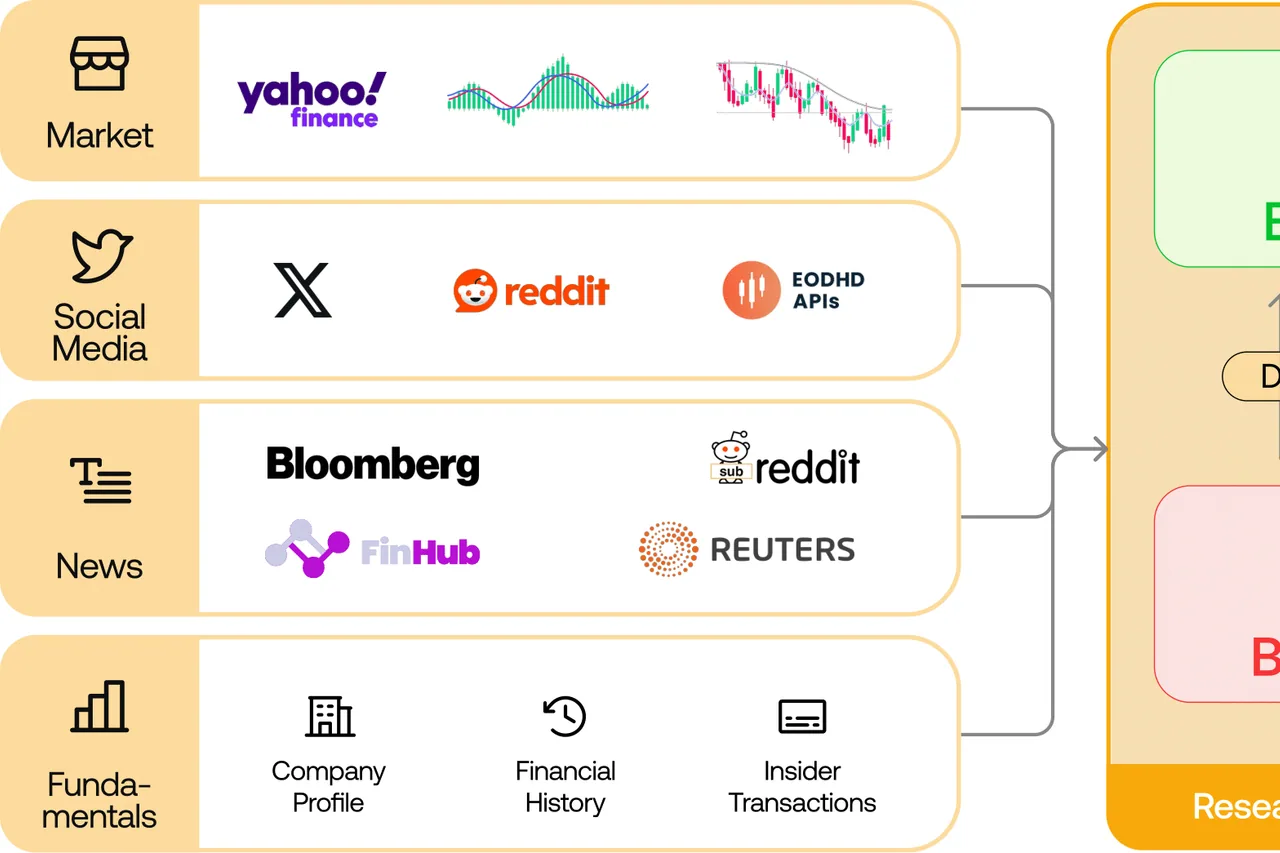
The software is built with LangGraph and can be run through an interactive command-line interface or Docker. It uses Yahoo Finance-covered tickers across equities and crypto, while its listed data sources include Alpha Vantage, FRED and Polymarket.
Why point-in-time controls matter
For teams evaluating AI in markets, the most consequential item in the release notes is the effort to address look-ahead bias. A backtest can become misleading when it gives a strategy access to data that would not have been available at the stated decision time—whether through revised macroeconomic series, improperly filtered market data, or accumulated memory that contains later outcomes.
A framework cannot solve that problem merely by naming agents. The validity of a simulated result rests on timestamped data availability, data revisions, realistic execution assumptions, costs and disciplined evaluation across periods and markets.
TradingAgents’ point-in-time fixes and decision-log approach therefore make the project more interesting as research infrastructure than as an autonomous trading product. They suggest an acknowledgement that reproducibility, traceability and failure recovery are core requirements when an LLM workflow influences a high-stakes decision.
The operating model: specialization plus challenge
The framework assigns distinct functions to a fundamentals analyst, sentiment analyst, news analyst and technical analyst. Its researcher layer introduces an explicit bull-versus-bear debate, then passes output to a trader agent. A risk-management team evaluates factors such as volatility and liquidity before a portfolio manager approves or rejects the proposal.
For enterprise builders, this is the transferable design pattern. A multi-agent system can make assumptions and disagreements visible: one role gathers evidence, another tests the conclusion, and a final control layer can impose constraints. The same pattern could apply to credit review, procurement, cybersecurity triage or strategic planning.
Still, specialization does not automatically produce independence. Agents sharing the same model family, prompts, source feeds or flawed inputs can reinforce the same error while appearing to reach a consensus. Organizations should treat “debate” as a workflow feature to test, not proof of robust reasoning.
What teams should test next
Before connecting systems like TradingAgents to real orders, operators should keep execution simulated and evaluate whether the system can:
- reconstruct every recommendation from its source data, timestamps, prompts and model versions;
- demonstrate that inputs were available at the decision time and that data revisions are controlled;
- measure results after spreads, fees, slippage and latency rather than on headline backtests;
- enforce hard risk, exposure and approval limits outside the LLM; and
- compare outputs across providers and models, especially as model updates can change behavior.
TradingAgents explicitly says it is for research and not investment advice, and that performance depends on models, temperatures, data quality and trading periods. That is the appropriate framing. Its value is in giving developers a configurable, open workflow for studying agentic financial analysis—not in removing the need for market-data governance and human accountability.