
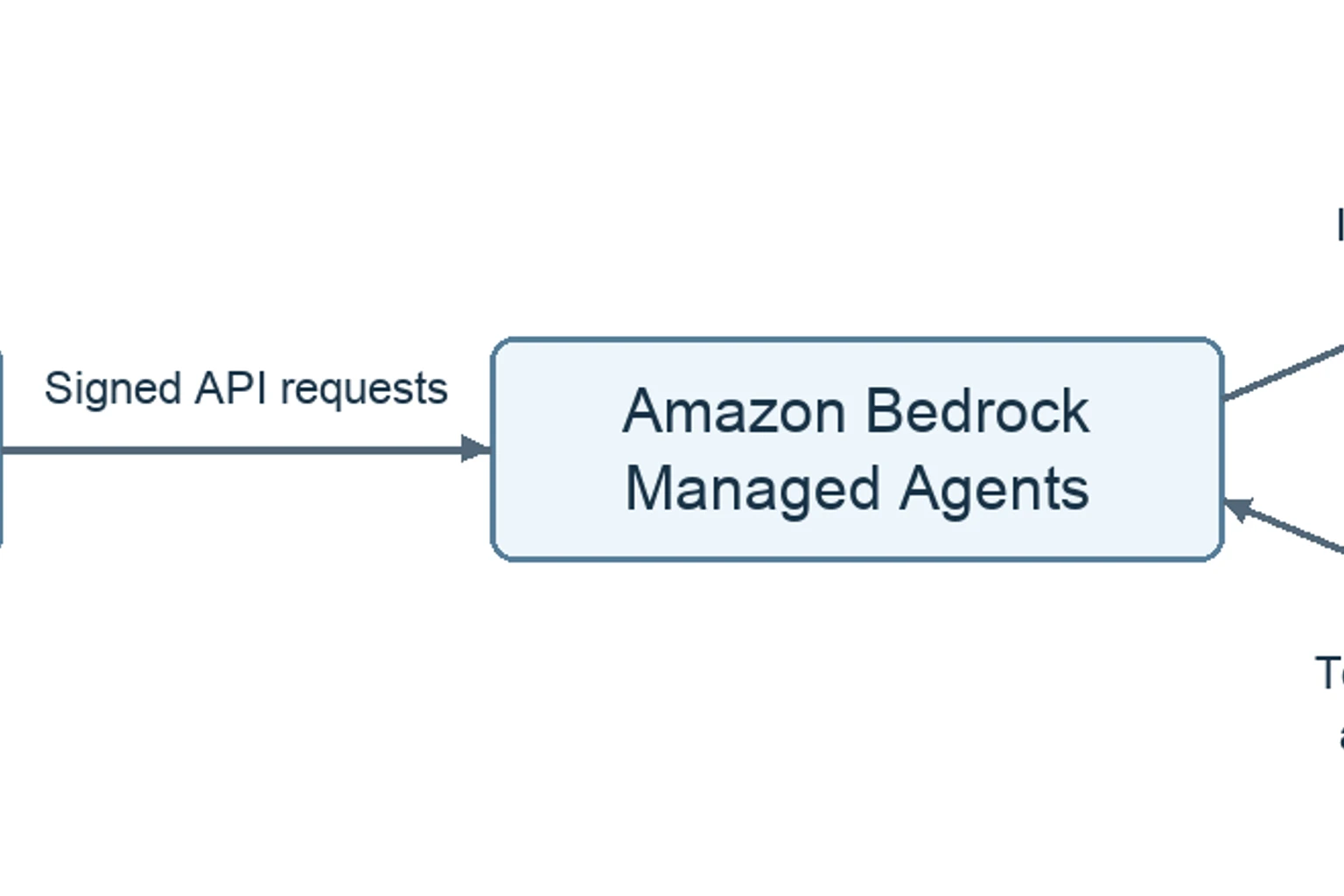
AWS has put agentic AI and cloud operations at the center of its latest weekly roundup. The most consequential change is the public preview of Amazon Bedrock Managed Agents powered by OpenAI, a service designed to let teams build agents optimized for OpenAI models while keeping execution and controls inside AWS.
For companies already standardized on AWS, the pitch is less about another model endpoint and more about operational fit: agents can use the identities, permissions and governance controls that teams already apply to AWS resources.
What AWS introduced
Bedrock Managed Agents uses a customized, AWS-native version of OpenAI’s Agents API. Developers can choose between self-hosted compute—such as an existing development machine, container or other compute environment—and Amazon Bedrock AgentCore Runtime, AWS’s managed option for runtime sessions and configurable storage within a customer’s account.
That architecture matters for teams moving from AI experiments to systems that can take actions against internal data and services. Agent deployments introduce questions that conventional chat applications often avoid: which credentials an agent receives, what resources it may access, where session data lives, and how activity is governed. AWS is positioning its existing cloud-control plane as the answer to those requirements.
AWS also added several models to Bedrock, including OpenAI GPT-6.1 Sol and GPT-6 Astra UltraFast mode, Anthropic Claude Sonnet 5.5, and SpaceXAI Grok 4.7. The additions expand options for coding, computer-use and browser-agent workloads, but model selection should remain a workload decision. Teams will need to evaluate quality, latency, cost, tool-use reliability and security behavior against their own tasks rather than rely on vendor performance claims.
Implications for operators and builders
The core opportunity is to reduce integration work for organizations that want OpenAI-based agents without building an entirely separate identity, security and runtime layer. Centralizing agent execution in AWS could make it easier to apply existing access policies and operational practices to AI workloads.
But a managed agent service does not remove the need for controls. Before production deployment, leaders should define bounded permissions, approval steps for consequential actions, logging requirements, failure handling and evaluation criteria. The right early use cases are likely to be narrowly scoped internal workflows with measurable outcomes—not broad autonomy.
AWS also announced a preview of the AWS Well-Architected Agent, which analyzes an AWS environment and produces contextual recommendations across cost, security, performance and resilience. It could become another input for cloud-operations teams, but recommendations should be reviewed alongside established architecture and change-management processes.
On data infrastructure, Aurora PostgreSQL can now query Apache Iceberg and Parquet data in a data lake directly, according to AWS. That may reduce ETL and duplication for teams combining operational PostgreSQL data with lakehouse data. Separately, S3 Tables now supports all Apache Iceberg V3 data types, including geospatial and nanosecond timestamp types.
Lifecycle changes require attention
The roundup also includes a practical planning signal. Starting October 29, 2026, Amazon Chime SDK SIP Media Application and Amazon WorkSpaces Secure Browser will enter Maintenance and no longer be available to new customers.
AWS has set September 2027 end-of-support dates for Amazon Managed Blockchain, Amazon DevOps Guru and AWS Backint Agent for SAP ASE. The standalone AWS Infrastructure Composer console is scheduled to reach end of support on December 7, 2026. Amazon Mechanical Turk reached end of support on September 29, 2026.
Platform owners should inventory dependencies now, identify affected applications and assign migration owners. Waiting until a product nears its deadline turns a roadmap exercise into an operational risk.
What to watch next
The main question is whether Bedrock Managed Agents develops into a durable production layer for governed agent workflows, rather than simply another way to call frontier models. Watch for details on regional availability, pricing, auditability, observability and the breadth of AWS services agents can safely use.
AWS’s release mix also points to a broader reality for enterprise AI: model access, runtime design, data architecture and lifecycle management are becoming one operating problem—not separate projects.