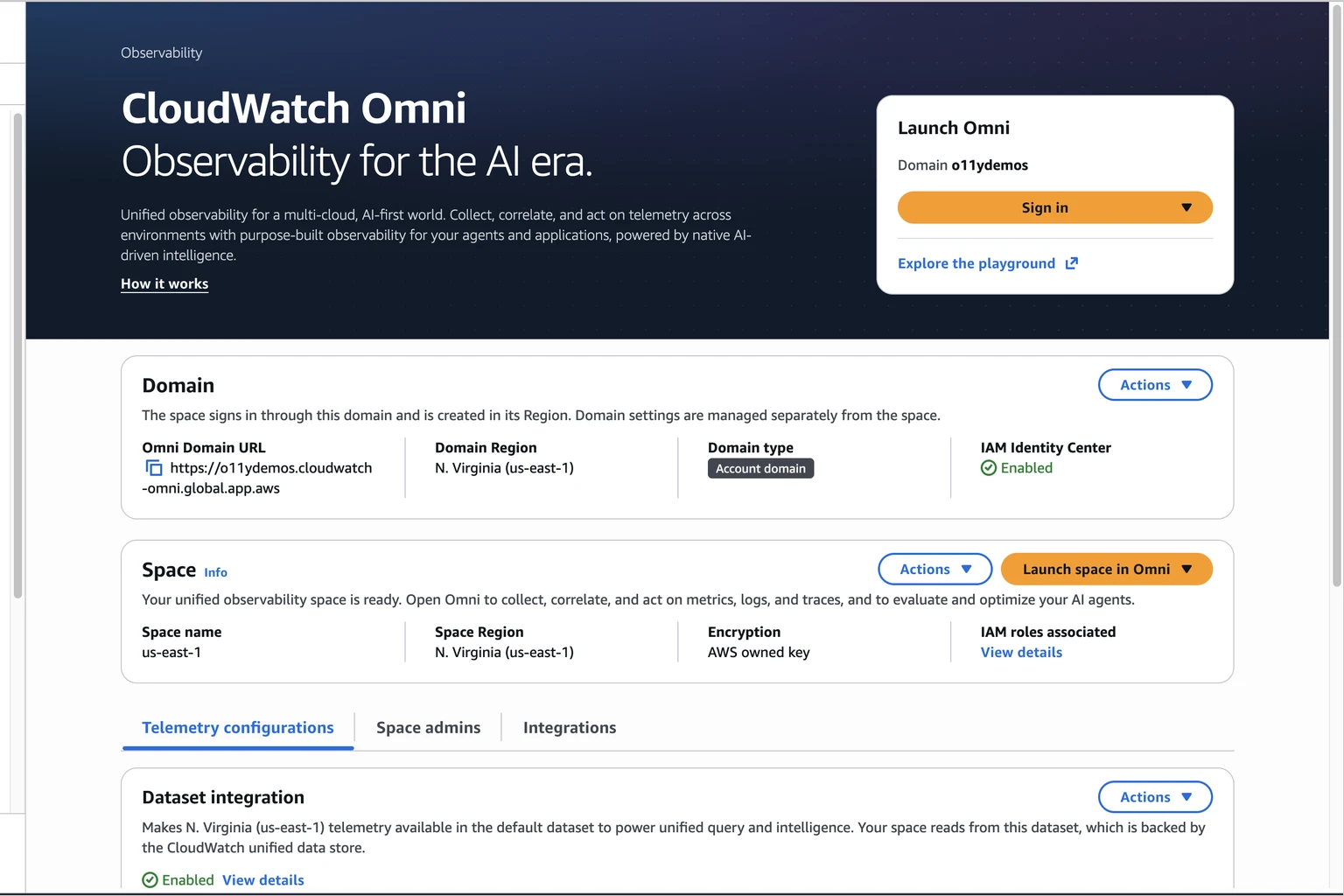
AWS has launched Amazon CloudWatch Omni, a new observability experience that puts application operations and AI-agent monitoring in one workspace. It is generally available, according to AWS, and extends rather than replaces existing CloudWatch alarms, dashboards, APIs and console workflows.
The product is notable less for a new metric store than for a change in how AWS packages operational work: around applications, teams and investigation sessions rather than individual logs, metrics and traces.
What changed
CloudWatch Omni is delivered through a dedicated web application, separate from the AWS Management Console. Teams can use enterprise single sign-on through IAM Identity Center and supported identity providers, including Okta and Azure AD; engineers do not need AWS Console access to participate.
For existing CloudWatch users, AWS says current logs, metrics, traces and alarms become available without reconfiguration. Omni uses OpenTelemetry and accepts telemetry through an OTLP endpoint, positioning it for workloads beyond AWS as well.
Teams create a Space for an owner group or environment. Within it, Omni is designed to discover services, map dependencies using telemetry and AWS Config discovery, and provide dynamic views of application health. Operators define the outcomes that matter—such as availability, latency budgets and error-rate thresholds—while AWS says the system updates topology and alarms as services change.
An incident workspace, not just another dashboard
The operational centerpiece is a shared investigation session. When an alarm fires, AWS says Omni can assemble relevant context, including topology, correlated signals and recent events such as deployments. Engineers from SRE, application and database teams can enter the same session rather than reconstructing the timeline across handoffs.
Amazon DevOps Agent is enabled by default in Omni investigation sessions. AWS says it correlates signals, traces root-cause paths across the dependency graph, proposes next steps and retains investigation history for later review.
That is a meaningful workflow promise, but buyers should treat the agent as an investigation aid rather than a decision-maker. The practical value will depend on whether service mapping is accurate, telemetry is complete and the suggested correlations hold up during real production incidents.
AI-agent quality joins traditional reliability signals
Omni also targets a growing operational gap for teams shipping generative AI and agentic systems: latency and error rates do not reveal whether an agent’s answer was useful, coherent, grounded or routed to the right tool.
AWS provides an IDE extension for VS Code and Kiro, plus the standalone web workspace. The extension can run locally without an AWS account; connecting to AWS enables persistent CloudWatch storage, shared traces and production dashboards. AWS says supported instrumentation includes OpenInference and ADOT, with support for frameworks including LangChain, LangGraph, CrewAI, the OpenAI SDK, Strands and Vercel AI SDK in Python and TypeScript.
For agent development, Omni records structured traces of model calls, tool use and other execution steps. It includes trace comparison, prompt management, datasets, a playground and experiments. AWS says it supplies 17 built-in evaluators, covering dimensions including coherence, helpfulness, faithfulness and routing correctness, while also integrating with third-party evaluators such as AutoEval and DeepEval.
The operational implication is clear: teams can potentially tie a prompt or model change to both quality regressions and production behavior in the same system used for service health.
What leaders should evaluate
CloudWatch Omni may reduce tool switching for organizations already standardized on CloudWatch and OpenTelemetry. The standalone access model could also let more incident participants collaborate without broad AWS Console permissions.
But implementation discipline still matters. Before rolling it out widely, teams should test:
- **Telemetry coverage:** whether critical cross-service and agent traces arrive with useful context.
- **Service ownership:** whether Spaces and identity groups match actual escalation paths.
- **AI evaluation design:** whether built-in scores reflect the business-specific failures users care about.
- **Cost and retention:** AWS directs customers to CloudWatch pricing; ingestion, storage and evaluation activity should be modeled before expanding coverage.
What to watch next
The key question is whether Omni’s automatic discovery, correlation and agent-led investigations remain reliable in complex, fast-changing production estates. Also worth watching is how well its open-standards posture works across non-AWS infrastructure and competing AI frameworks.
For AWS customers building both distributed applications and AI agents, Omni is an attempt to make observability a shared engineering workflow rather than a collection of separate monitoring screens.