Ukraine is turning a byproduct of drone warfare into an emerging AI asset: operational data from tens of thousands of flights.
The Ministry of Defense said in January that it would make millions of data points available to military contractors and commercial companies. More than 100 Ukrainian companies, as well as the UK government, have since gained access, according to reporting by *MIT Technology Review* and Ukrainian government statements.
For operators building autonomous systems, the attraction is straightforward. Battlefield flights capture machine performance and human decisions under conditions that are difficult—and expensive—to recreate: disrupted signals, poor visibility, changing terrain and improvised responses. Those edge cases are often the inputs needed to make AI systems more robust outside controlled test environments.
What changed: battlefield records are becoming a market
Military drone data is not new. US programs such as Project Maven have used sensor-heavy drone feeds to advance defense AI. The shift is in access and commercialization.
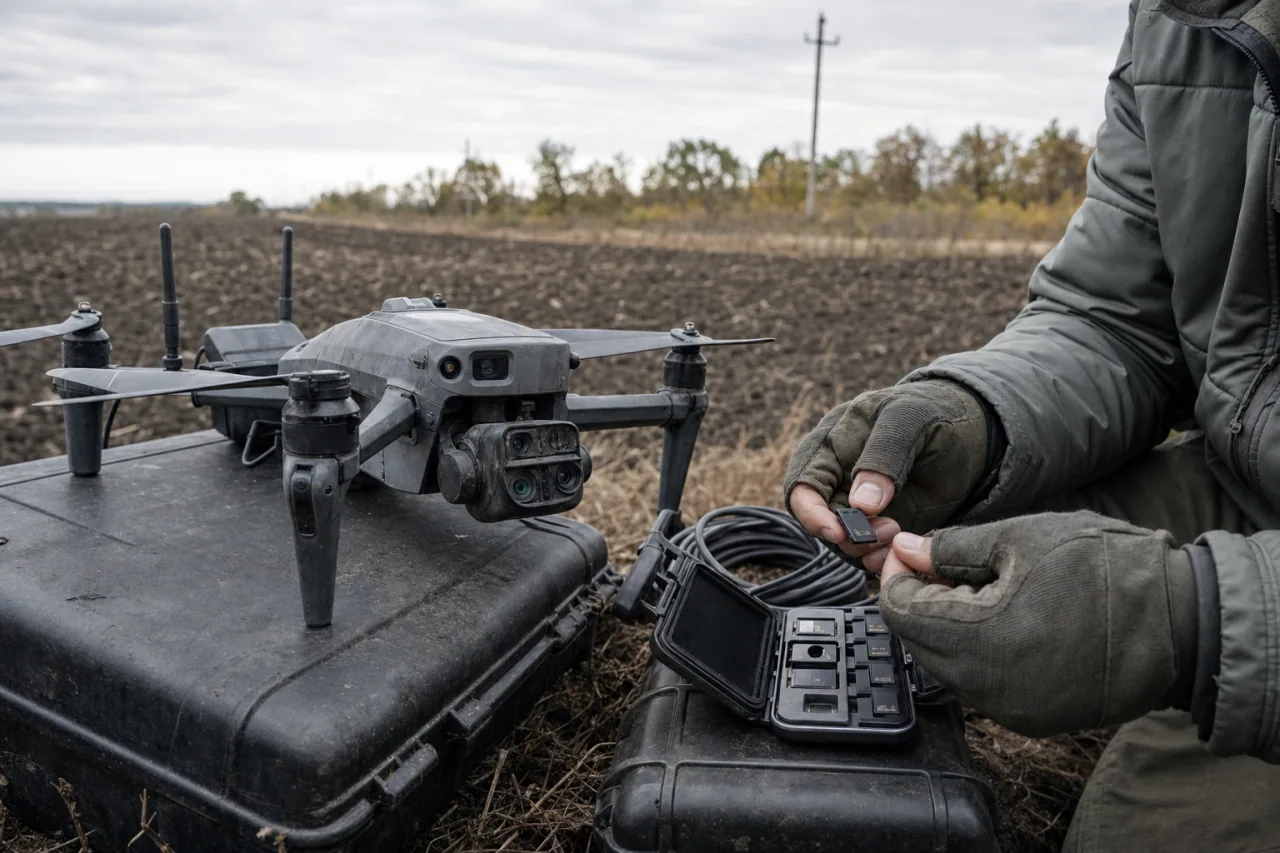
Ukraine’s approach broadens the pool of developers able to train on operational experience. Enabled Intelligence, a US company that prepares data for AI training, has said that more than 500,000 hours of drone footage from the conflict is available for use in subsequent models.
That creates a feedback loop. Civilian drone technologies are adapted for military use; their flights produce data; and processed datasets can then inform future military and commercial systems. The article points to agricultural deployments as one civilian destination: drones designed to work through difficult connectivity conditions can help with mapping and surveying in areas where prior systems depended on stable cellular coverage.
The commercial implication is larger than drones. High-quality records of autonomous systems encountering real-world failures can improve perception, navigation, communications resilience and human-machine coordination. Those capabilities matter for inspection, logistics, agriculture and remote operations as much as defense.
Why the data is unusually valuable
A drone flight does not produce only video. It can include telemetry, controller inputs, sensor readings and the sequence of actions taken as conditions change. When those records are processed and connected to operator behavior and outcomes, they become training material rather than raw footage.
For founders and product leaders, this underscores a persistent constraint in physical AI: rare events matter disproportionately, but they are hard to gather safely through normal operations. War generates large volumes of extreme, dynamic scenarios at a pace that testing programs cannot match.
That does not mean battlefield-trained models transfer cleanly to civilian settings. Data collected in conflict can contain biases, assumptions and operational goals that are inappropriate for commercial applications. Model builders will need to validate performance against their own environments rather than treat access to hard-to-obtain data as a shortcut to deployment readiness.
The governance gap is the business risk
Ukraine has begun putting access controls around the material. Its Avengers Labs program, for example, allows companies to train models without directly handing over sensitive databases. But access control is only one layer of the problem.
Once wartime data has influenced a model, tracing its downstream use becomes difficult. Conventional datasets can sometimes be tracked through contractual terms or embedded identifiers; model training can obscure that provenance. There are also serious consent and privacy questions for soldiers, operators and civilians captured in footage, sensor records or location data.
Existing laws of armed conflict do not clearly govern data after it is decontextualized, packaged and incorporated into products sold well beyond a war zone. That uncertainty creates compliance, reputational and procurement risk for companies that use or acquire models trained on such material.
What to watch next
Expect more governments and defense suppliers to explore battlefield-data licensing. The key policy question will be whether data is regulated like ordinary commercial input—or treated more like a controlled defense transfer, with licensing, origin records, restrictions on onward sharing and disclosure when wartime-trained models enter civilian products.
Companies should ask suppliers for a clear account of training-data provenance, permitted uses and downstream restrictions. In this market, the most consequential asset may not be the drone itself, but the operational experience embedded in the models it helps train.