
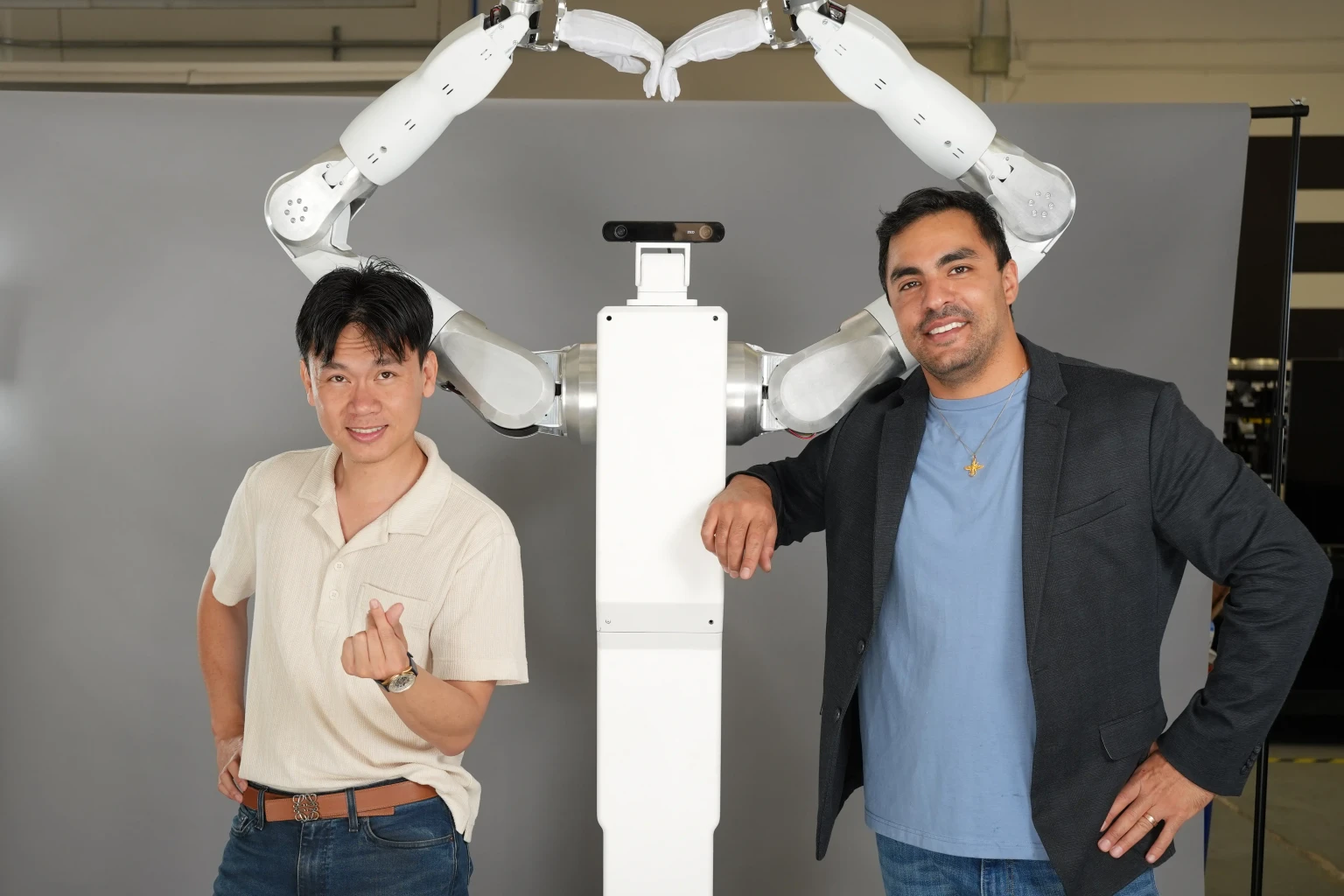
Feather Robotics is taking a different route into humanoid robotics: rather than wait for a broadly capable robot intelligence, it is selling modular hardware and software tools that developers can use for specific jobs today.
The startup, founded in 2025 by Hoa Mai and former Tesla Model 3 engineer Parsa Bakhtiari, describes its ambition as becoming the “Android of robotics.” Its premise is that a usable, adaptable platform can attract developers and application companies before general-purpose humanoids are ready for every environment.
What changed
Feather says it has moved beyond field testing toward a larger product launch. The company has begun selling robots in small quantities and reports more than $1 million in revenue, though it did not identify customers.
Its systems are already being used for restaurant cooking in Japan and for cleaning science labs, according to the company. The platform is modular: developers can alter hardware components, including arm length, to suit a task. On the software side, Feather says its robots can run models from robotics AI providers including Generalist, Skild and Physical Intelligence.
The company’s robot is priced at $30,000. Feather says that is about half the price of Unitree’s H2 Edu. Gradient Ventures led Feather’s previously announced $7.6 million pre-seed round and backed the company from its inception.
Why the platform approach matters
For operators, the important distinction is between buying a finished automation product and buying a configurable machine that can be tailored to a workflow. A restaurant, lab-services provider or systems integrator may not need a robot that can do everything. It may need one that can reliably perform a narrow sequence of physical tasks, fit into an existing workspace and support the software stack chosen for that deployment.
That is the opening Feather is targeting. Its approach separates the hardware platform from the AI model layer, potentially allowing customers or developers to select models as those capabilities mature. It also gives third parties room to build specialized applications instead of waiting for one vendor to solve perception, manipulation and autonomy across all settings.
The business case will still rest on reliability, integration and total operating cost—not purchase price alone. A $30,000 robot invites comparisons with annual labor costs, but deployment also requires task design, safety processes, maintenance, monitoring and, in many cases, human oversight. The strongest early use cases are likely to be structured environments where those requirements are bounded.
A changing competitive map
Feather is entering a market split among companies pursuing household robots, larger players such as Tesla and Figure pursuing general-purpose humanoids, and vendors selling robotic components or task-specific systems. Feather’s claim is that a U.S.-built modular humanoid platform can occupy a distinct position, particularly as restrictions limit the entry of some foreign-made models into the U.S.
The company acknowledges learning from Chinese robotics companies such as Unitree. That comparison underscores a broader competitive issue: accessible hardware, fast iteration and developer distribution may matter as much as headline demonstrations.
What to watch next
Feather’s next test is whether its larger launch produces repeatable deployments rather than one-off sales. Buyers should look for evidence of uptime, safety performance, implementation timelines and the range of tasks supported by the modular design.
For builders, the key question is whether Feather can create enough installed base and software access to make it worth developing on. If it does, the value may shift toward applications, integrations and operational data. If not, modularity alone will not create a platform ecosystem.
The near-term robotics market may therefore be less about a single “ChatGPT moment” and more about whether developers can turn increasingly capable machines into useful, supportable products in the field.