Google Labs is repositioning CC, its experimental AI assistant, as a shared agent for families and households. The change targets a practical coordination problem: schedules, forms, school notices, bills and errands are typically distributed across several people’s inboxes, calendars and mental checklists.
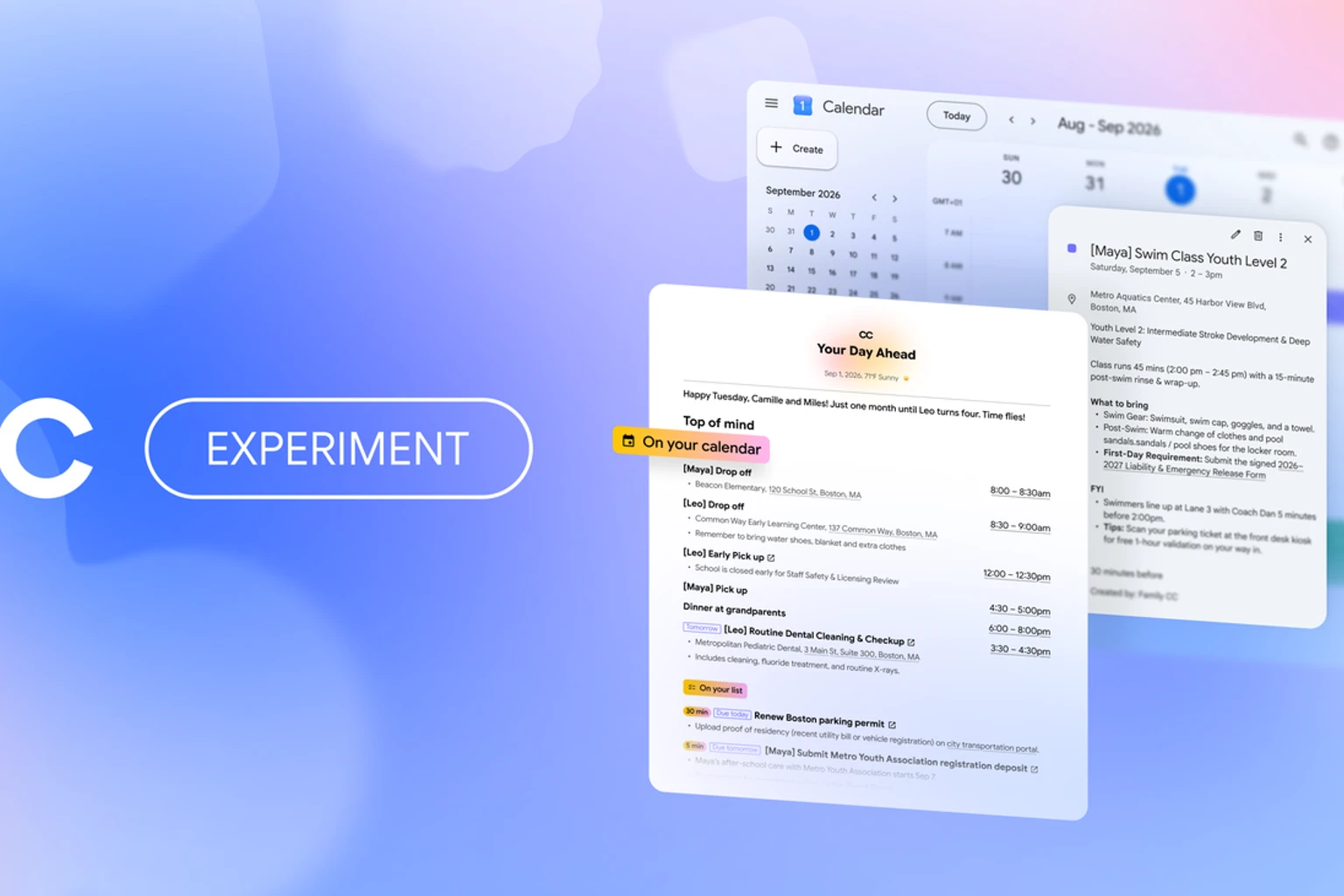
CC now has its own verified Google Account and can support groups of up to six members. Each person decides what information to share with the agent; CC is intended to create a shared daily briefing, maintain household calendars and task lists, and help complete selected administrative work.
What changed
The central product shift is from an individual assistant to a group-facing agent with a distinct identity and permissions model. Google says CC will respond only to people in its group and will not act or share information beyond that group without permission.
Users can grant CC ongoing access to messages from chosen senders—such as a school or travel provider—or forward individual emails, text-message screenshots, files or folders. They can also add CC to a calendar. The agent can then extract relevant information for a shared “Your Day Ahead” briefing and update Calendar and Tasks as plans change.
Google says CC can also assist with tasks such as pre-filling registration or permission-slip PDFs, producing school-supply lists, and creating meal plans. It asks for missing details and retains shared household context, while distinguishing that from individual information such as dietary preferences or time zones.
Why the design matters
Consumer AI products often demonstrate value through a single prompt. Household coordination is a tougher and more consequential test: the useful context is fragmented, continuously changing and owned by different people.
That makes permissions—not just model capability—the core product issue. Google’s approach gives the agent its own account rather than treating it as an invisible feature of one family member’s account. It also combines explicit sharing controls with an “auto cc” option for approved email senders and a weekly review of newly detected senders.
For builders of agent products, the implication is clear. Persistent agents that operate across multiple people need a legible identity, narrow authority and clear ways to inspect or revise what context they receive. A shared memory may improve usefulness over time, but it raises the stakes for data boundaries and error correction.
Google’s distribution advantage
CC is connected to Gmail, Google Chat, Docs, Drive, Calendar and Tasks. Google says each instance runs on an isolated cloud computer using its Antigravity agentic harness and Gemini models. That integration can reduce the setup burden that limits many standalone assistants: relevant information already arrives through the services a household uses.
The same advantage is also the product challenge. Users must be comfortable routing sensitive school, travel, health-adjacent or financial logistics through an agent. The usefulness of CC will depend less on polished summaries than on whether its extraction, calendar updates and document actions are consistently accurate—and readily reversible.
What to watch next
CC remains an early Google Labs experiment. It is available on web and mobile to U.S. users age 18 and older with personal Google accounts; existing users are being invited to upgrade, while new users can join a waitlist.
The key signals will be whether households adopt recurring sharing rules rather than relying on manual forwarding, how effectively Google handles conflicts between members’ preferences, and whether users trust the agent with action-taking workflows such as forms and registrations. If those mechanics hold up, family logistics could become a meaningful proving ground for collaborative AI agents—not because the tasks are novel, but because the coordination burden is real and frequent.