Google is using New York Fashion Week to make a case for a less abstract application of generative AI: purpose-built workflow tools for independent fashion businesses.
Ahead of the event, Google’s Envisioning Studio and Google Labs worked with designers Jane Wade and Sergio Hudson to create two custom tools in Google Flow, the company’s AI creative studio. The projects focused on two expensive, iterative parts of putting on a collection: styling looks before physical samples are made, and planning a runway show before production teams lock in set decisions.
The announcement is promotional, and Google did not publish measured cost or time savings. But the projects illustrate a useful enterprise pattern: AI has more immediate value when it is attached to a specific decision workflow rather than positioned as a general-purpose creative replacement.
From concept work to fewer physical revisions
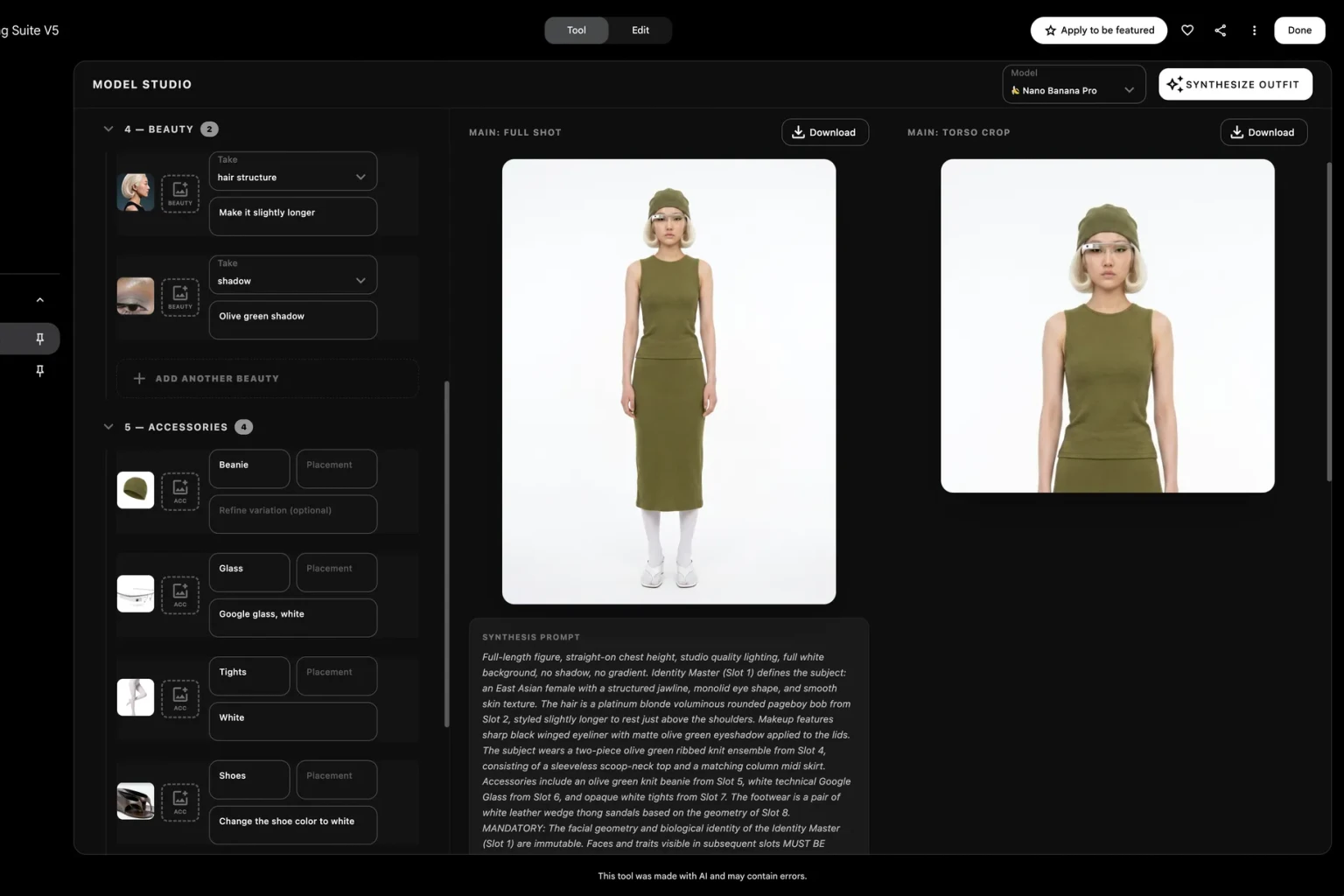
Wade’s tool, called Styling Suite, lets her assemble complete looks on digital models, including garments, shoes, accessories, hair and makeup. Google says in-person casting and fittings can consume up to three full days for a design team.
The operational goal is not simply faster image generation. It is to identify unbalanced looks or missing pieces before additional garments are cut and sewn. In an industry where samples, fittings and last-minute coordination consume both budget and calendar time, moving some of that review upstream could reduce avoidable iteration.
That distinction matters for product and operations teams. The strongest early AI use cases often do not eliminate a core creative task; they improve the quality of decisions made before a costly, less reversible step. Here, the physical sample is that step.
Visualizing the runway within constraints
Hudson’s Runway Visualization tool tackles show production. Google says changes to lighting and props have historically required new 3D renderings and additional coordination with production crews. The custom Flow tool enabled him to simulate the venue, change lighting and props, and map model paths while considering a constrained studio budget.
This is a familiar planning problem beyond fashion. Teams managing retail buildouts, live events, marketing shoots or other physical experiences routinely coordinate vendors around visual decisions that are difficult to preview. A tool that makes alternatives easier to compare could shorten approval loops—provided its outputs are sufficiently reliable for real production decisions.
Why Google’s approach is notable
Google describes Flow as a no-code environment in which users can describe a tool or workflow in natural language. In this case, the important move was co-development: engineers worked alongside users with narrowly defined needs instead of asking them to adapt to a broad, prepackaged assistant.
For companies deploying AI, that is the more transferable lesson. Start with a workflow where the inputs, constraints and decision owner are clear. Build around the systems people already use. Keep the professional—in this case, the designer—in control of final choices.
Fashion is particularly well suited to visual experimentation, but its processes also reveal AI’s limits. A virtual styling or runway plan does not replace fit, material behavior, manufacturing know-how or a production crew’s judgment. Its practical value depends on whether it reduces rework without creating new review, rights or quality-control burdens.
What to watch next
The key question is whether these bespoke demonstrations become repeatable products for small teams, or remain one-off collaborations tied to a high-profile event. Operators should look for evidence that custom Flow tools can connect to the assets and approvals that shape actual work: collection data, budgets, supplier specifications and production schedules.
They should also ask how teams will validate AI-generated visual plans before committing funds. If the tools prove useful, the opportunity is not “AI-designed fashion.” It is a more efficient design-to-production process, with creative direction still held by the people accountable for the result.
*Source: Google Blog, September 18, 2026.*