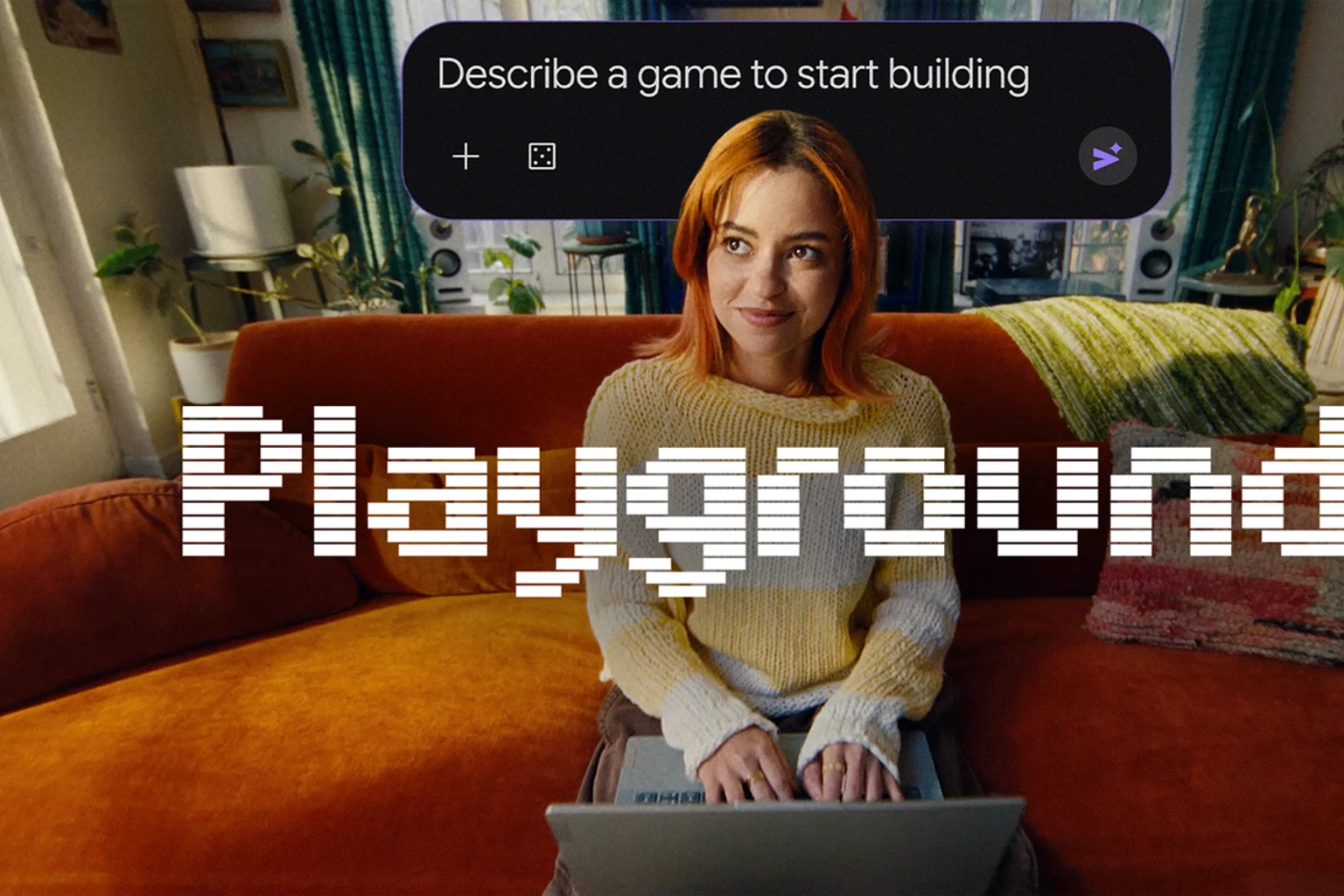
Google has launched Playground, an experimental platform where U.S. users aged 18 and older can create, play and share custom games through a conversational, prompt-driven interface. The company says no coding experience is required.
The product is not simply a game-generation demo. Google is packaging creation with a browser-based distribution layer: creators can test games, keep them private, share links or publish to the Playground Explore gallery. Games can be played on phones or laptops, and selected genres support multiplayer and in-game leaderboards.
What changed
Playground gives users a way to describe a game and iteratively alter elements such as physics, rules, characters and environments. They can begin from a blank canvas, remix starter prompts or use guided support.
Google is also positioning the platform as an entry point rather than a self-contained end state. It says a forthcoming integration with Unity Spark will let dedicated creators extend concepts with professional-level mechanics, high-fidelity 3D capabilities and the Unity runtime. Unity Spark is in testing, with a closed beta planned.
Initial access is limited to the U.S., with creation access rolling out in tiers based on Google One membership.
Why it matters for builders
The practical bet is on shortening the distance between an idea, a playable prototype and audience feedback. For small teams, independent creators and product designers, that could make it easier to test game loops or lightweight interactive concepts before committing engineering and art resources.
More importantly, Google is combining generation and distribution. A tool that produces an experience but offers no route to players has limited network effects. Playground’s gallery, profiles, creator-following, ratings and activity-based discovery are intended to create an ecosystem around the output. That may give Google a way to learn which generated formats people actually return to, share and improve.
The Unity Spark connection also signals an attempt to address a familiar limitation of prompt-first tools: early results may be useful for ideation, but serious creators need a route to deeper control. If the handoff works as described, Playground could serve as a top-of-funnel layer for more advanced game-development workflows rather than a replacement for them.
The operational constraints
A public catalog of user-created games brings moderation and quality-control work alongside technical novelty. Google says every published game will undergo safety screening aligned with its Community Guidelines, and users can report content. That process will matter as much as the generation experience: slow or inconsistent review can constrain the speed promised by prompt-driven creation, while weak review can damage discovery and trust.
Access design is another business variable. Tying tiered creation access to Google One membership may support a broader consumer subscription strategy, but it also means availability is not yet universal. Google has not detailed the tiers, generation limits or how creators will be able to operate commercially on the platform.
What to watch next
The key questions are whether games remain reliably editable after generation, whether discovery surfaces genuinely useful creations rather than short-lived novelty, and how quickly creators can move work into Unity Spark without rebuilding it. The closed beta will be the first clearer test of that bridge.
For operators, the near-term use case is prototyping and audience testing, not replacing established game-production pipelines. Playground’s significance will depend on whether Google can turn an accessible prompt interface into a durable creation-and-distribution loop—with enough control for ambitious creators and enough safeguards for a public community.