A new open-source project, ldraw-nova, offers a useful pattern for teams exploring AI-driven design automation: do not ask a model to directly output a finished 3D object. Ask it to create a plan and generator code, then use rendering and validation tools to iteratively improve the result.
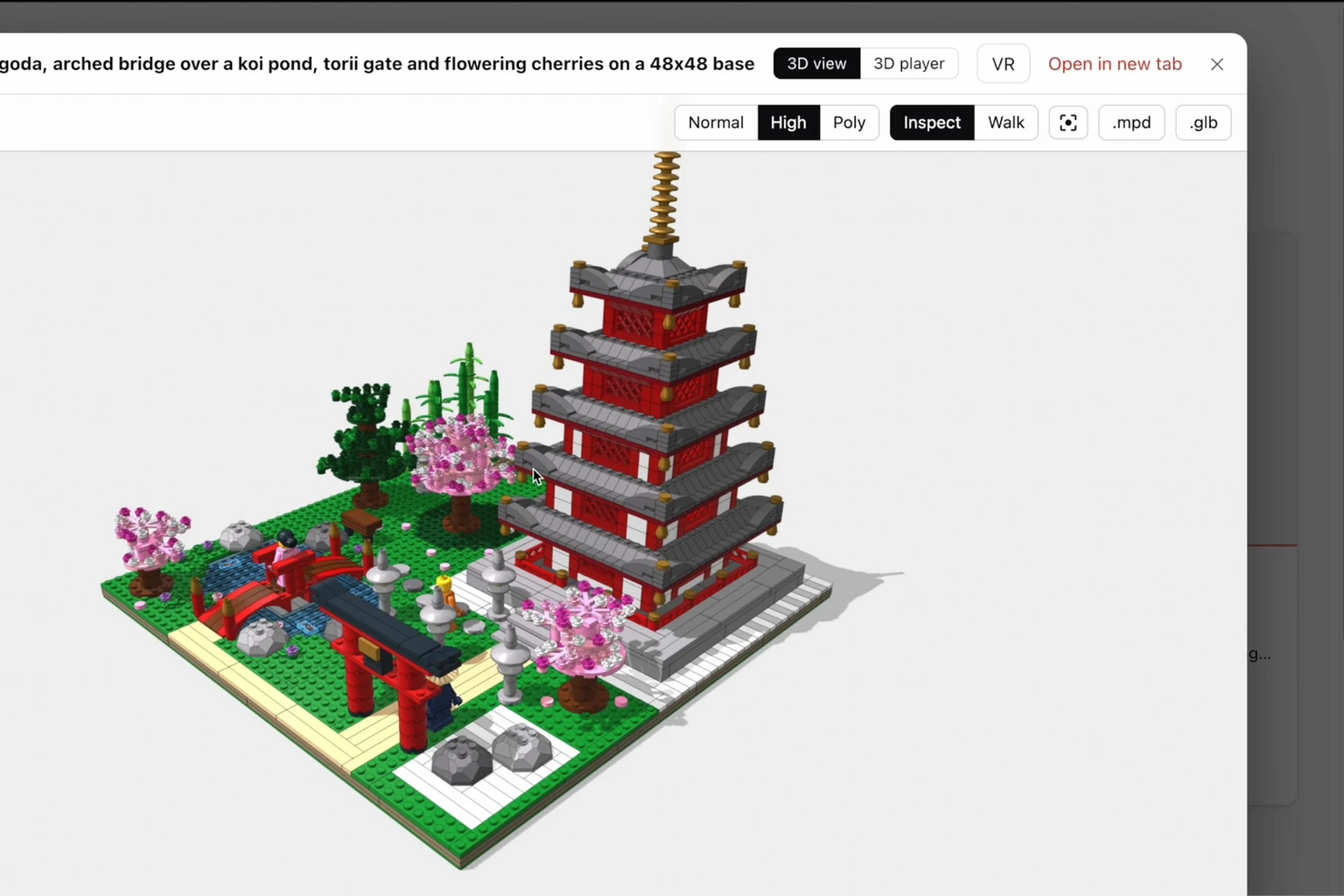
The project accepts a model idea and produces an LDraw model—a longstanding text-based format for specifying construction-brick models—along with source code, rendered views, a Blender-editable glTF file and the agent’s chat history. It can run as a Dockerized web application and includes a 3D viewer, image output and experimental VR interaction.
The important technical choice: generate the generator
The creator’s central finding is that language models struggle with raw geometry: positioning parts, calculating rotations and maintaining spatial consistency. Instead of relying on an agent to write every placement directly, ldraw-nova gives it Python-based primitives and examples.
The workflow is deliberately layered:
1. The agent reads construction and format guidance. 2. It plans components, submodels and aesthetics. 3. It creates a structured plan file. 4. It writes generator scripts that translate the plan into LDraw source. 5. It renders outputs, inspects them and iterates.
That makes this less like a text-to-3D prompt box and more like an agent building a small, specialized compiler pipeline. The intermediate artifacts matter. A plan and generator script are easier to inspect, modify, reuse and test than a single opaque output file.
For engineering leaders, this is a practical example of where agentic systems may be most reliable: not replacing formal systems, but producing work inside a constrained toolchain with explicit representations and feedback loops.
Retrieval and validation are part of the product
ldraw-nova’s agents can search for suitable parts, example models and reusable submodels. A semantic-search-and-reranking component can improve this discovery step when a TypeSafe API key is available; without it, the application falls back to full-text search, which the project says may result in weaker models.
The project also supplies collision and gap detection, headless rendering and documentation for particular model families, including vehicles, structural builds, mechanisms and larger modular models. Those capabilities are more consequential than the novelty of prompt-driven generation. In physical or geometry-heavy workflows, a system needs ways to check its own output rather than simply describe it plausibly.
This is a transferable design principle for enterprise AI projects. A useful agent should have access to domain data, constrained actions and tests that return machine-readable evidence. In software, that may mean compilers and test suites. In design and operations, it may mean simulation, validation rules or visual inspection stages.
Early-stage constraints remain substantial
The project is candid about its limitations. Large, correct models currently require expensive high-end models, generation is slow, and several categories—such as advanced spaceships, minifigures and certain Technic-style designs—need improvement. VR support on Meta Quest 3 also has handling and performance issues.
The application has no login, so its documentation advises running it only on trusted networks. Deployment also requires two repositories, Docker, Git and roughly 5 GB of disk space for the initial image build. That makes this a developer experiment and prototyping environment rather than a turnkey hosted product.
There is also an important distinction between a model that looks convincing in a render and one that is fully correct or buildable. ldraw-nova includes geometry checks, but its own documentation frames the work as a first release and acknowledges that generated output is not uniformly reliable.
What to watch next
The project’s next test is efficiency: whether lower-cost models can use the same plans, tools, examples and validation loop effectively. If that happens, the approach could become relevant beyond hobbyist construction models—for configurable product visualization, education, 3D asset authoring and early mechanical-design exploration.
The broader takeaway is more immediate. When an AI task involves structured output and difficult constraints, the strongest architecture may be one that gives the model a vocabulary, a programmatic workspace and repeated opportunities to verify its work—not one that expects a perfect answer in a single generation.