OpenAI has expanded Codex with reusable cloud development environments that can be accessed across devices, shifting its coding agent beyond isolated remote tasks and toward a more persistent team workspace.
Announced at the company’s Dev Day, the update lets developers run Codex from a computer, remotely from a phone, or in the cloud. The environments are intended to start tasks faster and give teams a shared setup with approved settings and permissions.
That is the material change: Codex could already run work remotely, but OpenAI is now positioning the underlying environment as something that persists, can be configured, and can be reused instead of being rebuilt for each job.
Why persistent environments matter
For engineering organizations, AI coding tools become more useful when the agent has an operating context that is consistent with how teams actually work. A reusable environment could reduce repetitive setup around repositories, permissions and configuration, while making it easier to hand work between people and devices.
The value is operational rather than simply conversational. A developer can initiate work from one place, inspect or direct it from another, and potentially share an approved workspace with colleagues. That model also makes agent work less dependent on an individual laptop being active.
The trade-off is governance. Teams will need clear boundaries around what repositories an environment can access, which permissions are pre-approved, how secrets are handled, and when an agent can act without direct review. Persistent context can reduce friction, but it also makes access controls and auditability more consequential.
Codex is getting a broader workflow
OpenAI paired the environment update with changes across the Codex experience. Its refreshed command-line interface adds voice-based task initiation and direction, plus an `/agents` view for delegating and tracking multiple tasks. The company also cited improvements to prompt editing, session resumption, worktrees and terminal readability.
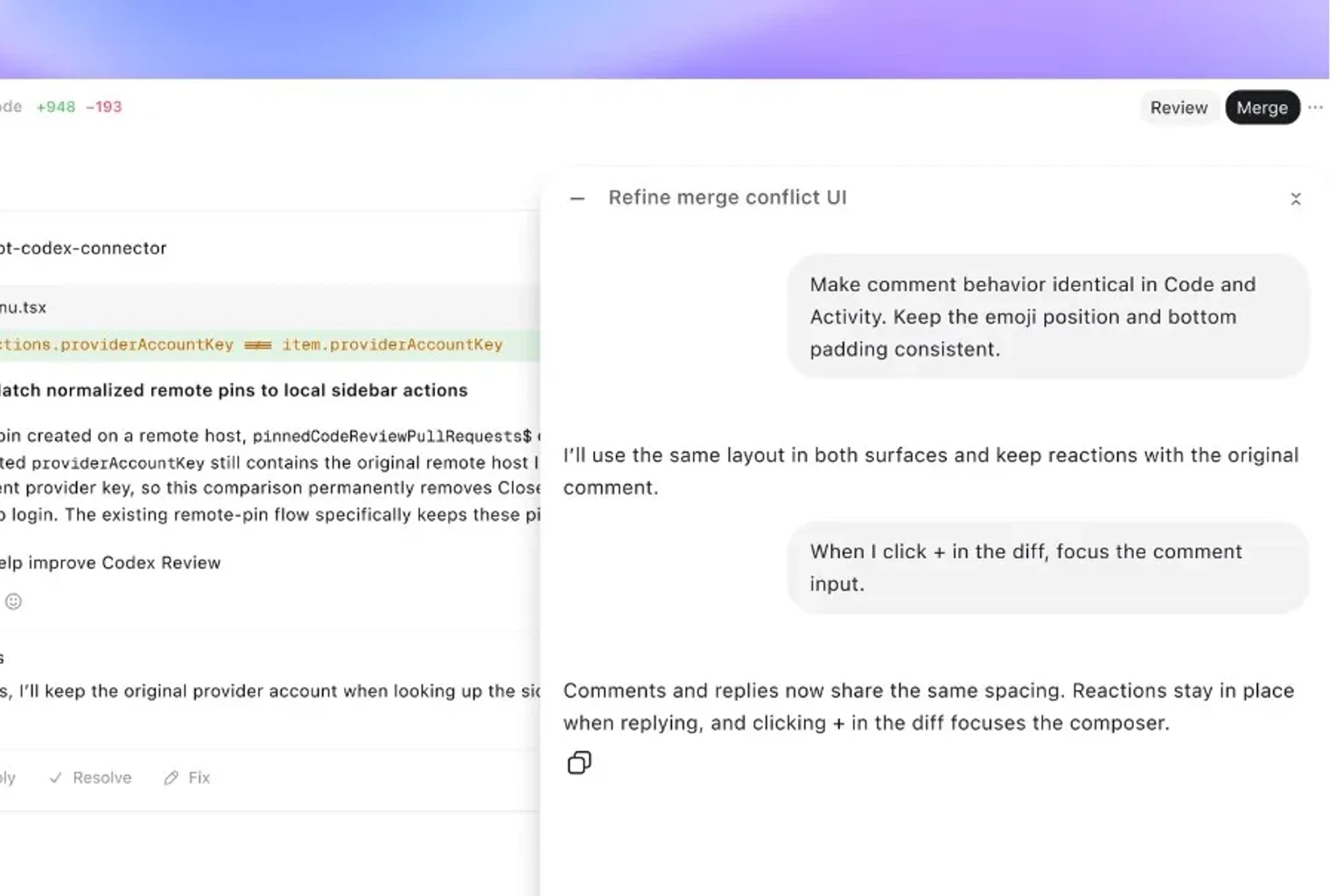
In the ChatGPT desktop app, a new code-review experience lets users view summaries, explore changes and ask Codex about potential issues before sharing feedback on GitHub pull requests or GitLab merge requests. Automatic reviews can conduct an initial pass while a user is away.
Together, these additions suggest OpenAI is targeting more of the software-development loop: assigning work, managing parallel activity, reviewing proposed changes and resuming long-running sessions. The immediate question for engineering leaders is not whether an agent can generate code, but whether its outputs fit existing review, ownership and deployment practices.
Security becomes an asynchronous use case
OpenAI also introduced Codex Security Cloud, a set of tools for scanning entire GitHub repositories on demand, on a schedule or when new commits arrive. Codex is designed to investigate findings, remove duplicates and prepare fixes in the cloud even when a user is inactive and their laptop is closed.
The tools include access to models from OpenAI’s Daybreak Blue cybersecurity initiative without a separate application, according to the company.
This extends the same persistent-workspace idea to security operations: scanning and triage can run continuously, while human teams decide what to validate, prioritize and merge. Organizations should still treat prepared fixes as proposals requiring their normal security and change-management controls.
What to watch next
OpenAI also announced API updates, including a Decisions API for real-time decisions with user-defined questions and predefined answers, and an Agents API update supporting computer use. It said developers can use Amazon Bedrock Managed Agents to build OpenAI agents that run entirely on AWS.
The important test will be whether the new environments deliver reliable setup, useful controls and smooth collaboration in real repositories. For operators, pilot programs should measure task startup time, review quality, security findings and the administrative overhead created by permissions and environment management—not just code-generation speed.