
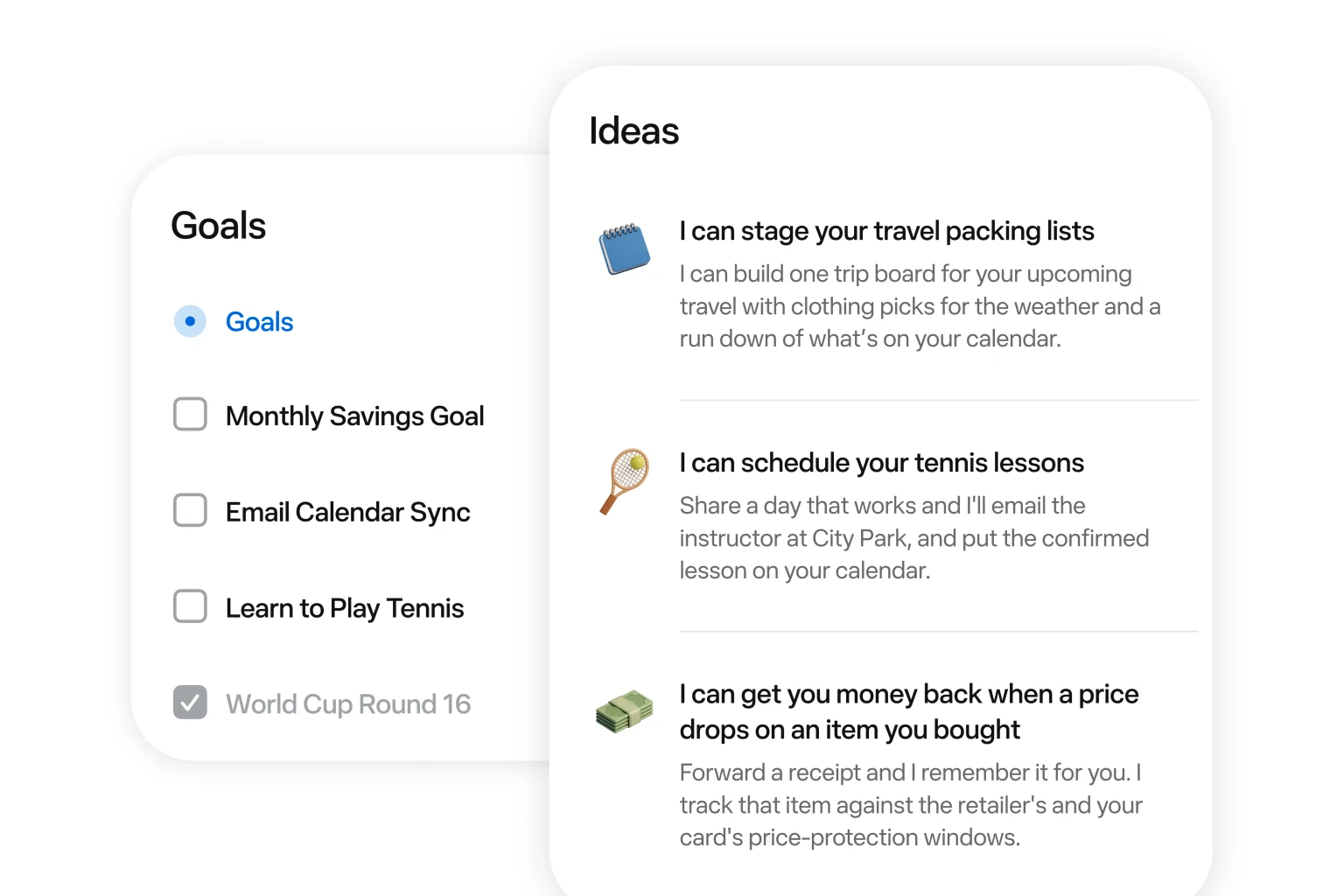
Meta has introduced Muse, a personal AI agent for U.S. consumers that is designed to act on a user’s behalf—not merely answer questions.
The product’s premise is familiar to anyone following the shift from chatbots to agents: connect the assistant to the tools that hold the details of daily life, then let it complete work. Meta says Muse can send emails, book travel, fill out forms, build plans, convert recipe videos into grocery lists, issue invitations, help lower bills and make purchases.
That makes Muse an important product launch for Meta, but its central business challenge may be credibility rather than model capability.
What changed
Muse is launching on the web, iOS, Android and in WhatsApp chats, with Meta saying it will come to its AI glasses later. It is powered by Meta’s Muse Spark model and supports connections to services including email, calendars, payments, health and fitness, smart-home, shopping, dining, music and events apps.
Users choose connections individually. If a desired service has a public API, Meta says Muse can establish a connection with credentials supplied by the user; otherwise, it can use a browser to access the service.
The product is free up to a usage limit, with a $20-per-month Power plan and a $100-per-month Maximum plan for additional task execution. A payment card is required to begin, even for the free tier. Purchases use Link by Stripe for checkout, and Meta says Shopify Shop Pay and 1Password integrations are planned.
Why this is a higher-stakes agent
A chatbot can be useful without knowing much about its user. An agent that books, buys, schedules and submits forms depends on access to identity, preferences, financial information and communications. The value proposition and the privacy risk grow together.
Meta says Muse operates in a dedicated secure virtual machine with its own browser. It also says a separate Sentinel agent works on that machine but is system-level isolated from Muse. Crucially, Meta says Muse cannot see user passwords or payment methods and that conversations and data are not shared with Meta’s advertising systems.
Those are meaningful design claims, but they need independent security scrutiny. Operators building agent products should take note: privacy assurances are no longer just policy language. They need to be expressed in product controls, technical architecture, permission boundaries and clear auditability.
Muse’s individual opt-in connections and its approval-oriented workflow are likely intended to make high-consequence actions more understandable. That is a better starting point than opaque, blanket access. But the real test is whether users can easily understand what an agent can see, what it is allowed to do, and how to revoke that access.
Meta’s trust deficit
The launch comes less than two weeks after Meta agreed to an $18 billion multistate settlement tied to alleged social-media harms to children, according to TechCrunch. The company also carries a long record of privacy controversies and regulatory action, including the FTC’s 2019 $5 billion settlement with Facebook over privacy-related violations.
That history changes the adoption equation. Consumers may weigh a convenient travel booking or automated grocery list against giving Meta visibility into inboxes, calendars and transactions. For a company whose core business is advertising, a promise that agent data will remain separate from ad systems will receive particularly close attention.
The company also says Muse will learn from conversations over time and proactively suggest actions. That could make the agent more valuable, but it increases the importance of granular controls over retained context, data use and recommendations.
What to watch next
Muse’s early success will hinge on mundane reliability: correct bookings, clear handoffs, sensible approvals, recoverable mistakes and support when transactions go wrong. Its commercial model also bears watching. The gap between a free tier and a $100 monthly plan suggests Meta is testing how much consumers will pay for delegated digital work.
More broadly, Muse is a useful market signal. Consumer AI is moving from assistance to authority. The winners will not simply be the agents that can take the most actions; they will be the ones that can demonstrate—repeatedly—that users remain in control.