Meta’s new AI app, Muse, is off to a faster mobile start than ChatGPT’s app did in its first days, according to estimates from app intelligence firm Appfigures. The comparison comes with important caveats, but it highlights a durable competitive advantage for large consumer platforms: they can turn existing social graphs and app ecosystems into AI distribution channels.
The early numbers
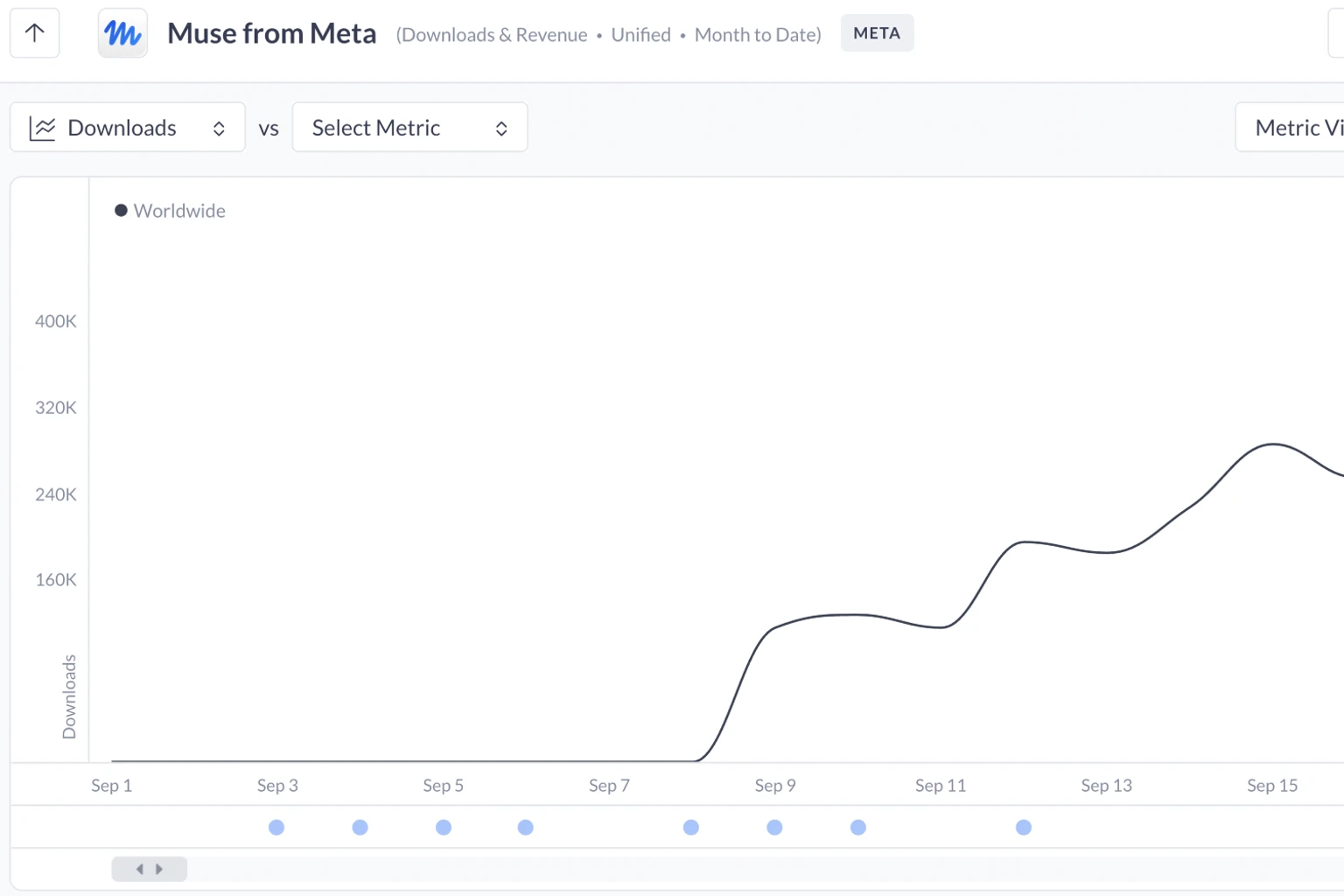
Appfigures estimates that Muse reached 1.8 million iOS downloads in the U.S. and Canada during its first 12 days. That compares with 1.3 million for ChatGPT across the same markets and the equivalent period after its mobile debut.
Muse has also generated an estimated 2.8 million global installs over its first 12 days. On daily activity, Appfigures puts Muse at 642,000 U.S. daily active users, versus 231,000 for ChatGPT at the comparable stage. On iOS alone, Muse reportedly reached 359,000 U.S. daily users—still ahead of ChatGPT’s early figure.
Muse has risen from No. 2 to No. 1 overall in the U.S. App Store, according to reporting cited by TechCrunch.
These are third-party estimates, not figures disclosed by Meta, and should be treated as directional. More importantly, the launches were structurally different. ChatGPT’s mobile app initially launched globally on iOS; Muse is available on iOS and Android but only in the U.S. and Canada. Appfigures narrowed part of its analysis to U.S. and Canadian iOS data to create a closer comparison, but it cannot fully isolate the effects of platform, timing, market conditions or marketing.
Meta’s real advantage: an installed audience
The result is less a definitive verdict on which AI product users will prefer over time than evidence of what Meta can do with distribution.
Muse can connect with Facebook and Instagram and works within WhatsApp. Appfigures says more than 95% of Muse users are also Facebook users, while 63% use Instagram. That overlap gives Meta a ready-made acquisition funnel, a pool of identity and social-context signals, and multiple places to surface the product.
Meta has used that playbook before. Threads benefited from integrations and promotion across Meta’s larger apps and has since exceeded 500 million users, according to TechCrunch’s earlier reporting. An AI app that is embedded in, or easily linked to, the company’s existing communication and social products could receive a similarly sustained push.
For AI startups, this is a reminder that model quality alone is not a go-to-market strategy. Consumer AI increasingly competes through default placement, workflow integration, account systems, notification channels and trust built through existing products. An independent app can still win, but its retention and differentiated utility must overcome the customer-acquisition advantage of platform owners.
Downloads are not the outcome
The key question is whether Muse’s initial reach becomes durable behavior. High install counts can reflect promotion, curiosity and low-friction account onboarding. They do not establish that users will repeatedly rely on an assistant, share it with others, or pay for premium capabilities.
Operators watching the category should look for signs beyond app-store rank: retention after several weeks, frequency of use, conversion to paid offerings if Meta introduces them, and whether the service drives more engagement in Facebook, Instagram or WhatsApp. Another test is whether users give Muse tasks that require recurring personal context rather than one-off prompts.
Meta has not released its own adoption figures or detailed its promotional activity. That leaves the current picture incomplete—but the early estimates show how quickly the AI market can shift when an incumbent brings an assistant to a large, connected consumer base.
What to watch next
- **Retention versus acquisition:** Does Muse keep its early users once launch promotion fades?
- **Cross-app integration:** How deeply will Meta place Muse inside WhatsApp, Instagram and Facebook workflows?
- **Monetization:** Whether Meta positions the app primarily as an engagement layer, an advertising signal source, or a paid AI product.
- **Competitive response:** OpenAI, Google and other AI providers will need to keep improving distribution partnerships as platform-native assistants gain ground.
Muse’s opening is notable, but it is not yet proof of a lasting lead. It is, however, a clear demonstration that in consumer AI, owning the route to the user can be as consequential as owning the model.