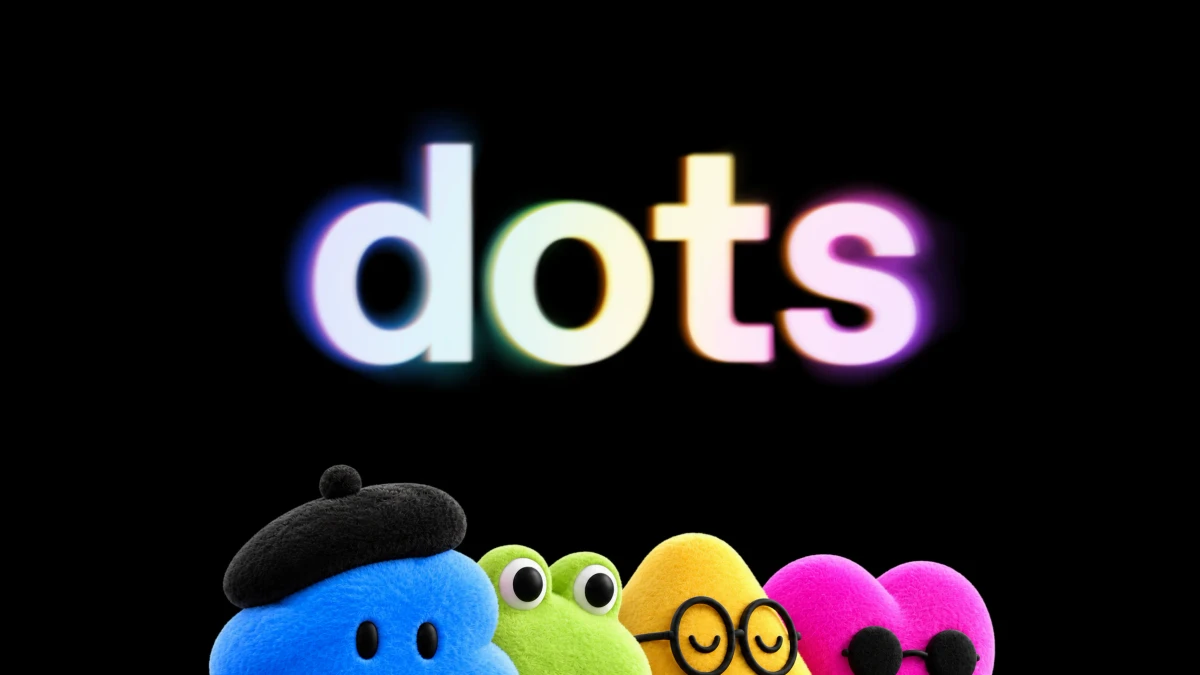

OpenAI’s newly announced Dots platform arrives with friendly avatars and consumer-facing demonstrations, including ordering food. But an early hands-on test suggests its more consequential role may be as workplace software: an agent that can operate applications, work across a user’s computer, and turn loosely specified tasks into usable output.
That distinction matters. The near-term value of agents is unlikely to come from reliably navigating every consumer website. It is more likely to come from handling bounded, reviewable workflows in environments a company or user controls.
What changed
Dots gives ChatGPT users an agent with a cloud-based virtual machine, access to applications such as Blender and GIMP, and—through the desktop ChatGPT app—the ability to work on a user’s own computer. Users can interact with it through chat or voice, then watch it perform actions in a separate window.
OpenAI is initially offering Dots to its highest-tier subscribers, including its $100-per-month Pro plan. The pricing and gated rollout position it closer to premium productivity software than a mass-market shopping assistant.
The product currently supports one agent per user, though OpenAI says multiple Dots are planned.
The practical boundary: controlled workflows versus the open web
The Verge’s testing illustrates the divide. Dots could begin tasks such as scheduling an internet installation, but it stalled on a site’s “human check.” It also ran into security checks when attempting to access an Ikea account and a restaurant ordering site. In one case, it needed the user to take over the browser; in another, it required account credentials and payment details that the tester was not willing to enter.
Those are not edge cases for consumer agents. Anti-bot systems, authentication flows, payment steps and poorly structured websites are standard parts of online commerce. OpenAI itself provides guidance for cases where websites block its cloud-browser traffic.
For operators evaluating agents, this is an important implementation constraint: a browser agent should not be measured only by whether it can find information or click through a demo. It should be evaluated on exception rates, handoff design, permissions, security controls and the cost of human intervention.
Where Dots performed better
Dots was more effective when working in systems the tester controlled. Given access to a personal website, it produced a redesigned prototype after a voice conversation about desired changes. With desktop access, it assembled video clips into a social-media-ready format and deployed website changes by operating the site’s backend.
The outputs were not described as perfect, but they were usable and completed quickly. That is a more credible agent pattern: provide substantial context, assign a discrete outcome, retain a review step, and let the system perform the repetitive software work.
For a small business, that could mean preparing a batch of marketing assets, implementing straightforward CMS updates, organizing media, or converting a verbal brief into a first draft of a deliverable. The benefit is not necessarily replacing expert work; it is completing the backlog of tasks that would otherwise be delayed or done poorly.
The operating model to watch
Dots is best understood as a general-purpose computer-use agent rather than an autonomous employee. Its usefulness depends on the workflow’s boundaries and on how much access an organization is prepared to grant.
That makes governance central. The test required what the reviewer characterized as a large number of permissions. Teams considering similar tools should start with low-risk workflows, separate testing from production environments, limit access by role, require approval before consequential actions, and maintain clear audit trails.
The key question is not whether an agent can order dinner. It is whether it can reliably complete a defined unit of business work, escalate when it cannot, and leave the operator with a result that is easier to verify than to create from scratch.
What to watch next
OpenAI’s next challenge is less about adding charming agent personalities than improving reliability across authentication, security checks and account-sensitive actions. It will also need to show whether its premium pricing is justified by repeatable gains for professionals and teams.
For now, Dots points toward a practical agent future: software that works alongside people inside familiar tools, with humans still handling the exceptions and the final judgment.