Stoke Space has completed an initial closing of a $1 billion Series E, bringing its total funding to $2.3 billion as it pursues one of commercial spaceflight’s hardest technical goals: a rocket whose first and second stages can both return for reuse.
The round, led by Point72 Ventures and Spark Capital, is intended to fund the next phase of the company’s development: launch infrastructure, higher-rate manufacturing and flight operations, plus work on a larger second-generation rocket. For customers waiting on launch capacity, the financing matters less as a headline than as runway for a capital-intensive effort that must still demonstrate orbital flight and recovery.
A direct bet on full reusability
Stoke’s Nova Pathfinder is designed to carry three metric tons to low-Earth orbit. Chief executive Andy Lapsa told TechCrunch that the company expects a first flight in early 2027, following structural and operational testing of its first stage at Moses Lake, Washington. The next major technical step is ground-firing both stages with the launch system.
The company’s distinction is its ambition to recover the upper stage as well as the booster. SpaceX’s Falcon 9 established reuse of a first-stage booster, but routine recovery and reuse of a payload-carrying second stage remains unproven. SpaceX is attempting it with Starship; Stoke is making it central to its initial product strategy.
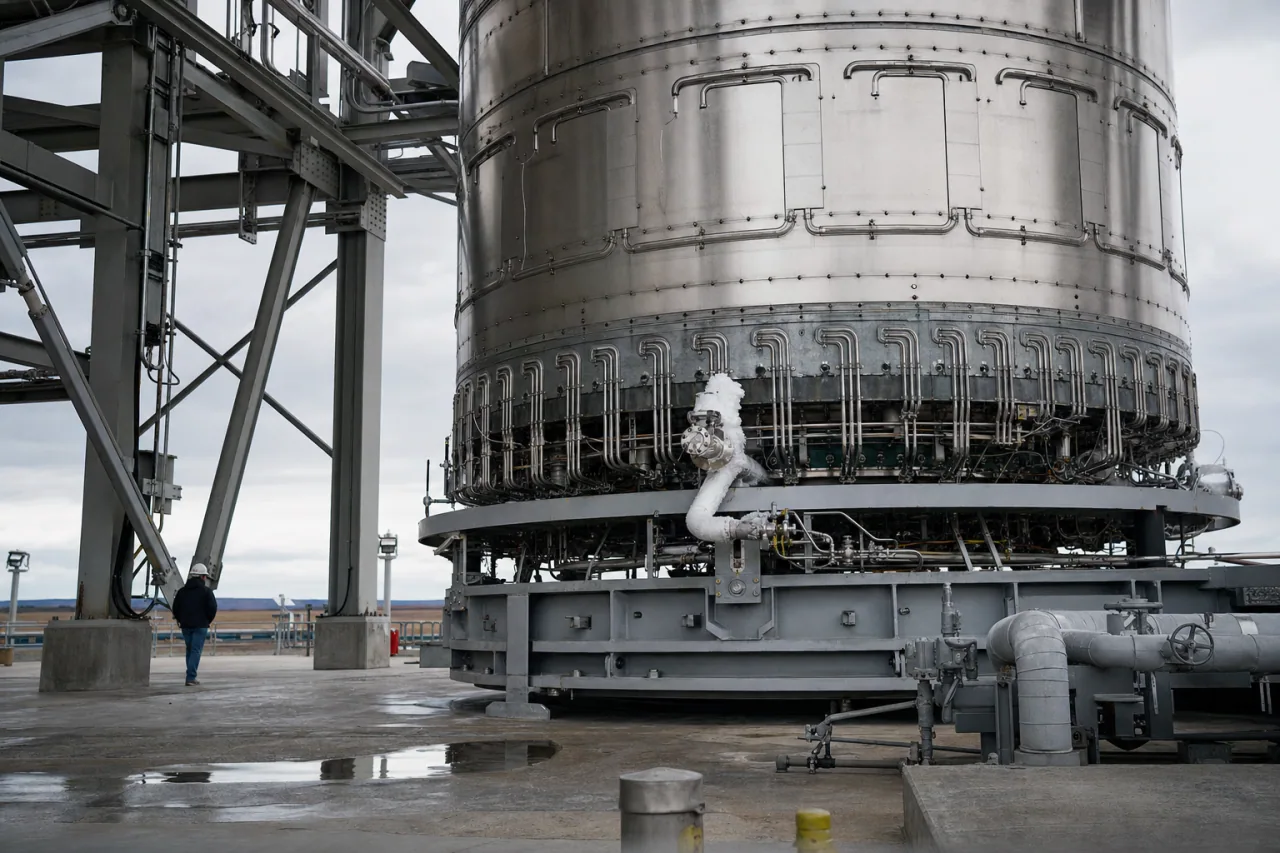
One particularly consequential design choice is Stoke’s reentry protection. Rather than relying only on passive thermal-shield materials, the company plans to circulate super-cooled liquid hydrogen through the second stage’s heat shield. Lapsa said the active-cooling approach has been extensively ground tested and that early flights can use excess coolant to provide additional margin.
That creates an opportunity and a risk. If it works in flight, active cooling could be a differentiator in the difficult economics of upper-stage reuse. If it adds operational complexity, reliability challenges or turnaround costs, the value proposition of full reusability becomes harder to realize.
The bigger vehicle is the commercial prize
Alongside the financing, Stoke disclosed Nova Block 2, a larger vehicle targeted for deployment in 2029. It is intended to use the same underlying engines and heat-shield technology as Pathfinder while carrying 15 metric tons to low-Earth orbit—slightly more than Falcon 9’s stated capacity.
That capacity positions Block 2 for the satellite-constellation market, where launch supply, schedule certainty and price can matter as much as raw payload performance. Stoke says it has already sold launch contracts for Pathfinder, though the company has not disclosed customers or terms.
The 2029 timing is notable because Elon Musk has said Falcon 9 could be phased out around then. Whether that happens is uncertain. But the strategic point holds: third-party launch buyers want alternatives as satellite demand grows and as SpaceX balances external customers against its own internal projects.
What operators should watch
For prospective launch customers, the near-term question is not whether Stoke can eventually challenge SpaceX’s scale. It is whether Pathfinder can reach orbit, validate its recovery architecture and establish a credible flight cadence. Rocket development schedules routinely slip, and an inaugural orbital attempt would itself be a significant milestone.
For investors and suppliers, the $1 billion round signals that differentiated launch systems require patient financing beyond a demonstration vehicle. Stoke now has resources to build production and operations in parallel with flight testing—but funding does not remove the technical risk.
The company’s investment thesis will ultimately be tested on a straightforward operational metric: whether its two-stage reuse design can deliver reliable launches and fast, economical turnaround. Until then, the new capital buys Stoke time and capacity—not proof.