
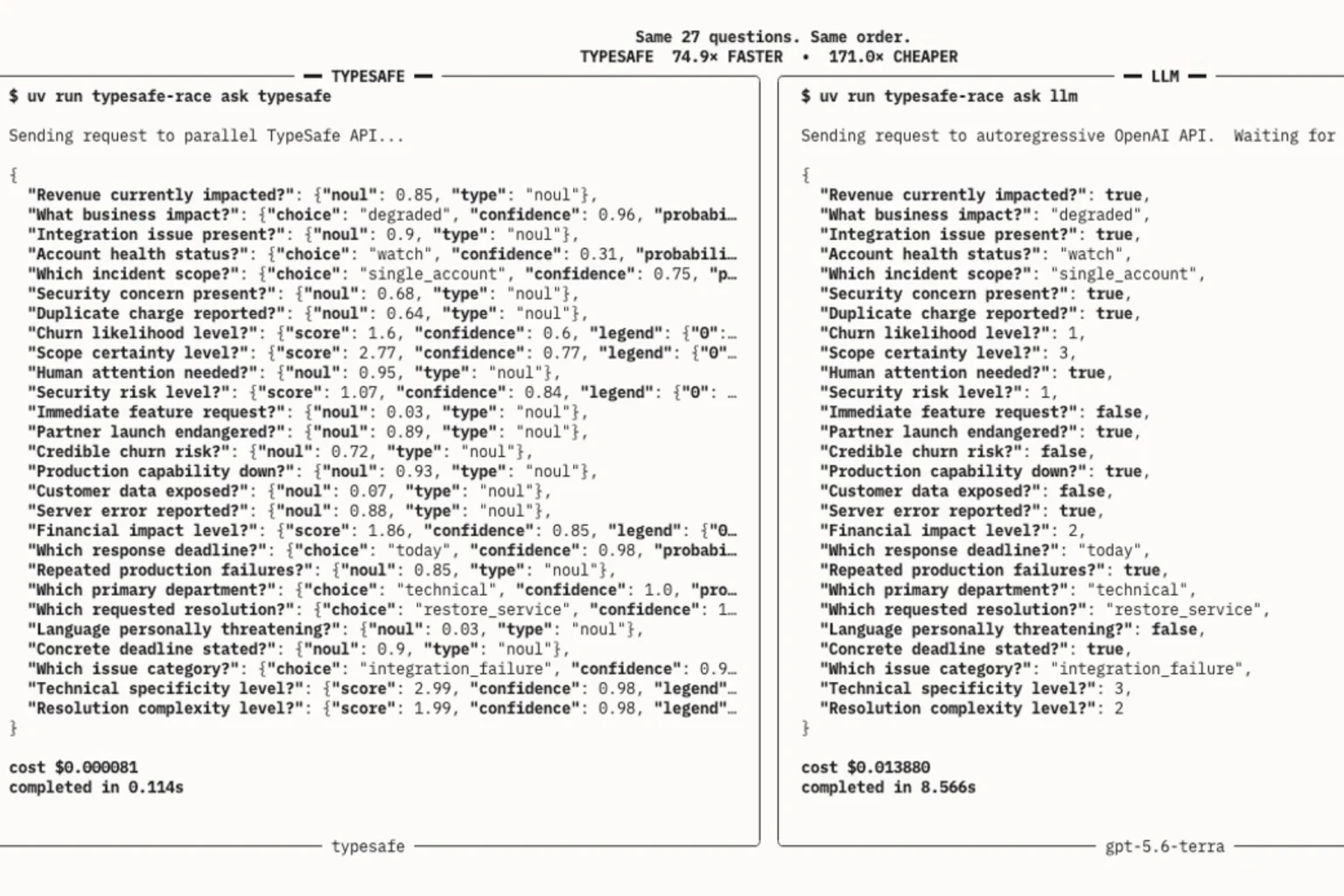
TypeSafe AI has released Jev, a transformer-based model designed to return probabilities rather than natural-language responses. The distinction is consequential for teams trying to put AI inside production workflows: instead of asking a model to explain itself or generate an answer, developers define a set of possible outcomes and receive a calibrated confidence score.
The startup was founded two years ago by former OpenAI researcher Diogo Almeida, who worked on ChatGPT and reinforcement learning from human feedback (RLHF). Its premise is that language models are strong at language but are not necessarily the most economical or controllable tool for routine software decisions.
What changed
Jev is what TypeSafe calls a “System One” model: built for fast, narrow judgments rather than extended reasoning. It does not emit text, according to the company. It produces probabilities across predefined outputs.
That bounded-output design addresses a practical failure mode of generative AI. If an application needs to decide whether a command is safe, whether an email belongs in a workflow, or whether an agent action needs review, an open-ended text response can be difficult to operationalize. A probability tied to an explicitly defined action can be connected directly to policy thresholds.
TypeSafe says the model is fast and inexpensive, with input usage metered by the billion rather than the million and no charge for output tokens. It says Jev is trained exclusively on synthetic data through a technique it calls “reinforcement learning from calibrated decisions.” The company has not disclosed detailed architecture information; outside observers cited by TechCrunch suspect it may build on an open-weight language model.
Why operators should care
The primary opportunity is not a replacement for general-purpose LLMs in every task. It is a potential control layer for frequent, constrained decisions where latency, unit economics and predictable integrations matter more than fluent prose.
Early developer reports point to several such workloads:
- **Safety classification.** Vercel software engineer Pranit Sharma said the company used Jev in place of an OpenAI model to review commands for safety, reporting results five to 18 times faster and with better accuracy. That is a user report, not an independent benchmark, but it illustrates the intended use case.
- **Workflow triage.** Bryo AI CTO Nikhil Mudholkar tested Jev on business-email classification against Gemini. He reported slightly lower accuracy for Jev but costs 10 to 20 times lower, and highlighted its confidence scores as useful for automation.
- **Agent oversight.** A cheap classifier could review agent traces, identify possible jailbreaks, or send ambiguous cases to a human or a more capable model. Such monitoring becomes harder to justify when every check itself requires a costly LLM call.
- **Model routing.** Teams could use a low-latency probability model to decide whether a request needs an expensive reasoning model, a smaller model, or no model call at all.
The operational value is in the handoff rule. For example, a team might automatically approve an action above a chosen confidence threshold, request review in a middle band, and reject it below another. That makes uncertainty visible rather than hiding it behind a polished answer.
The important caveat
“Cannot hallucinate” should not be mistaken for “cannot be wrong.” Jev’s predefined output space prevents it from fabricating an unstructured response, but the decision can still be poorly calibrated, based on insufficient context, or wrong for a changed environment. The developer, not the model, still has to choose labels, thresholds, escalation paths and ongoing evaluation.
That means adoption should start with measurable classification or routing tasks, retained audit logs, and comparison against existing rules or models. Confidence scores are useful only if they remain well calibrated on real production data.
What to watch next
Jev’s initial demand reportedly briefly exceeded TypeSafe’s API-serving capacity, suggesting developers see a gap between general LLMs and deterministic rules engines. The more meaningful test will be whether published evaluations and customer deployments show stable accuracy, calibration and cost advantages across domains.
Also watch for imitation. If the category proves durable, major model providers and infrastructure vendors may package similar probability-first models for safety gates, routing and workflow automation. For builders, the near-term lesson is simpler: reserve generative models for tasks that require generation, and consider bounded decision models where the job is to make a fast, auditable call.