
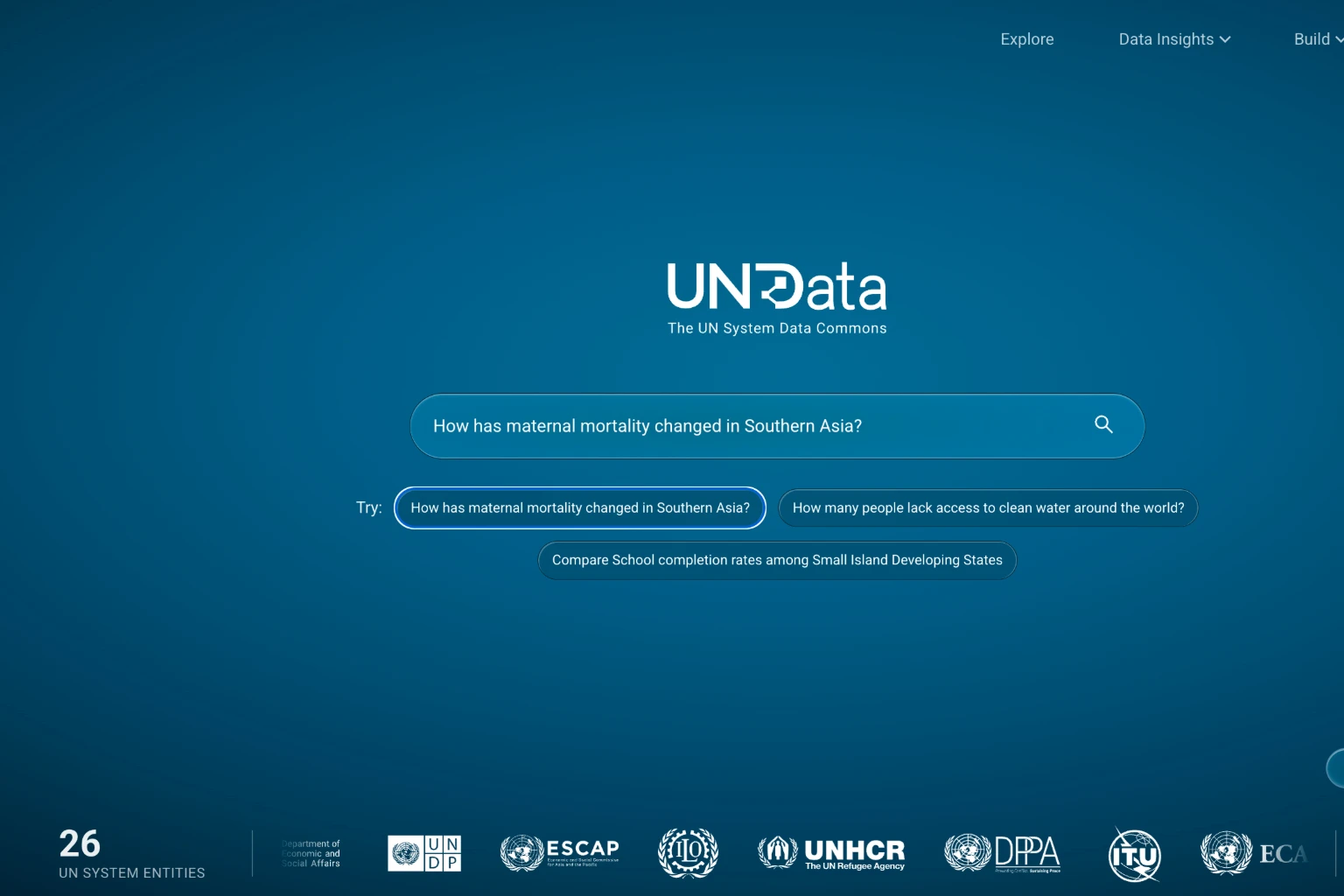
The United Nations is moving its global statistics infrastructure toward an AI-native model. Its new UN System Data Commons, built on Google’s open-source Data Commons platform, is designed to let people—and AI systems—find and use statistics spanning multiple UN agencies through natural-language queries.
The shift replaces the legacy UNData portal’s primarily database-style browsing experience. More consequentially, it adds support for the Model Context Protocol (MCP), a standard that enables AI applications to connect to external data sources. That makes the project a useful example for organizations trying to turn fragmented, authoritative information into a governed resource for AI tools.
What changed
The UN says 26 entities have committed to participate, with data from nearly 20 available at launch. Its goal is to bring 80% of the UN system’s statistical datasets onto the platform by 2027.
Google.org supplied $2 million in capacity-building funding and technical support. But Google says the service runs as a UN-governed instance and is intended to be independently operated and scaled by the UN over time.
At its core, Data Commons maps disparate datasets into a common framework. In the UN implementation, a user can ask for a statistic in ordinary language rather than locate a dataset, learn its schema and manually reconcile figures from several agencies. The platform also records the origin of a statistic, enabling a retrieved answer to be traced back to its UN source.
That provenance layer is critical. AI assistants can make data easier to access, but their generated outputs are not automatically reliable analysis.
Why the UN is making the change now
UNICEF’s internal testing points to the gap between an AI model sounding informed and producing dependable development statistics. In a benchmark covering more than 133,000 responses across six large language models, the average accuracy score was 21.2%, according to João Pedro Azevedo, UNICEF’s chief statistician.
About three in five answers did not provide a usable number, he said. When models gave numbers in repeated prompts roughly two days apart, the same number appeared only about half the time. The UNICEF work is being prepared for journal submission and has not yet been peer-reviewed; the agency says it will release its methodology, code and data with the paper.
At the same time, the route users take to authoritative sources is changing. UNICEF reports that referrals from ChatGPT answers to its data site rose 67% year over year between January 1 and September 14. AI-assistant traffic is now estimated to account for roughly one in 10 visits to a site that receives more than 6 million monthly visits.
For data publishers, this creates a clear operational imperative: make structured, source-linked data accessible where AI-enabled research happens, rather than relying on users to navigate a traditional portal.
The opportunity—and the remaining control problem
Google demonstrated an MCP-connected AI system that could retrieve several UN indicators, then produce charts, dashboards and written analysis. That could reduce the manual effort required for recurring research tasks, policy briefs and executive reporting.
But connecting a model to authoritative figures solves only one part of the problem. A model can still choose an inappropriate comparison, miss a methodological caveat, confuse correlation with causation or overstate a conclusion. Google’s Data Commons lead, Prem Ramaswami, cautioned that humans should review outputs before they are cited or published.
For enterprises, the lesson is not simply to expose a database to an agent. The useful pattern is standardized data, source-level citations, constrained retrieval and human review for consequential conclusions.
What to watch next
The major measure of success will be coverage and consistency as more UN agencies onboard. It will also be worth watching whether the platform’s provenance survives downstream use: can users see not just a number, but its source, definition, time period and caveats inside the tools where they work?
The UN’s rollout suggests that AI readiness is becoming a data-governance project as much as a model-integration project. Organizations that treat it that way may get more dependable AI-assisted analysis—and fewer confident but unusable answers.