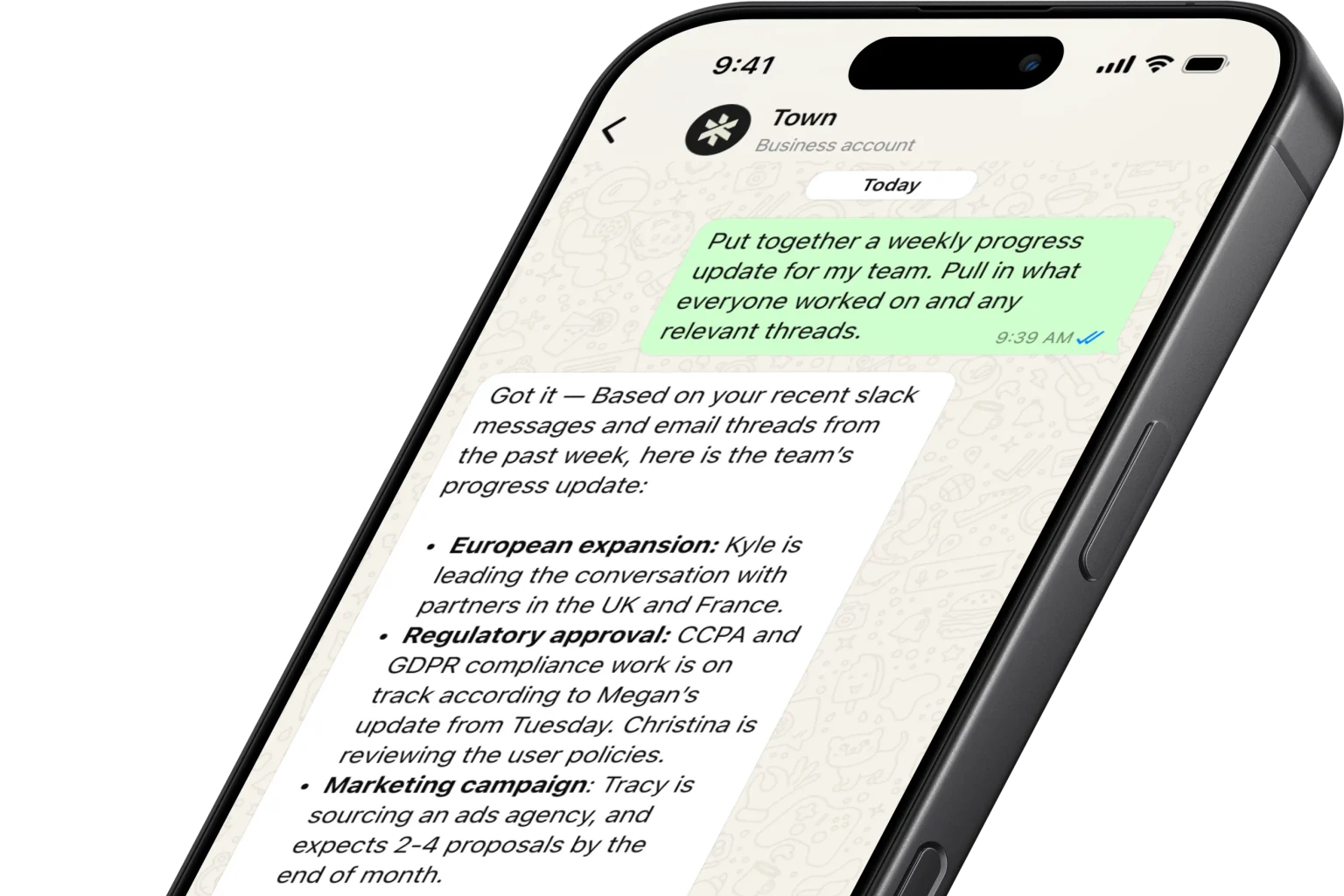
Rather than asking people to adopt another AI app, a new class of assistants is meeting them in the inboxes and chat threads they already use. The pitch is straightforward: send a text, forward an email, or reply to a daily summary; the agent remembers context, connects to services such as calendars and email, and takes the next step.
That is a meaningful product shift from conversational AI that answers questions to software that is expected to manage commitments, communicate externally and complete transactions. The crowded field now includes broad personal assistants such as Caddy, Folk, Instinct, Iris, Martin, Poke and Rene, alongside specialist products for families and travel.
The interface is familiar; the permissions are not
The attraction of text messaging is low friction. Caddy, for example, operates through iMessage on iPhone and RCS on Android, identifying potential actions from connected calendars and conversations. Folk can be reached through iMessage, WhatsApp and Telegram, while Martin spans SMS, phone, WhatsApp, email and Slack. Poke launched as a text-based general-purpose assistant and was approved by Apple as the first AI agent on the Messages for Business platform, according to TechCrunch.
For users, messaging makes delegation feel natural: “remind me next week,” “put this on the calendar,” or “book that restaurant.” For builders, it can lower acquisition and onboarding friction because the interaction happens in an established channel.
But the product complexity sits behind the simple message. An agent that can read email, update calendars, purchase items, make calls or send messages needs reliable identity, permissions, auditability and recovery paths when something goes wrong. Context retention can improve usefulness, but it also expands the amount of personal and operational data a provider holds.
Vertical agents are turning coordination into a product
The strongest near-term use cases may be domains defined by recurring coordination work rather than open-ended autonomy.
Family-focused services including Fambot, Ohai, Ollie and Orbits aggregate school communications, calendars, chores, meals, lists and household service requests. Fambot sends a nightly view of the following day and lets parents reply by SMS to ask questions or adjust calendars. Ollie has emphasized privacy and says it has achieved SOC 2 compliance. Miso applies the format to travel, combining text-based planning with a dedicated travel team and incorporating preferences and loyalty points.
These products are not merely competing on a model’s ability to converse. They are competing on integrations, workflow coverage, proactive reminders and the confidence that the assistant will not create new coordination failures. That gives vertical entrants a clearer wedge, but it also means they must earn access to sensitive information shared across multiple people.
Capital is arriving before the category is settled
Instinct has become the conspicuous funding signal: the company raised $1 billion in September at a reported $10 billion valuation after a prior $350 million round, according to TechCrunch. Its private-beta assistant can connect to email, calendar and Google Workspace, and the company has introduced dedicated email addresses for agents to manage accounts and communicate with businesses. It has also begun rolling out calling support.
Those capabilities point to the category’s central tension. A dedicated agent email and the ability to place calls can remove real administrative work. They also make an assistant more autonomous in ways that amplify privacy, security and authorization concerns.
What operators should watch
For companies evaluating these tools, the important question is not whether an agent can produce a plausible reply. It is whether it can execute a bounded workflow with clear controls.
Look for four things: granular permissioning for connected accounts; logs that show what the agent saw and did; approval gates for irreversible or high-cost actions; and a clean way to revoke access or correct mistakes. Teams should also test how the agent handles ambiguous instructions, changes in context and external failures such as an unavailable reservation.
Messaging-first agents may become a practical interface for personal and household operations. Their durable advantage, however, will depend less on being available by text than on proving they can be trusted with the work behind the text.