AI models are beginning to do useful electronics engineering work, but the evidence is narrower—and more practical—than a chatbot drawing a plausible schematic.
A new public benchmark from [EEBench](https://eebench.org/blog/can-ai-design-circuit-boards-yet/) evaluates models on circuit-design tasks using deterministic checks and SPICE simulation. Its early results indicate that leading models can solve some constrained analog and digital design problems, including component selection and tolerance-aware verification. They do not establish that an AI can independently take a product from requirements to a manufacturable, reliable circuit board.
What is being tested
EEBench V1 puts models through 13 tasks using [atopile](https://atopile.io/), a declarative electronics-design environment. Rather than operating a graphical CAD interface, agents work with components, connections and electrical constraints expressed in code. They can revise a design, build it, simulate it and inspect failures in the same project environment.
That distinction matters. An agent that must navigate menus and place traces through a GUI is being tested partly on computer use. A code-first workflow shifts more of the test toward electrical reasoning: whether a circuit meets explicit requirements and whether the selected components are viable.
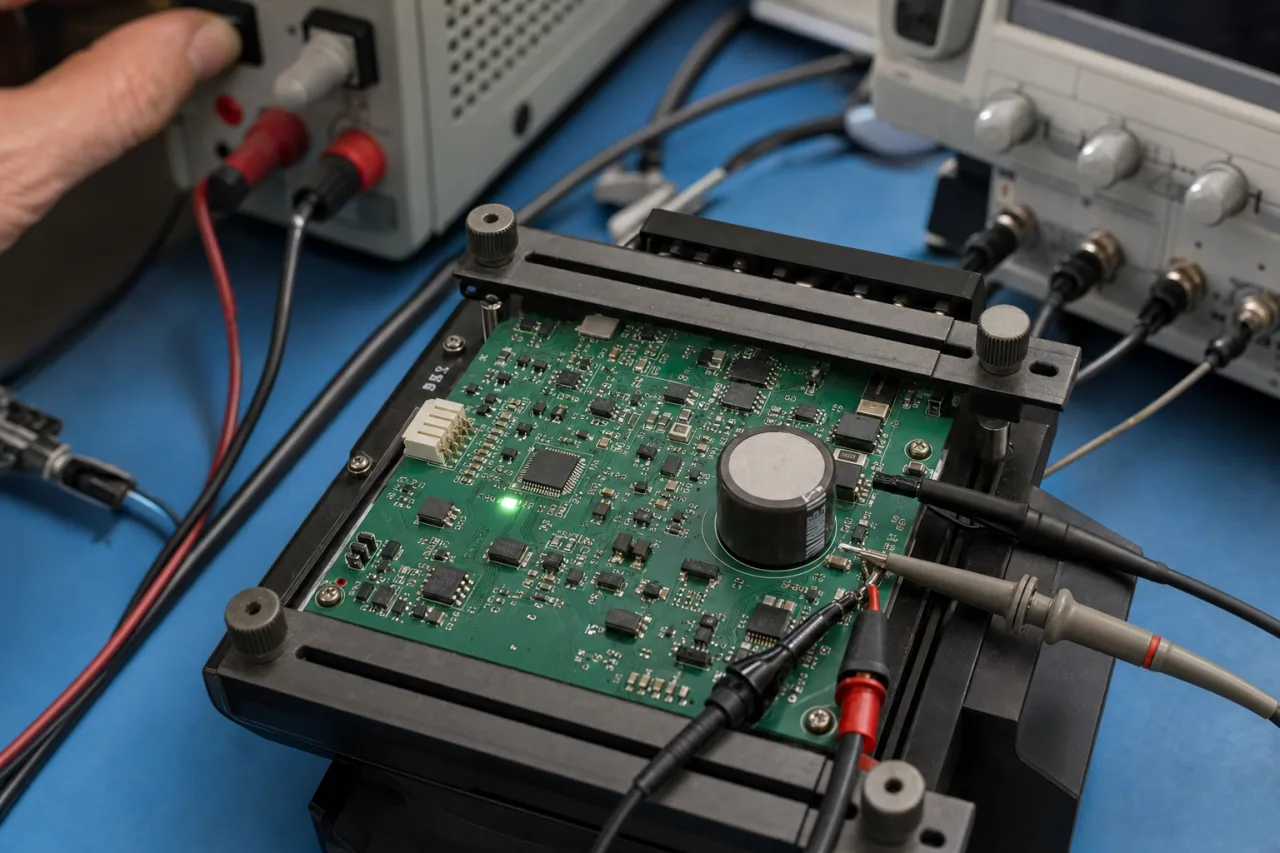
One task models a residential energy meter whose processor must remain powered for 20 milliseconds after a 5V supply disappears. Adding a capacitor is the obvious first move. The hard part is choosing one that keeps the protected rail above a 3.0V brownout threshold despite voltage-dependent capacitance, tolerances, price, package constraints and recharge behavior once power returns.
Other tasks include tolerance-aware analog filter design. The benchmark evaluates gain, cutoff frequency, Q and transient behavior across worst-case component corners, not just nominal values.
The early scores are promising, not conclusive
In EEBench’s September 1 results, Claude Opus 5 led the published leaderboard at 61.6% across the 13 tasks. Grok 4.6 scored 57.1%, followed by Claude Fable 5.1 at 56.4%. EEBench lists GPT-5.5 at 42.3% and GPT-5.6 Sol at 39.4%; it had not yet tested GPT-6 Astra, which OpenAI recently demonstrated working on a board in KiCad.
Those figures should be read as a measure of performance in this particular simulation-backed environment, not as a general certification of engineering capability. EEBench is built and funded by the team behind atopile, the tool used for the benchmark, although it says it does not sell scores. The methodology, task definitions and run details are public, which makes the benchmark more inspectable than a private demo, but broader third-party replication will still matter.
Why operators should care now
The immediate opportunity is not autonomous hardware teams. It is faster iteration for engineers working on bounded tasks: selecting parts, generating candidate circuits, checking design constraints, writing simulation setups and diagnosing why a rail, filter or threshold misses spec.
The economics can be meaningful because electronics design is filled with repeatable verification loops. If an agent can make a change, run the simulation, identify the failed operating corner and propose a lower-cost alternative, it can reduce time spent on routine exploration. The evaluation framework also points to a credible post-training path: failed voltage limits, BOM costs and tolerance-corner results create concrete reward signals rather than relying on whether a schematic merely looks convincing.
What the benchmark does not cover
EEBench V1 stops before several stages that determine whether hardware succeeds in the field: PCB layout, electromagnetic compatibility, thermal behavior, manufacturing design rules, assembly, supply-chain substitutions, board bring-up and long-term reliability.
That is why the practical operating model remains human-led. Teams should treat models as design and verification copilots, keep engineers accountable for architecture and sign-off, and require simulation evidence plus conventional review before committing to prototypes.
What to watch next
The important next signal is whether gains on simulation tasks translate into physical outcomes: cleaner layouts, fewer prototype spins and boards that pass lab validation. Watch for benchmarks that add layout and manufacturability checks, and for published comparisons between AI-generated designs and real-world board test results.
For now, the answer to whether AI can design circuit boards is: for a growing set of well-specified circuit problems, yes. Whether it can deliver a production-ready board without an experienced engineer in the loop remains an unproven—and much higher-stakes—claim.