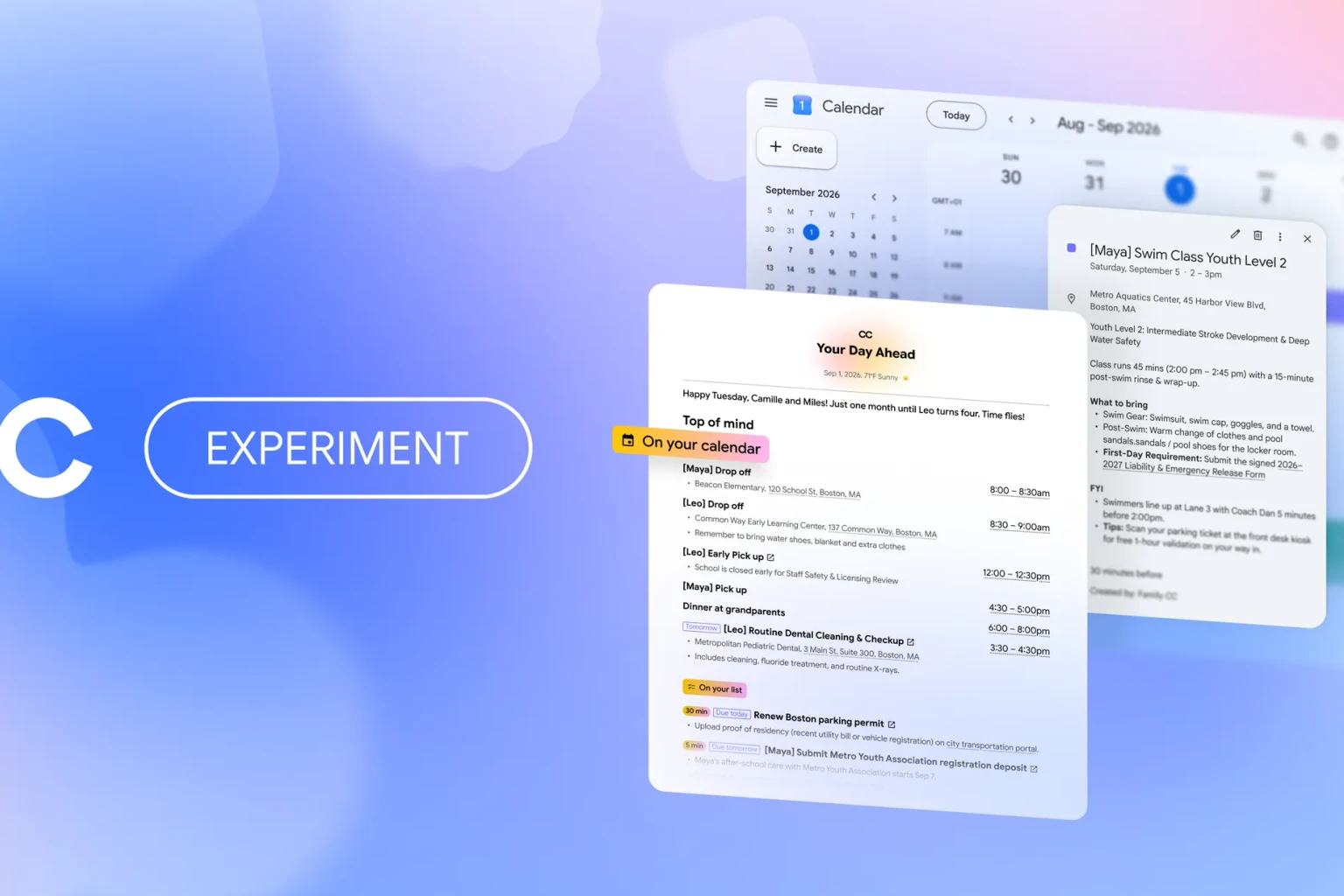
Google is repositioning CC, its experimental AI agent, from a personal productivity tool into a shared service for household management. The shift is notable not because it creates another AI chatbot, but because it gives an agent a distinct account, selected access to family information and the ability to coordinate work across people.
CC can draw on emails, calendars, chats and tasks to organize school events, practices, appointments, bills, meal planning and shopping. Google says it can also take selected actions, including filling in permission slips and activity-registration PDFs, creating supply lists, estimating drive times, and generating shared Docs or Sheets.
What changed
CC originally connected to services including Gmail, Calendar and Drive to produce a daily briefing. Google later brought that concept into the Gemini app as Daily Brief. The new version expands the operating model from one person’s schedule to a group’s workflow.
Each CC instance gets its own Google account and its own permissions. A household can have up to six members, and each person decides what information to share. Users can forward relevant messages to CC or set certain senders—such as schools, travel providers, clubs or sports organizations—to share messages automatically. Google says CC can suggest additional senders for ongoing sharing.
That matters because family coordination is largely an intake problem: key details arrive in different inboxes, are buried in long messages, and require someone to turn them into dates, tasks and follow-ups. CC is designed to make that transformation automatic, adding relevant items to shared calendars or task lists and asking for missing information when needed.
Why this is a more consequential agent test
The operational promise of agents is not simply summarization. It is reliable movement from unstructured information to a completed workflow. Household management is a useful proving ground: it has frequent, repetitive inputs; clear deadlines; multiple stakeholders; and errors that are immediately visible.
For Google, CC also extends the value of its existing consumer surface area. Gmail, Calendar, Drive and Gemini already hold or touch much of the information needed for coordination. A household agent can make those products more interconnected without requiring families to adopt a separate planning app.
The product is also a signal for builders of agent software. Shared agents need a different architecture from personal assistants. They require explicit data boundaries, attribution for actions, durable group context and clear ways to resolve ambiguity. A school email may be relevant to one child, both parents and a caregiver—but not necessarily everyone in the group.
Google’s separate-account approach is an attempt to establish those boundaries. It may be more understandable than granting a single family member’s assistant broad access to everyone else’s data. But it also raises the standard for controls: families will need to know what CC received, what it inferred, what it shared, and what action it took.
Limits are substantial for now
CC remains an experiment in Google Labs. It is available only to U.S. users aged 18 or older with personal Gmail accounts; existing users will receive upgrade invitations, while new users can join a waitlist.
Those restrictions create an immediate mismatch for its school-centered use case. Older children cannot use the service directly, and school-provided accounts are excluded, even though those inboxes often contain the information a family most wants to organize.
Google says CC runs on an isolated cloud computer powered by Gemini and its Antigravity agentic harness. That makes permission design and trust central product questions, not implementation details. The more effectively CC acts on a household’s behalf, the more consequential a mistaken form submission, calendar entry or inferred preference becomes.
What to watch next
The key measure will be whether CC can earn permission to act, not merely permission to read. Watch for more granular approval settings, action histories, error correction and broader support for education-related accounts.
More broadly, CC will test whether consumers want agents organized around an individual identity or around a shared operational unit. If families find the shared model useful, the same pattern could translate to small businesses, project teams and other groups where work is coordinated through fragmented messages and calendars.