
Google Translate is making two targeted changes to its live translation feature on mobile, aimed less at adding languages than at making the service easier to use in the situations where a phone is already acting as a real-time communication tool.
Android users can now keep a live translation session running while they multitask or lock their screen. Separately, iOS users worldwide can now play live translations through the phone’s earpiece, a capability Google says was already available on Android.
Google Translate’s live translation supports near-real-time audio translation in more than 70 languages, according to the company.
The change is about session durability
The background capability addresses a straightforward product constraint: live translation is often needed for longer than a quick exchange. Google says more than one-third of live translation sessions now exceed five minutes.
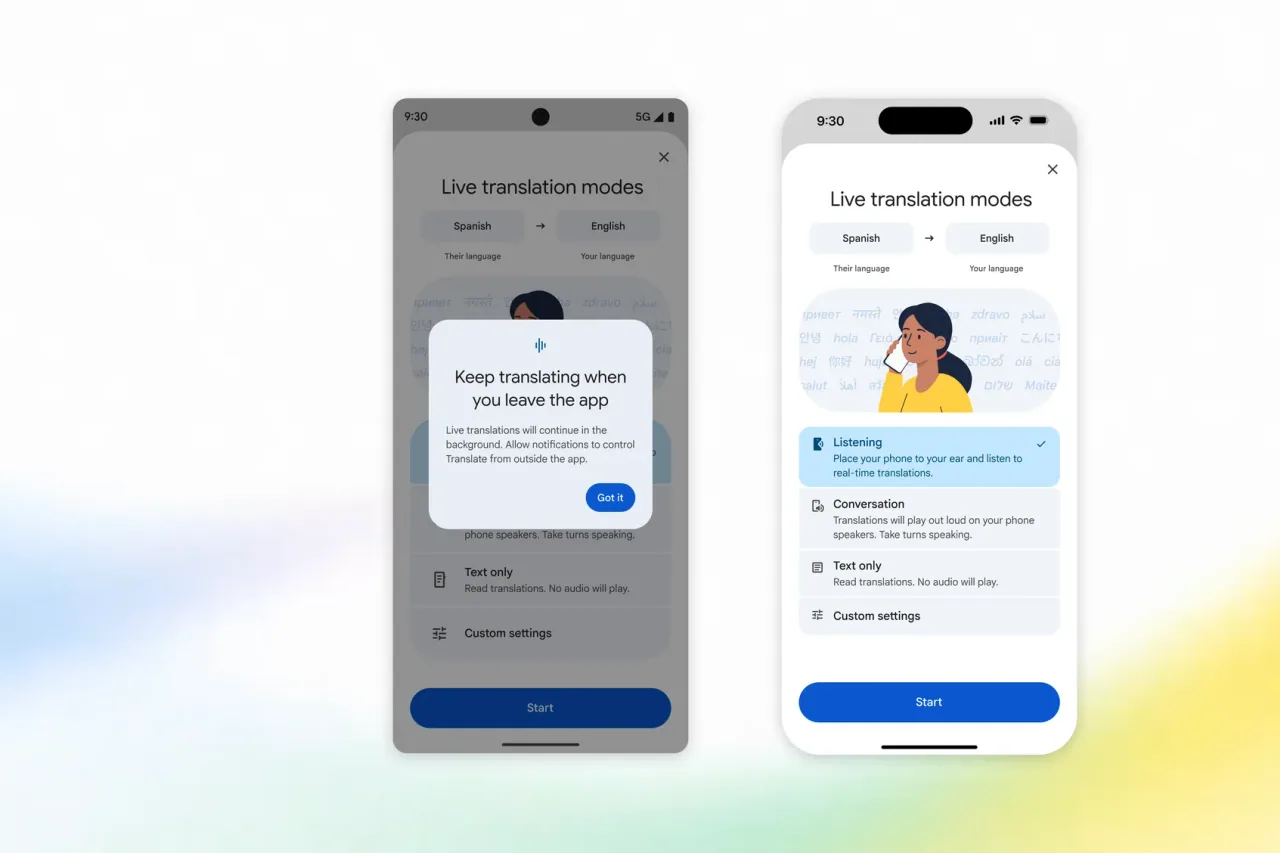
On Android, users can therefore leave the Translate app’s foreground, handle another task, or lock the device without ending the live translation session. That is useful in scenarios such as extended meetings, tours, conversations and announcements, where keeping an app open and a display active can be impractical.
The update also signals that Google is treating live translation as a continuing service rather than a single-screen interaction. For operators building customer-facing, travel, field-service or globally distributed workflows, that distinction matters: the useful test is not merely whether a system can translate an utterance, but whether it can remain available during the full interaction.
Google said equivalent background support for iOS is coming soon, but did not provide a timetable.
iPhone users get a more discreet listening option
The iOS earpiece feature lets users hold their phone to their ear to hear translated audio without headphones. Google positions it for environments such as noisy airports and crowded tours.
That addition reduces friction in a common mobile constraint: headphones may not be available, and playing translated speech over a phone speaker may be difficult or inappropriate in public. It also brings the iPhone experience closer to Android’s existing feature set.
For businesses with multilingual staff or customers, the immediate value is situational. A front-line employee or traveler can potentially follow spoken information with less setup than a dedicated interpretation device or a headphone-dependent workflow requires. But organizations should still evaluate translation quality, language coverage and privacy requirements for their specific use cases, particularly where conversations contain sensitive or high-stakes information.
What to watch next
The important follow-on is platform parity. Google has committed to bringing Android-style background operation to iOS, which would make the core long-session experience more consistent across major mobile platforms.
More broadly, the updates show where utility in consumer AI translation is shifting: toward reliability during messy, real-world interactions. As real-time translation becomes embedded in phones, competitive differentiation will increasingly depend on continuity, audio handling and ease of use—not just headline language counts.
Google’s announcement does not change the stated 70-plus-language availability for live translation. It does, however, make that capability more usable for the longer and noisier conversations in which language assistance is most likely to be needed.
[Read Google’s announcement](https://blog.google/products-and-platforms/products/translate/google-translate-ios-android-upgrades/).