Code-review teams evaluating newer reasoning models have a practical signal to investigate: performance may improve most when a pull request’s risks are distributed across a codebase rather than visible in the changed lines.
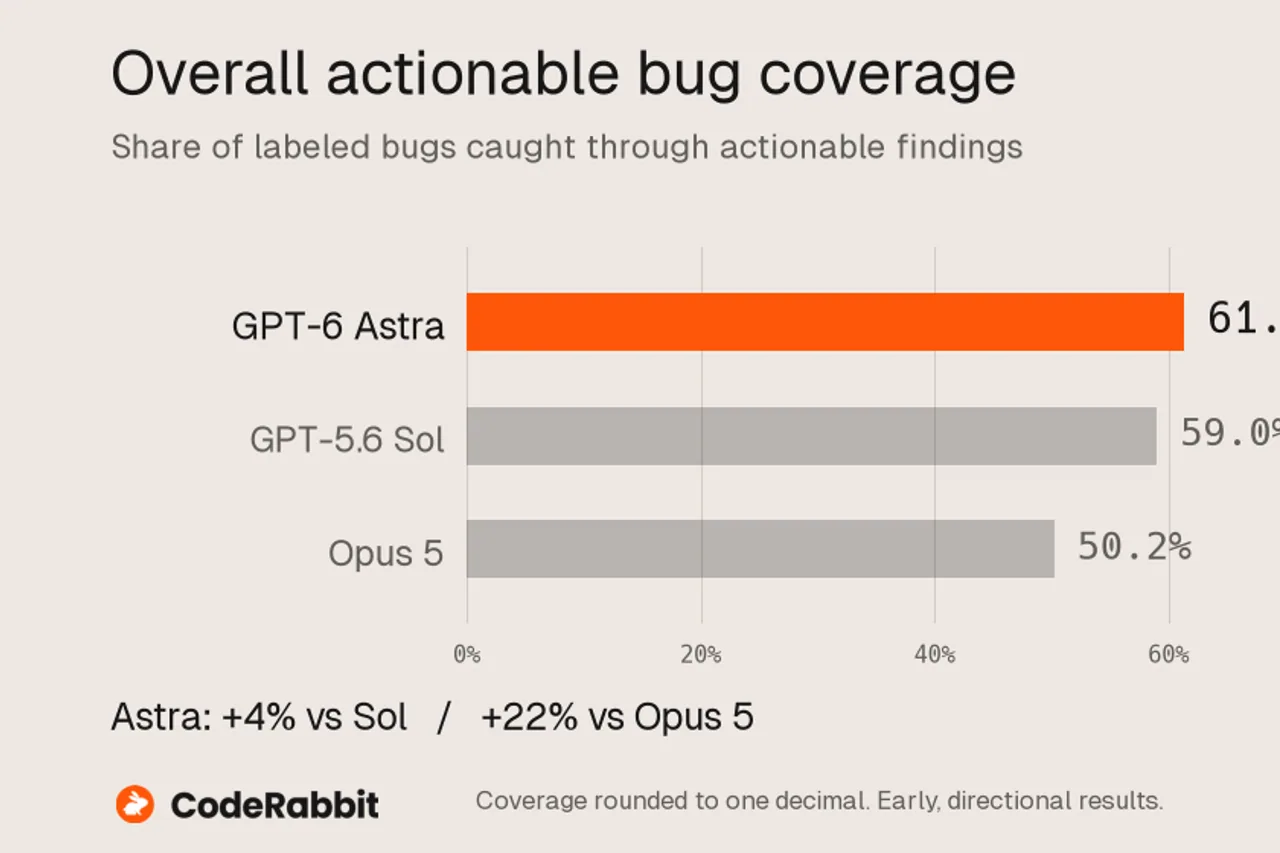
In an early evaluation published by CodeRabbit, OpenAI’s GPT-6 Astra achieved 61.3% actionable bug coverage, compared with 59.0% for GPT-5.6 Sol and 50.2% for Opus 5. CodeRabbit defines the measure as the share of labeled bugs caught through findings developers can act on.
The more consequential result was in a harder cross-file subset. Astra reached 57.1% coverage, versus 47.6% for Sol and 42.9% for Opus 5—a reported relative gain of 20% over Sol and 33% over Opus.
The value is in dependency-heavy work
The findings should be read narrowly. They come from one vendor’s early evaluation, not a general ranking of models or a prediction of a team’s production defect rate. Still, the pattern is relevant to engineering leaders: models that can connect a change to behavior elsewhere in a repository could be more valuable for API changes, shared libraries, authorization logic, data migrations and other dependency-heavy work.
That does not make a premium model the default reviewer. Simpler pull requests leave less opportunity for stronger reasoning to differentiate itself. Teams should route work by risk and complexity, reserving the most expensive capability for changes where cross-file context is likely to alter the review outcome.
The same selection principle could apply beyond code. CodeRabbit suggests testing such reasoning on incident investigation, policy and requirements analysis, and research synthesis—work that requires reconciling scattered evidence. Those applications were not measured in the published evaluation.
Token prices create a real hurdle
Astra’s standard published API pricing is $10 per million input tokens and $50 per million output tokens. In CodeRabbit’s illustrative scenario—100,000 uncached input tokens and 10,000 billable output tokens, including reasoning—the estimated cost is $1.50 per task.
That compares with $0.60 for GPT-5.6 Sol, $0.32 for GPT-5.6 Terra, and $0.032 for GPT-5.6 Luna under the same assumed usage. On that basis, Astra is 2.5 times Sol’s cost, roughly 4.7 times Terra’s, and nearly 47 times Luna’s.
Those figures are not a cost-per-resolved-defect calculation. Caching, retries, tool calls, service tiers and actual output length can all change the bill. A more capable model may also need fewer attempts or generate findings that save more developer time. But the pricing means a capability evaluation without a workflow economics evaluation is incomplete.
A useful pilot measures four things on the same set of historical or live pull requests: verified issues found, false-positive rate, developer verification time and total inference cost. The key metric is not token cost alone; it is cost per useful, validated outcome.
Privacy can determine the deployment path
For regulated and enterprise development work, model selection also turns on data handling. CodeRabbit says neither it nor its model providers train on customers’ proprietary code or personal information from private reviews. It also notes that Astra supports zero data retention for eligible OpenAI API customers, subject to the provider’s applicable controls and capabilities.
Procurement and security teams should independently confirm eligibility, retention terms, regional requirements and which tools or integrations remain available under a zero-retention configuration. A technically strong reviewer that cannot satisfy customer commitments will not clear production deployment.
What to watch next
The next evidence that matters is independent, repeatable testing: gains on difficult repositories, findings with clear supporting evidence, and lower total cost per successful review outcome. Astra’s cross-file result is a reason to run a targeted trial—not yet a reason to replace every lower-cost model in the review stack.