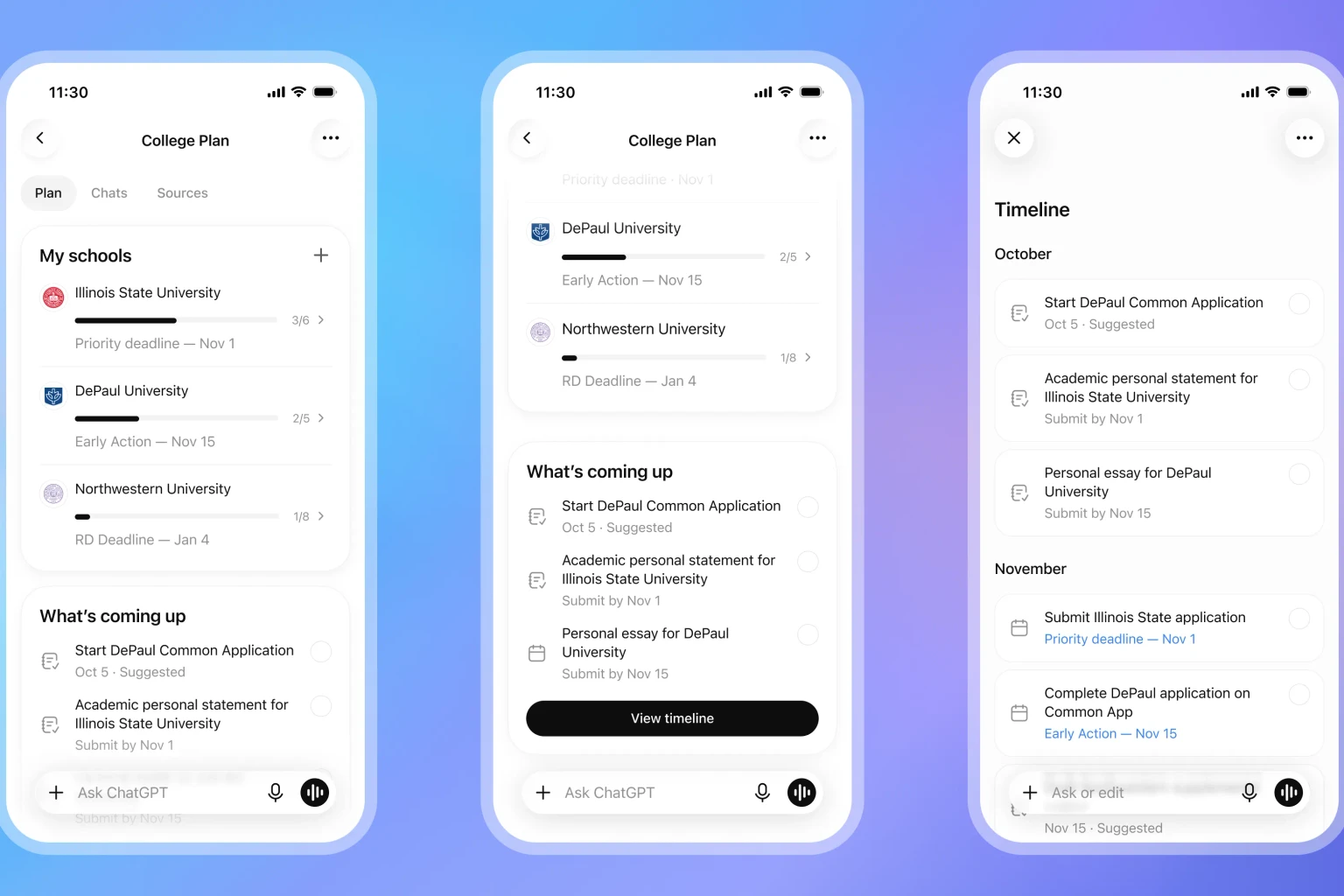
OpenAI plans to add a College Planner to ChatGPT for Teens, a mode introduced in August with safeguards and break reminders. The feature is designed to organize the operational side of applying to college: requirements, deadlines, tasks and financial-aid steps across a student’s school list.
It is a notable shift in product scope. Rather than simply answering questions, ChatGPT is being positioned as a persistent planning layer around a consequential, multi-step process.
What is changing
According to OpenAI, students will be able to return to a single plan to update application progress, view a timeline and identify outstanding work. They can also ask ChatGPT for help interpreting a requirement or deciding how to begin a task.
The College Planner is slated to arrive “soon.” Its initial US focus will be students in grades 10 through 12 who are planning to attend a four-year college.
OpenAI is also adding study-oriented features:
- **Continuous multi-photo capture on iOS**, allowing users to upload multiple photos at once and turn them into a PDF.
- **Flashcard generation from a user’s notes.**
Together, the tools extend ChatGPT beyond chat into document intake, study preparation and deadline management.
Why it matters
College applications are an unusually structured workflow: every institution has its own requirements, deadlines and financial-aid process, while the user must coordinate records, essays, forms and follow-ups. That makes the category a practical test for whether an AI assistant can turn conversational guidance into a reliable task-management experience.
For OpenAI, the opportunity is larger than college admissions. A planner that can maintain a user’s status across a defined process points toward a broader product direction: AI systems that help people execute workflows over time rather than generate one-off responses.
The iOS capture and flashcard features support that direction. They create an input-to-output loop in which physical notes become digital source material, then study aids. That may increase the utility of ChatGPT in routine student work, but it also raises the importance of clear boundaries around authorship, learning and accuracy.
Safety and trust remain central
The launch comes shortly after Common Sense Media described ChatGPT for Teens as an “unacceptable risk,” arguing that the tool still completes students’ homework and does not always send parent alerts when it should. OpenAI says teens use ChatGPT for less than 15 minutes per day on average.
The tension is not peripheral to the product. College planning can involve sensitive personal, educational and financial information. A tool that consolidates deadlines and requirements may be useful, but users and families will need to verify institution-specific details and understand how their data is handled.
What to watch next
The important question is whether College Planner functions primarily as an organized checklist or can reliably manage the messy reality of admissions workflows, including changing requirements and user-specific context.
For builders, the release is another signal that useful AI products may be won through narrow workflow design: trusted source information, persistent state, clear task ownership and good escalation when the system is uncertain. In high-stakes domains, a conversational interface alone is unlikely to be enough.