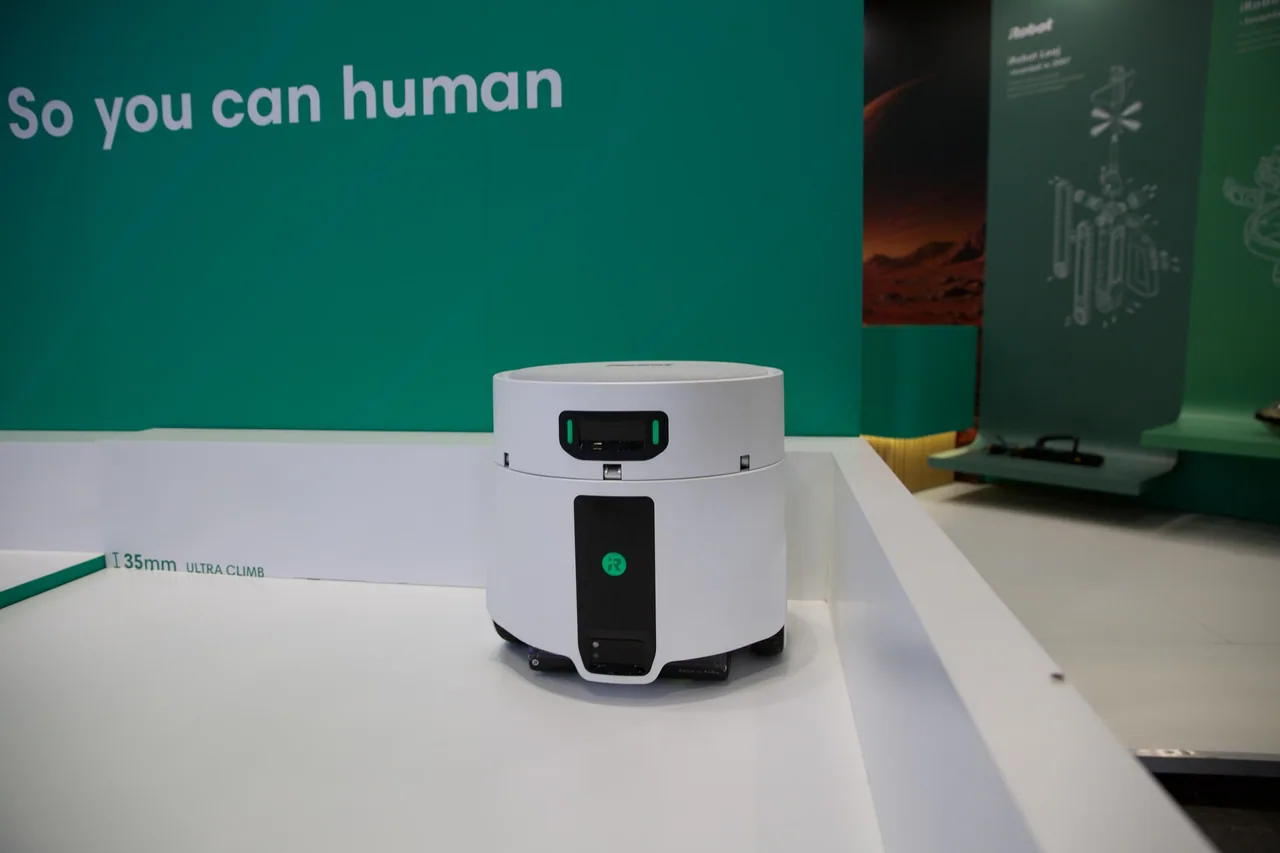
iRobot has introduced the Roomba Duo, a concept home-cleaning robot that pairs a heavy-duty floor-cleaning base with a smaller Roomba deployed for the spaces its larger counterpart cannot reach.
Shown at IFA in Berlin, the device is not yet a product with a price, release date or finalized specifications. But it offers a clear signal of the direction iRobot’s new ownership and leadership may be considering: fewer single-purpose gadgets, more capable robotic systems that consolidate cleaning hardware.
A floor washer that carries its own smaller robot
The Duo’s main unit is designed to sweep, vacuum and wash larger areas. It also serves as an autonomous mobile dock, carrying clean- and dirty-water tanks as well as a dust bag. Navigation relies on lidar and cameras to map rooms, avoid obstacles and identify dirt, according to iRobot.
Its more unusual feature is the smaller robot mounted on top. The companion unit, identified as the Roomba Plus 757, is mechanically lowered by an arm to clean beneath tables, in corners and in other places too constrained for the larger machine.
That architecture addresses a persistent trade-off in home robotics: cleaning capacity often requires bigger batteries, water tanks and brushes, while useful coverage requires a compact form factor. Rather than force one device to compromise, the Duo treats the home as a multi-robot environment.
Moving beyond the standard robot vacuum
iRobot says the main machine is its most powerful vacuum to date and is closer in capability to an upright vacuum. The unit uses a large roller mop with 46 newtons of downward pressure and can steam-mop. In a demonstration reported by *The Verge*, it picked up pasta from carpet and then washed the carpet.
If those capabilities translate into a shipped product, the relevant comparison may no longer be a conventional robot vacuum. The Duo is intended to combine equipment that many households currently buy separately: a robot vacuum, stick vacuum, carpet cleaner and floor washer.
That consolidation has an operational appeal. A single system could reduce the number of docks, charging stations, tanks and consumable workflows a household has to manage. It could also allow cleaning tasks to be assigned based on the geometry of a room rather than the limits of one chassis.
A product strategy signal, not a buying decision
The announcement comes after Picea acquired iRobot out of bankruptcy earlier this year. New CEO Hao Li, who came from Picea, presented the concept at IFA.
For iRobot, the Duo provides a way to reset expectations around the Roomba brand. The robot vacuum category has become crowded, and incremental gains in navigation, suction and mopping are increasingly difficult to distinguish. A coordinated large-and-small robot configuration is a more visible product thesis.
It also creates harder engineering and commercial questions. The Duo shown in Berlin reportedly required two people to move between demonstrations, and observers were not permitted to inspect its internals. The mechanical deployment system appeared smooth in demonstrations, but a consumer version would need to prove long-term reliability, safe operation around people and pets, manageable maintenance, and a price that makes consolidation more attractive than buying separate tools.
What to watch next
The key question is whether iRobot turns the Duo from a show-floor concept into a defined product. The company says it plans to gather feedback while development continues.
Operators and builders should watch for the details that determine whether multi-robot home systems become practical: handoffs between machines, cleaning verification, water and waste management, recovery from mechanical faults, and serviceability. The idea is compelling because it divides labor between specialized robots. Its viability will depend on whether that added capability arrives without adding disproportionate cost, complexity and maintenance.